

-
1 текущее время цикла
Programming: current cycle timeУниверсальный русско-английский словарь > текущее время цикла
-
2 время
* * *вре́мя с.
timeв дневно́е вре́мя — during daylight hours, in the daytime, by dayв и́стинном масшта́бе вре́мени — on a real time basisв ночно́е вре́мя — during the hours of darkness, at nightв реа́льном масшта́бе вре́мени — on a real time basisдо после́днего вре́мени — until recentlyзави́сящий от вре́мени — time-dependent (e. g., of current)испо́льзуемый в настоя́щее вре́мя — be now in useне зави́сящий от вре́мени — time-independentобращё́нный во вре́мени — time-reversedотнима́ть мно́го вре́мени — be time-consuming (e. g., of experiment)отсчи́тывать вре́мя ( о часах) — keep timeотсчи́тывать вре́мя в обра́тном поря́дке — count down (time)отсчи́тывать вре́мя от нуля́ вверх — count up (time)постоя́нный во вре́мени — time-constant, stationaryсо вре́менем — in due course, in the course of time, in timeсре́дний по вре́мени — time-averageс тече́нием вре́мени — in the course of timeабсолю́тное вре́мя — absolute timeастрономи́ческое вре́мя — astronomical timeа́томное вре́мя — atomic timeвре́мя безде́йствия ( линии связи) — unoccupied [idle] timeвре́мя безотка́зной рабо́ты — time between failures, TBFвре́мя безызлуча́тельной релакса́ции — non-radiative relaxation timeвре́мя бла́нка тлв., рлк. — blanking timeвре́мя блокиро́вки приё́мника — receiver blocking timeвре́мя блокиро́вки э́хо-загради́теля — hangover time of an echo suppressorвре́мя взаимоде́йствия — interaction timeвре́мя включе́ния1. ( полупроводниковых приборов) (turn-)on time2. (контактов реле, автомата и т. п.) make-timeвре́мя возвра́та ( в исходное состояние) — reset timeвре́мя восстановле́ния — recovery timeвре́мя восстановле́ния управле́ния тиратро́ном по се́тке — grid-recovery timeвсеми́рное вре́мя — universal timeвспомога́тельное вре́мя ( на вспомогательные операции) — auxiliary [handling] timeвре́мя втя́гивания ( реле) — pull-in timeвре́мя вхожде́ния в синхрони́зм ( генератора колебаний) — locking timeвре́мя вы́борки ( из памяти) — access timeвре́мя вы́дачи информа́ции — information access timeвре́мя выде́рживания ( радиоактивных продуктов) — decay [“cooling”] timeвре́мя вы́держки1. (напр. бетона) curing time2. ( в нагревательных печах) holding timeвре́мя выключе́ния ( полупроводниковых приборов) — turn-off timeвре́мя вы́лета ( самолёта) — departure timeвре́мя высве́чивания — de-excitation [luminescence] time, fluorescent lifetimeвре́мя вычисле́ния — computing timeвре́мя гаше́ния обра́тного хо́да ( развёртки) — blanking periodвре́мя го́да — seasonвре́мя горе́ния дуги́ — arc-duration, arcing timeгражда́нское вре́мя — civil timeгри́нвичское вре́мя — Greenwich timeвре́мя де́йствия защи́ты — time of operation (of protective gear, e. g., relays)декре́тное вре́мя — legal timeдискре́тное вре́мя — discrete timeвре́мя диффу́зии — diffusion time (in semiconductors)вре́мя диффузио́нного перено́са — diffusion transit time (in semiconductors)вре́мя диэлектри́ческой релакса́ции — dielectric relaxation time (in semiconductors)вре́мя до разруше́ния — time to failureвре́мя до разры́ва — time to ruptureвре́мя дре́йфа ( носителей заряда в полупроводниках) — drift timeедини́чное вре́мя — unit timeвре́мя жи́зни ( носителей зарядов) — life(time), survival timeвре́мя жи́зни, излуча́тельное — radiative lifetimeза́данное вре́мя — preset timeвре́мя, за́данное по гра́фику — scheduled timeвре́мя заде́ржки — delay timeвре́мя заде́ржки и́мпульса — pulse-delay timeвре́мя замедле́ния — slowing-down timeвре́мя заня́тия свз. — holding timeвре́мя запа́здывания — time lag, lag timeвре́мя запа́здывания и́мпульса — pulse delay time (Примечание. Русский термин вре́мя запа́здывания и́мпульса обозначает интервал времени между передними фронтами входного и выходного импульсов на уровне 50% от максимального значения, английский термин pulse delay time — на уровне 10% от максимального значения; пример: pulse delay time is … at 50% peak.)вре́мя за́писи — recording [writing] timeвре́мя заря́дки ( батареи) — charging timeвре́мя заступле́ния (напр. на дежурство) — check-in timeвре́мя затуха́ния ( импульса) — fall timeвре́мя захва́та ( носителей зарядов в полупроводниках) — capture timeзвё́здное вре́мя — sidereal timeвре́мя зво́на радио — ringing timeзона́льное вре́мя — zone timeвре́мя изготовле́ния — production timeвре́мя излуча́тельной релакса́ции — radiative relaxation timeвре́мя изодро́ма — integral action timeвре́мя интегра́ции ( сигналов) — integration timeвре́мя иска́ния тлф. — selection timeвре́мя испо́льзования це́пи ( в проводной связи) — circuit timeисте́кшее вре́мя — the time elapsed afterи́стинное вре́мя1. ав. true time2. астр. apparent timeвре́мя когере́нтности (лазера, мазера) — coherence timeмаши́нное вре́мя — machine timeвре́мя междоли́нного рассе́яния — intervalley scattering time (in semiconductors)вре́мя ме́жду се́риями и́мпульсов набо́ра но́мера тлф. — interdigit hunting timeме́стное вре́мя — local timeвре́мя на перемеще́ние ( слитка) — ingot manipulation timeвре́мя на перемеще́ние нажимны́х винто́в ( прокатного стана) — screwdown timeвре́мя нараста́ния и́мпульса — pulse rise timeвре́мя нараста́ния колеба́ний — build-up timeвре́мя нараста́ния то́ка — current-rise timeвре́мя на установле́ние и разъедине́ние соедине́ния тлф. — operating timeвре́мя нача́ла разгово́ра тлф. — “time on”, starting time of a callнепреры́вное вре́мя вчт. — continuous timeнерабо́чее вре́мя — down [idle] timeвре́мя облуче́ния — exposure [irradiation] timeвре́мя обрабо́тки — processing timeвре́мя обра́тного хо́да ( строчной и кадровой развёрток) — retrace [return] timeвре́мя обраще́ния1. вчт. access time2. эл. time of circulationвре́мя обслу́живания мат. — holding timeвре́мя ожида́ния ( в теории массового обслуживания) — waiting timeвре́мя ожида́ния отве́та ста́нции тлф. — answering intervalвре́мя ожида́ния установле́ния междунаро́дного соедине́ния — service interval of an international callвре́мя оконча́ния разгово́ра — “time off”, finish time of a callоперацио́нное вре́мя — operation timeвре́мя опроки́дывания ( спусковой схемы) — flip-over timeвре́мя опро́са ( в телеметрической системе) — sampling timeвре́мя опустоше́ния лову́шки — trap release timeвре́мя осажде́ния ( покрытия) — deposition timeвре́мя отка́чки вак. — pump-down timeвре́мя отключе́ния (повреждения, короткого замыкания и т. п.) — clearing time (of a circuit-breaker, fuse, etc.)вре́мя откры́тия кла́пана — valve-opening time, valve-opening periodвре́мя отла́дки — debug timeвре́мя отла́дки програ́ммы — program(me) testing timeвре́мя отпуска́ния ( реле) — release [drop-out] timeвре́мя отсу́тствия колеба́ний рлк. — resting timeвре́мя переключе́ния — switching timeвре́мя переключе́ния в закры́тое состоя́ние — turn-off time (in semiconductors)вре́мя переключе́ния в откры́тое состоя́ние — turn-on time (in semiconductors)вре́мя перено́са носи́телей заря́дов — transit [transport] timeвре́мя перехо́да ( из одного состояния в другое) — transition timeвре́мя перехо́да из норма́льного в сверхпроводя́щее состоя́ние — normal-superconducting transition [n-s transition] timeвре́мя перехо́да из сверхпроводя́щего в норма́льное состоя́ние — superconducting-normal transition [s-n transition] timeвре́мя перехо́дного проце́сса — response time, transient responseперехо́дное вре́мя ( движущего контакта) — transit timeвре́мя поворо́та анте́нны — slew timeвре́мя повто́рного включе́ния — reclosing timeподготови́тельное вре́мя — preparation timeподготови́тельно-заключи́тельное вре́мя — setting-up timeвре́мя по́иска ( информации) — retrieval timeполё́тное вре́мя — flight timeвре́мя полувыра́внивания — rise time at 50% (of self-regulation)вре́мя по расписа́нию — schedule timeвре́мя последе́йствия э́хо-загради́теля — hangover time of an echo suppressorвре́мя послесвече́ния экра́на — after-glow time, persistenceвре́мя посы́лки вы́зова тлф. — ringing timeпоясно́е вре́мя — standard [zone] timeвре́мя пребыва́ния (напр. материала в аппарате) — dwell time, stay period, duration of stayвре́мя преобразова́ния — conversion timeвре́мя прибы́тия — arrival timeвре́мя приё́ма зака́за на разгово́р тлф. — booking [filing] timeвре́мя приё́мистости ( двигателя) — acceleration period, acceleration timeвре́мя прилипа́ния носи́телей заря́да — trapping time (in semiconductors)вре́мя прирабо́тки дви́гателя — running-in [breaking-in] periodвре́мя прогре́ва ( двигателя) — warm-up timeпроизводи́тельное вре́мя — production timeвре́мя прока́тки — rolling time, time in rollsвре́мя пролё́та (напр. электронов) — transit timeвре́мя пролё́та доме́на (в устройствах, использующих эффект Ганна) — domain transit timeвре́мя просмо́тра ( потенциалоскопа) — viewing timeвре́мя просто́я — down [idle] timeвре́мя просто́я кана́ла цепи́ свя́зи — circuit outage [lost circuit] timeвре́мя просто́я радиоста́нции — off-air timeвре́мя прохожде́ния сигна́ла — propagation [transmission] timeвре́мя прохожде́ния сигна́ла до це́ли и обра́тно рлк. — round-trip travel [round-trip propagation] timeвре́мя прохожде́ния че́рез афе́лий — the time of aphelion passageвре́мя прохожде́ния шкалы́ ( в измерительных приборах) — periodic timeвре́мя прямо́го восстановле́ния — forward recovery time (in semiconductors)пусково́е вре́мя ( двигателя) — starting timeрабо́чее вре́мя — operating timeвре́мя развё́ртывания (напр. радиостанции) — installation [set-up] timeвре́мя разго́на ( двигателя) — acceleration period, acceleration timeвре́мя разогре́ва — warm-up timeразреша́ющее вре́мя — resolving [resolution] timeвре́мя разря́да — discharge timeвре́мя раска́чки ( контура) — build-up timeвре́мя распа́да — decay timeвре́мя распознава́ния ( образа) — (pattern) recognition timeвре́мя распростране́ния ( сигнала) — propagation timeрасчё́тное вре́мя — estimated timeвре́мя реа́кции — reaction time, time lagвре́мя ревербера́ции — reverberation timeвре́мя регули́рования ( время перехода системы к определённому установившемуся состоянию) — settling timeвре́мя релакса́ции — relaxation timeручно́е вре́мя — manual timeвре́мя самовыра́внивания — rise time (of a self-regulating system)вре́мя свобо́дного иска́ния тлф. — hunting timeвре́мя свобо́дного пробе́га ( электрона) — mean free timeсо́лнечное вре́мя — solar timeсо́лнечное, сре́днее вре́мя — mean solar timeвре́мя спа́да и́мпульса — pulse decay [fall] timeвре́мя сплавле́ния — alloying time (in semiconductors)вре́мя сраба́тывания ( реле) — operate [actuation] timeвре́мя сраба́тывания счё́тчика части́ц — resolving time of a radiation counterвре́мя счё́та ( импульсов) — count(ing) timeвре́мя счи́тывания — read-out timeтарифици́руемое вре́мя тлф. — paid [toll, chargeable] timeвре́мя теплово́й релакса́ции — thermal relaxation [thermal recovery] time (in semiconductors)вре́мя техни́ческого обслу́живания — servicing timeвре́мя тро́гания ( реле) — time for motion to startвре́мя удержа́ния абоне́нта тлф. — period of number reservation in long-distance serviceвре́мя успокое́ния ( приборов) — damping timeвре́мя установле́ния1. ( в импульсной технике) rise time2. ( в системах авторегулирования) settling timeвре́мя установле́ния равнове́сия — equilibration [equilibrium] timeвре́мя установле́ния соедине́ния тлф. — connection [setting-up] timeвре́мя ухо́да (напр. с дежурства, смены) — check-out timeвре́мя формова́ния — moulding timeхарактеристи́ческое вре́мя — characteristic timeвре́мя холосто́го хо́да — idle timeвре́мя хране́ния — storage timeвре́мя ци́кла — cycle timeвре́мя ци́кла па́мяти — memory cycle timeвре́мя части́чного перехо́да в положе́ние поко́я — partial restoring timeвре́мя чувстви́тельности — sensitive period, sensitive timeшту́чное вре́мя — time per piece, floor-to-floor timeвре́мя экспони́рования — time of exposure, exposureэфемери́дное вре́мя астр. — ephemeris timeя́дерное вре́мя — nuclear traversal time* * * -
3 время
1) life
2) time
3) times
4) while
– в настоящее время
– в ночное время
– в последнее время
– в то время
– в то время как
– во время
– время бездействия
– время бланка
– время взаимодействия
– время включения
– время возбуждения
– время возврата
– время возвращения
– время восстановления
– время всемирное
– время втягивания
– время выборки
– время выдерживания
– время выдержки
– время выключения
– время вылета
– время высвечивания
– время выходит
– время вычисления
– время года
– время декретное
– время до разрушения
– время до разрыва
– время доступа
– время дрейфа
– время жизни
– время заданное
– время задержки
– время заказа
– время замедления
– время занятия
– время запаздывания
– время записи
– время зарядки
– время затухания
– время захвата
– время звона
– время изготовления
– время изодрома
– время интеграции
– время интегрирования
– время искания
– время истинное
– время когерентности
– время лишнее
– время машинное
– время мировое
– время московское
– время на перемещение
– время нагрева
– время нарастания
– время облучения
– время обнаружения
– время обработки
– время обращения
– время ожидания
– время опроса
– время от времени
– время откачки
– время отладки
– время отпускания
– время переключения
– время перехода
– время по расписанию
– время подготовительно-заключительное
– время поиска
– время полувыравнивания
– время последействия
– время поясное
– время пребывания
– время преобразования
– время прибытия
– время прилета
– время прогрева
– время прокатки
– время пролета
– время просмотра
– время простойное
– время простоя
– время прохождения
– время развертывания
– время разговора
– время раскатки
– время раскачки
– время распознавания
– время реверберации
– время регулирования
– время релаксации
– время самовыравнивания
– время спадания
– время сплавления
– время срабатывания
– время счета
– время считывания
– время трогания
– время успокоения
– время установления
– время ухода
– время формования
– время хранения
– время цикла
– время чувствительности
– время экспонирования
– все время
– всемирное время
– вспомогательное время
– гражданское время
– декретное время
– единичное время
– еще во время
– заданное время
– заключительное время
– звездное время
– зональное время
– машинное время
– местное время
– мировое время
– модельное время
– настоящее время
– натуральное время
– непрерывное время
– операционное время
– отмечать время
– отсчитывать время
– подготовительное время
– полетное время
– потерянное время
– поясное время
– пусковое время
– разрешающее время
– расчетное время
– реальное время
– ручное время
– солнечное время
– стендовое время
– тарифицируемое время
– штучное время
– эфемеридное время
– ядерное время
время безотказной работы — time between failures
время блокировки приемника — receiver blocking time
время бызызлучательной релаксации — non-radiative relaxation time
время вхождения в синхронизм — locking time
время выборки одного слова — word time
время выдачи информации — information access time, <comput.> readout time
время гашения обратного хода — blanking period
время горения дуги — arc-duration
время действия защиты — time of operation
время диффузионного переноса — diffusion transit time
время до запуска логического анализатора — negative time
время заданное по графику — scheduled time
время задержки импульса — pulse-delay time
время задержки оптопары — delay nime
время запаздывания импульса — pulse delay time
время излучательной релаксации — radiative relaxation time
время использования цепи — circuit time
время истинное местное — <astr.> local apparent time
время междолинного рассеяния — intervalley scattering time
время на перемещение нажимных винтов — screwdown time
время нарастания импульса — pulse rise time
время нарастания колебаний — build-up time of oscillations
время нарастания тока — build-up time, current-rise time
время начала разговора — time on
время обратного хода — retrace time, return time
время обращения информации — <comput.> circulation time
время обращения к запоминающему устройству — storage access
время обрыва тока — clearing time
время одного поколения — generation time
время ожидания максимальное и среднее — <comput.> maximum and average delay
время ожидания ответа станции — answering interval
время окончания разговора — time off
время опустошения ловушки — trap release time
время открытия клапана — valve-opening time
время отладки программы — program testing time
время отсутствия колебаний — resting time
время переноса носителей зарядов — transit time
время переходного периода — transient period
время переходного процесса — response time
время поворота антенны — slew time
время повторного включения — reclosing time
время поиска неисправности — working hours of
время послевечения экрана — after-glow time
время приема заказа — filing time
время приема заказа на разговор — booking time
время прилипания носителей заряда — trapping time
время приработки двигателя — breaking-in period
время пролета домена — domain transit time
время простоя канала цепи связи — circuit outage time
время простоя радиостанции — off-air time
время прохождения сигнала — propagation time
время прохождения через афелий — time of aphelion passage
время прохождения шкалы — periodic time
время прямого восстановления — forward recovery time
время распространения сигнала — time of propagation
время свободного искания — hunting time
время свободного пробега — mean free time
время солнечное истинное — <astr.> mean solar time
время спада импульса — decay time, pulse fall time
время тепловой релаксации — thermal relaxation time
время установления равновесия — equilibration time
время установления соединения — connection time
время холостого хода — lost motion time
время цикла памяти — memory cycle time
излучательное время жизни — radiative lifetime
используемый в настоящее время — time-independent
максимальное время ожидания — <comput.> time-out
малое время обращения — quick access, rapid access
отсчитывать время в обратном порядке — count down time
отсчитывать время от нуля вверх — count up time
переводить дугу во время — change arc into time
полезное время работы — good time
среднее солнечное время — mean solar time
форсировать время включения — speed up in turn-on
-
4 CULTURE, LITERATURE, AND LANGUAGE
■ Bell, Aubrey F. G. The Oxford Book of Portuguese Verse: XIIth Century-XXth Century. Oxford: Oxford University Press, 1925, 1952 (2nd edition, B. Vi-digal, ed.).■. Portuguese Literature. Oxford: Oxford University Press, 1922, 1970 (2nd edition, B. Vidigal, ed.).■ Bleiberg, German, Maureen Ihrie, and Janet Pérez, eds. Dictionary of the Literature of the Iberian Peninsula, 2 vols. Westport, Conn.: Greenwood, 1993.■ Castro, Francisco Lyon de, ed. História da literatura portuguesa, 7 vols. Lisbon: Alfa, 2001-02.■ Cidade, Hernani. Lições de Cultura e Literatura Portuguesa, 3 vols. Lisbon, 1960-62.■ Cook, Manuela. Portuguese: A Complete Course for Beginners. London: Hodder and Stoughton, 1996. Figueiredo, Fidelino. História literária de Portugal. Coimbra, 1944. Gentile, Georges Le. La Littérature Portugaise. Rev. ed. Paris, 1951. Kunoff, Hugo. Portuguese Literature from Its Origins to 1990: A Bibliography Based on the Collections at Indiana University. Metuchen, N.J.: Scarecrow Press, 1994.■ Longland, Jean. Contemporary Portuguese Poetry. A Bilingual Selection. Irvington-on-Hudson: Harvey House, 1966. Prado Coelho, Jacinto do. Dicionário das Literaturas Portuguesas, Galega e Brasileira, 3rd ed. Oporto, 1978. Rossi, Giuseppe C. Storia della letteratura portoghesa. Florence, 1953.■ Santos, João Camilo dos. "Portuguese Contemporary Literature." In Antônio Costa Pinto, ed., Modern Portugal, 218-42. Palo Alto, Calif.: SPOSS, 1998.■ Saraiva, Antônio José. História da cultura em Portugal, 3 vols. Lisbon, 1950-60.■. História da Literatura Portuguesa. Lisbon, 1990 ed.■, and Oscar Lopes. História da Literatura Portuguesa. Oporto and Coimbra, 1992 ed.■ Seguier, Jaime de, ed. Dicionário Prático Ilustrado. Oporto: Lello, 1961 and later eds.■ Simões, João Gaspar. História da poesia portuguesa, 2 vols. Lisbon, 1955-56 and later eds.■. História da poesia portuguesa do século XX. Lisbon, 1959 and later eds.■ Stern, Irwin, ed.-in-chief. Dictionary of Brazilian Literature. Westport, Conn.: Greenwood, 1988.■ TRAVEL AND TOURIST GUIDES ON PORTUGAL■ Ballard, Sam, and Jane Ballard. Pousadas of Portugal: Unique Lodgings in State-owned Castles, Palaces, Mansions and Hotels. Boston: Harvard Common, 1986.■ Bridge, Ann, and Susan Lowndes Marques. The Selective Traveller in Portugal. London: Chatto & Windus, 1968.■ Ellingham, Mark, et al. Portugal: The Rough Guide. London: Rough Guides, 2008 ed.■ Hogg, Anthony. Travellers' Portugal. London: Solo Mio, 1983.■ Kite, Cynthia, and Ralph Kite. Portuguese Country Inns & Pousadas. New York: Warner Books; Karen Brown's Country Inn Series, 1988.■ Lowndes, Susan, ed. Fodor's Portugal 1991. New York: Fodor's, 1990.■ Proença Raúl, and Sant'anna Dionísio, eds. Guía De Portugal. I. Generalidades. Lisboa E, Arredores. Lisbon: Fundação Calouste Gulbenkian, 1924; 1983.■ Robertson, Ian. Portugal: Blue Guide. London: Benn; New York: Norton, 2000 and later eds.■ Stoop, Anne de. Living in Portugal. Paris and New York: Flammarion, 1995. Wright, David, and Patrick Swift. Minho and North Portugal: A Portrait and Guide. New York: Scribners, 1968.■. Lisbon: A Portrait and Guide. New York: Scribners, 1971.■. Algarve: A Portrait and Guide. New York: Scribners, 1973.■ HISTORY OF PORTUGAL Ancient and Medieval (2000 BCE-1415 CE)■ Alarção, Jorge de. Roman Portugal. Volume I: Introduction. Warminster, U.K., 1988.■ Almeida, Fortunato de. História de Portugal. Vol. I. Coimbra, 1922. Arnaut, Salvador Dias. A Crise Nacional dos fins do século XVI. Vol. 1. Coimbra, 1960.■ Baião, Antônio, Hernani Cidade, and Manuel Múrias, eds. História de Expansão Portuguesa no Mundo, 3 vols. Lisbon, 1937-40. Caetano, Marcello. Lições de História do Direito Português. Coimbra, 1962. Cortesão, Jaime. Os Factores Democráticos no Formação de Portugal. Lisbon, 1960.■ David, Pierre. Etudes Historiques sur la Galice et le Portugal du VI au XII siécle. Paris, 1947.■ Dias, Eduardo Mayone. Portugal's Secret Jews: The End of an Era. Rumford, R.I.: Peregrinação Publications, 1999. Diffie, Bailey W. Prelude to Empire: Portugal Overseas before Henry the Navigator. Lincoln: University of Nebraska Press, 1960. Dutra, Francis A. "Portugal: To 1279." Dictionary of the Middle Ages. Vol. X: 35-48. New York: Scribners, 1987.■. "Portugal: 1279-1481." Dictionary of the Middle Ages. Vol. X: 48-56. New York: Scribners, 1987. Gama Barros, Henrique de. História de Administração Pública em Portugal nos séculos XII à XV, 11 vols. Lisbon, 1945-51. Godinho, Vitorino Magalhães. A Economia dos Descobrimentos Henriquinos. Lisbon, 1962.■ Gonzaga de Azevedo, Luís. História de Portugal, 6 vols. Lisbon, 1939-44.■ Herculano, Alexandre. História de Portugal, 8 vols., 9th ed. Lisbon, 1940.■ Kennedy, Hugh. Muslim Spain and Portugal: A Political History of al-Anda-lus. London: Longman, 1996.■ Lencastre e Tavora, Luía Gonzaga. O Estudo da Sigilografia Medieval Portuguesa. Lisbon, 1990.■ Livermore, H. V. The Origins of Spain and Portugal. London: Allen & Unwin, 1971.■ Lopes, David. "Os Árabes nas obras de Alexandre Herculano." Boletim da Segunda Classe. Lisbon: Academia Real das Sciéncias, III (1909-10). MacKendrick, Paul. The Iberian Stones Speak. New York: Funk & Wagnalls, 1969.■ Martinez, Pedro Soares. História Diplomática De Portugal [chapter I, 114315]. Lisbon, 1986.■ Mattoso, José, ed. A Nobreza Medieval Portuguesa: A Família e o Poder. Lisbon: Estampa, 1981.■. Religião e cultura na Idade Média Portuguesa. Lisbon: Imprensa Nacional, 1982.■. Identificaçao de um país ( ensaio sobre as orígens de Portugal), 2 vols. Lisbon: Estampa, 1985.■. Novos Ensaios de História Medieval Portuguesa. Lisbon: Edit. Presença, 1988.■. Historia de Portugal. Vol. 2: A Monarquia Feudal ( 1096-1480). Lisbon: Estampa, 1993.■ Oliveira Marques, A. H. de. Hansa e Portugal na Idade Média. Lisbon, 1959.■. Introduçao à História da Agricultura em Portugal. Lisbon, 1968.■. Daily Life in Portugal in the Middle Ages. Madison: University of Wisconsin Press, 1971.■. Ensaios de História Medieval Portuguesa. Lisbon, 1980.■. "Introduçao à História da Cidade Medieval Portuguesa." Bracara Augusta XXV, 92-93 (January-December 1981): 367-87.■. Guía do Estudante de História Medieval Portuguesa, 3rd ed. Lisbon, 1985.■. Portugal Na Crise Dos Séculos XIV e XV-Vol. IV of Serrão and Oliveira Marques, Nova História de Portugal. Lisbon, 1987.■ Peres, Damião de, ed. História de Portugal. Vols. I, II. Barcelos, 1928-29.■ Rau, Virginia. Subsídios para o estudo das Feiras Medievais Portuguesas. Lisbon, 1943.■. Sesma'rias Medievais Portuguesas. Lisbon, 1946.■ Ribeiro, Orlando. "Portugal, formação de." Dicionário da História de Portugal. Vol. III, 432-51. Lisbon, 1966.■ Rogers, Francis M. The Travels of the Infante Dom Pedro of Portugal. Cambridge, Mass.: Harvard University Press, 1961.■ Russell, P. E. The English Intervention in Spain and Portugal in the Time of Edward III and Richard II. Oxford: Oxford University Press, 1955.■ Savory, H. N. Spain and Portugal: The Prehistory of the Iberian Peninsula. New York: Thames and Hudson, 1968.■ Silva, Armando Coelho Ferreira. A Cultura Castreja no Noroeste de Portugal. Pacos de Ferreira, 1986.■ Varagnac, André. O Homem antes da Escrita ( Pre-história). Lisbon, 1963.■ Azevedo, J. Lúcio de. História de António de Vieira, 2 vols. Lisbon, 1918-20.■. Épocas de Portugal Económico. Lisbon, 1929.■ Borges de Macedo, Jorge. Problemas de História de Indústria Portuguesa no Século X VIII. Lisbon, 1963.■. "Pombal." Dicionário de História de Portugal. Vol. III, 415-23. Lisbon, 1968.■ Bovill, Edward W. The Battle of the Alcazar: An Account of the Defeat of Dom Sebastian at El-Ksar el-Kebir. London, 1952.■ Boxer, C. R. Four Centuries of Portuguese Expansion, 1415-1825: A Succinct Survey. Johannesburg, South Africa: Witwaterstrand University Press, 1961.■. The Portuguese Seaborne Empire 1415-1825. London: Hutchinson, 1969.■. João de Barros: Portuguese Humanist and Historian of Asia. New Delhi, India: Xavier Centre, 1981.■ Cheke, Marcus. Dictator of Portugal: A Life of the Marquis of Pombal, 16991782. London: Sidgwick & Jackson, 1938.■ Cunha, Luís da. Testamento Político. Lisbon, 1820.■ Davidson, Lillias C. Catherine of Bragança. London: John Murray, 1908.■ Dutra, Francis A. "Membership in the Order of Christ in the Seventeenth Century." The Americas 27 (1970): 3-25.■ Eberlein, H. D., and R. W. Ramsdell. The Practical Book of Italian, Spanish and Portuguese Furniture. Philadelphia: Lippincott, 1927.■ Ericeira, Luís de Meneses [Count of]. História de Portugal Restaurado, 4 vols. Oporto, 1945.■ Fisher, H. E. S. "Anglo-Portuguese Trade, 1700-70." Economic History Review XVI, 2 (1963): 219-33.■ Francis, A. D. The Methuens and Portugal: 1691-1708. Cambridge: Cambridge University Press, 1966.■ Hanson, Carl A. Economy and Society in Baroque Portugal, 1668-1703. Minneapolis: University of Minnesota Press, 1981.■ Herculano, Alexandre. History of the Origin and Establishment of the Inquisition in Portugal. New York: AMS Press, 1968 reprint.■ Kendrick, T. D. The Lisbon Earthquake. London: Methuen, 1956.■ Livermore, H. V. "The Privileges of an Englishman in the Kingdom and Dominions of Portugal." Atlante 11 (1954): 57-77.■ Macauley, Neil. Dom Pedro: The Struggle for Liberty in Brazil and Portugal, 1798-1834. Durham, N.C.: Duke University Press, 1986.■ Macauley, Rose. They Went to Portugal. London: Jonathan Cape, 1946.■. They Went to Portugal, Too. London: Carcanet, 1990.■ Magalhães Godinho, Vitorino. Prix et Monnaies au Portugal. Paris, 1955.■. "Portugal and Her Empire." In New Cambridge Modern History. Cambridge: Cambridge University Press, Vol. V (1961): 384-97; Vol. VI (1961): 509-10.■. A Economia dos descobrimentos henri-quinos. Lisbon, 1962.■. Estructura da Antiga Sociedade Portuguesa. Lisbon, 1975.■ Mauro, Frédéric. Le Portugal et l'Atlantique au XVII siécle ( 1570-1670). Paris: SEVPEN, 1960.■ Maxwell, Kenneth. "Pombal and the Nationalization of the Luso-Brazilian Economy." Hispanic American Historical Review XLVIII (November 1968): 608-31.■. Conflicts and Conspiracies: Brazil and Portugal, 1750-1808. Cambridge: Cambridge University Press, 1973.■ Norris, A. H., and R. W. Bremner. The Lines of Torres Vedras. Lisbon: British Historical Society of Portugal, 1980.■ Oliveira, Antônio de. A Vida Económica e Social de Coimbra de 1537 à 1640, 2 vols. Coimbra, 1971-72.■ Prestage, Edgar. The Royal Power and the Cortes in Portugal. Watford, U.K.: Voss & Michael, 1927.■. Portuguese Pioneers. London: Black, 1933.■. "The Mode of Government in Portugal during the Restoration [1640-68] Period." In Edgar Prestage, ed., Melange d'Etudes Portugaises Offerts a M. Georges Le Gentil, 265-70. Lisbon, 1949.■ Rabassa, Gregory. "Padre Antônio Vieira: Portugal's Amazing Polymath." Camões Centre Quarterly 2, 3-4 (Autumn and Winter 1990): 27-32. Rau, Virginia. D. Catarina de Bragança: Rainha de Inglaterra. Lisbon, 1944. Ricard, Robert. "Prophecy and Messianism in the Works of Antônio Vieira." The Americas 37 (1960): 357-88.■ Roche, T. W. E. Philippa: Dona Filipa of Portugal. London: Phillimore, 1971.■ Rogers, Francis M. The Travels of the Infante Dom Pedro of Portugal. Cambridge, Mass.: Harvard University Press, 1961.■ Rooney, Peter T. "Hapsburg Fiscal Policies in Portugal, 1580-1640." Journal of European Economic History 23, 3 (1994): 545-62.■ Roth, Cecil. "The Religion of the Marranos." Jewish Quarterly Review 22 (1931): 1-33.■. A History of the Marranos. Philadelphia: Jewish Publication Society of America, 1932.■ Saraiva, Antônio José. Inquisição e Cristãos-Novos. Oporto, 1969.■. A Inquisição Portuguesa. Lisbon, 1969 and later eds.■ Schneider, Susan. O Marquês De Pombal E O Vinho Do Porto: Dependência e subdesenvolvimento em Portugal no século XVIII. Lisbon, 1980.■ Shaw, L. M. E. Trade, Inquisition and the English Nation in Portugal, 16401690. London: Carcancet, 1989.■ Shillington, V. M., and A. B. W. Chapman. The Commercial Relations of England and Portugal. London: Routledge, 1907.■ Sideri, Sandro. Trade and Power: Informal Colonialism in Anglo-Portuguese Relations. Rotterdam: Rotterdam University Press, 1970.■ Smith, John Athelstone [Conde de Carnota]. Marquis of Pombal, 2nd ed. London, 1872.■ Thomas, Gerturde Z. Richer Than Spices. New York: Knopf, 1965. Walford, A. R. The British Factory in Lisbon. Lisbon, 1940.■ Baptista, Jacinto. O Cinco de Outubro. Lisbon, 1965. Brandão, Raúl. Memórias, 3 vols. Lisbon, 1969 ed.■ Cabral, Manuel Villaverde. O desenvolvimento do capitalismo em Portugal no século XIX. Lisbon, 1981. Caetano, Marcello. História Breve das Constituções portuguesas. Lisbon, 1971 ed.■ Carnota, Conde da. Memoirs of Marshal, the Duke of Saldanha, with Selections from His Correspondence, 2 vols. London: John Murray, 1880. Carvalho, Joaquim de. Estudos sobre a cultura portuguesa do século XIX. Coimbra, 1955.■ Cheke, Marcus. Carlota Joaquina, Queen of Portugal. London: Sidgwick and Jackson, 1947.■ França, José-Augusto. Zé Provinho na Obra de Rafael Bordalo Pinheiro. Lisbon, 1975.■ Fuschini, Augusto. Liquidações políticas. Lisbon, 1896.■ Godinho, Vitorino Magalhães. Estrutura da Antiga Sociedade Portuguesa. Lisbon, 1975 ed.■ Hammond, Richard J. Portugal and Africa, 1815-1910: A Study in Uneconomic Imperialism. Stanford, Calif.: Stanford University Press, 1966.■ Homem, Amadeu Carvalho. A Propaganda Republicana ( 1870-1910). Coimbra, 1990.■ Livermore, H. V. Portugal: A Short History. Edinburgh, U.K.: Edinburgh University Press, 1973. Machado, Alvaro Manuel. A Geração de 70-uma revolução cultural e literária. Lisbon, 1986 ed.■ Martins, Joaquim Pedro de Oliveira. Portugal Contemporâneo, 3 vols. Lisbon, 1953 ed.■ Medina, João. Eça Político. Lisbon, 1974.■ Mônica, Maria Filomena. Fontes Pereira de Melo. Oporto: Ed. Afrontamento, 1999.■ Nobre, Eduardo. Paixoes Reais. Lisbon: Quimera, 2002.■ Pereira, Miriam Halpern. Livre Câmbio e Desenvolvimento Económico: Portugal na segunda metade do século XIX. Lisbon, 1971.■ Peres, Damião, ed. História de Portugal. Volume III. Barcelos, 1935 ed.■ Ramos, Rui. D.Carlos. 1863-1908. Lisbon: Circulo de Leitores, 2006.■. Liberal Reformism in Portugal. Oliveira Martins, the Movement for New Life and the Politics of the Constitutional Monarchy ( 1885-1908). Oxford: Oxford University Press, 1998.■ Rorick, David. Maria da Fonte: History and Myth. M.A. thesis, History Department, Sonoma State University, Sonoma, Calif., 1984.■ Sá, Vítor de. Perspectivas do Século XIX. Lisbon, 1964.■ Serrão, Joel. Sampaio Bruno: O homem e o pensamento. Lisbon, 1958.■. Temas Oitocentistas, 2 vols. Lisbon, 1959-62.■. "Liberalismo." In Joel Serrão, ed., Dicionário de História de Portugal. Vol. II, 732-41. Lisbon, 1965.■. Do Sebastianismo ao Socialismo. Lisbon, 1975 ed.■ Silbert, Albert. Do Portugal de Antiga Regime ao Portugal Oitocentista. Lisbon, 1972.■ Teles, Basílio. Do Ultimatum ao 31 de Janeiro. Lisbon, 1968 ed.■ Parliamentary, Republican Portugal (1910-26)■ Antunes, José Freire. A Cadeira do Sidónio Pais. Lisbon, 1980. Arriaga, Manuel de. Na primeira presidência da República Portugueza: Um rápido relatório. Lisbon, 1916.■ Bell, Aubrey, F. G. In Portugal. London, 1912.■. Portugal of the Portuguese. London: Pitman, 1915.■ Bragança-Cunha, V. de. Revolutionary Portugal, 1910-1936. London: Swift, 1937.■ Brandão, Raúl. Memórias, 3 vols. In Brandão, Obras Completas. Lisbon, 1969.■ Burity, Braz [Pseudonym of Joaquim Madureira]. A Forja da Lei. Coimbra, 1915.■ Cabral, Manuel V. Portugal Na Alvorada Do Século XX. Lisbon, 1979.■. 'The Aesthetics of Nationalism: Modernism and Authoritarianism in Early 20th-Century Portugal." Luso-Brazilian Review (Madison, Wisc.) 26, 1 (Summer 1989): 15-43. Campos, Ezequiel. Política. Oporto, 1924.■ Cardia, Sottomayor, ed. Seara Nova: Antologia. Pela Reforma da República (1, 2) 1921-1926, 2 vols. Lisbon, 1971-72.■ Carqueja, Bento. O Povo de Portugal. Oporto, 1916.■. O Futuro de Portugal: Portugal Apos À Guerra. Oporto, 1920.■ Cortesão, Jaime. "Memórias da Grande Guerra." In Obras Completas de Jaime Cortesão. Lisbon, 1969.■ Cunha Leal, Francisco. As Minhas Memórias, 3 vols. Lisbon, 1966-68.■ Derou, Jean. Les Relations Franco-Portugaises ( 1910-1926). Paris: Publications de la Sorbonne, 1986.■ Fazenda, Pedro. A Crise Política. Lisbon, 1926.■ Ferrão, Carlos. História De la República. Lisbon, 1976.■ Ferreira, David. "5 De Outubro de 1910." In Joel Serrão, ed., Dicionário de História De Portugal III (1968): 264-67. Ferreira Martins, Gen. Luís, ed. Portugal na Grande Guerra, 2 vols. Lisbon, 1945.■ Gomes da Costa, Gen. Manuel. Memórias. Lisbon, 1930. História Política da Primeira República Portuguesa ( 1910-1915), 2 vols. Lisbon, 1973.■ Lorenzo, Felix. Portugal ( cinco anos de republica). Madrid, 1915.■ Machado, Bernardino. Depois de 21 de Maio. Lisbon, 1922.■ Machado Santos, Antônio. 1907-1910: A revolução portugueza. Relatôrio.■ Lisbon, 1911. Madureira, Arnaldo. 0 28 De Maio. Lisbon, 1982.■ Magno, David. Livro da Guerra de Portugal na Flandres. Oporto, 1920.■. A Situação Portuguesa. Oporto, 1926.■ Marques Guedes, Armando. Cinco Meses no governo. Oporto, 1926.■ Martins, Rocha. Memórias sobre Sidónio Pais. Lisbon, 1921.■ Medeiros, Fernando. Nas Orígens Do A Sociedade E A Economia Portuguesas Salazarismo. Lisbon, 1978. Medina, João. "Oh! a República!...," Estudos sobre o Republicanismo e a Primeira República Portuguesa. Lisbon, 1990.■, ed. História Contemporânea De Portugal: Primeira República, 2 vols. Lisbon, 1986.■ Mônica, Maria Filomena. "Uma Aristocracia Operária: Os Chapeleiros (18701913)." Análise Social 60, 2nd series (1979). Montalvor, Luís de, ed. História de Regimen Republicano em Portugal, 2 vols. Lisbon, 1930-32.■ Oliveira, César. O Operariado E A República Democrática, 1910-1914. Oporto, 1972.■ Oliveira Marques, A. H. de. "The Portuguese 1920s: A General Survey." Iberian Studies 2 (1973): 32-40.■. História De la República Portuguesa: As Estruturas De Base, 2 vols. Lisbon, 1973-74.■. A Primeira República Portuguesa: Alguns aspectos estruturais. Lisbon, 1975 ed.■. O Terceiro Governo Afonso Costa— 1917. Lisbon, 1977.■. Pabôn, Jesus. La Revolución Portuguesa, 2 vols. Madrid, 1945-46; Portuguese edition: Lisbon, 1961. Paxeco, Oscar. Os Que Arrancaram Em 28 De Maio. Lisbon, 1937. Peres, Damião, ed. História De Portugal. Ediçao Monumental: Supplemento. Oporto, 1954.■ Pessoa, Fernando. A Memória do Presidente— Rei Sidónio Pais. Lisbon, 1928.■ Relvas, José. Memórias Políticas, 2 vols. Lisbon, 1977-78.■ Schwartzman, Kathleen C. "Lucros, investimentos e coligações políticas na I República." Análise Social XVIII, 72-71 (1982): 741-58.■. The Social Origins of Democratic Collapse: The First Portuguese Republic in the Global Economy. Lawrence: University of Kansas Press, 1989.■ Serrão, Joel. Liberalismo, socialismo e republicanismo. Lisbon, 1979.■ Silva, Antônio Maria da. O Meu Depoimento, 2 vols. Mem Martins, 1978-82.■ Teixeira, Nuno Severiano. O Poder e a guerra, 1914-1918. Lisbon: Estampa, 1996.■, and Antônio Costa Pinto, eds. A Primeira República Portuguesa: Entre O Liberalismo E O Autoritarismo. Lisbon: Ed. Colibri, 2000.■ Telo, Antônio José. Decadência E Queda Da I República Portuguesa, 2 vols. Lisbon, 1980-84.■ Torre (Gomez), Hipôlito dela, and J. Sanchez Cervello. Portugal En El Siglo XX. Madrid: Ediciones Istmo: Colecciôn La Historia en sus textos, 1992.■ Valente, Vasco Pulido. "A República e as classes trabalhadores (Outubro 1910-Agosto 1911)." Análise Social IX, 31 (1972): 293-316.■. O Poder e o Povo: A Revolução de 1910. Lisbon, 1974.■ Veríssimo Serrao, Joaquim. História De Portugal. Volume XI: A Primeira República ( 1910-1926): História Política, Religiosa, Militar e Ultramarina. Lisbon, 1989.■. História De Portugal Volume XII: História Diplomática, Social, Económica e Cultural. Lisbon, 1990.■ Vincent-Smith, John. "Britain and Portugal, 1910-1916." Ph.D. dissertation, History, University of London, 1971.■ Wheeler, Douglas L. "The Portuguese Revolution of 1910." Journal of Modern History 44 (June 1972): 172-94.■. Republican Portugal: A Political History, 1910-1926. Madison: University of Wisconsin Press, 1978.■. "Nightmare Republic: Portugal, 1910-1926." History Today (London) 32 (September 1981): 5-10.■ Young, George. Portugal Old and Young: An Historical Study. Oxford, Clarendon Press, 1917.■ Afonso, Rui. Injustiça: O Caso Sousa Mendes. Lisbon: Caminho, 1990.■ Antunes, José Freire. Os Americanos E Portugal. Vol. 1. Os anos de Ricard Nixon, 1969-1974. Lisbon, 1986.■. Os Americanos e Portugal. 1961. Kennedy e Salazar: O Leão e a Raposa. Lisbon, 1991.■. Salazar/Caetano. Cartas Secretas. 1932-1968. Lisbon: Círculo de Leitores, 1993.■. Jorge Jardim: Agente Secreto. Lisbon: Bertrand, 1996.■. Portugal na guerra do petróleo: Os Açores E As Vitórias de Israel 1973. Lisbon: Edeline, 2000. Aquino, Acácio Tómas de. O Segredo das Prisões Atlânticas. Lisbon, 1978. Araquistain, Luis. "Dictatorship in Portugal." Foreign Affairs 7 (October 1928): 41-53.■ Assac, Jacques Ploncard. Salazar. Paris: La Table Ronde, 1967.■ Baklanoff, Eric N. "The Political Economy of Portugal's Old Regime: Growth and Change Preceding the 1974 Revolution." World Development 7, 8-9 (August-September 1979): 799-812.■ Barreno, Maria Isabel, Maria Teresa Horta, and Maria Velho da Costa. The Three Marias: New Portuguese Letters. New York: Doubleday, 1975.■ Blume, Norman. "SEDES: An Example of Opposition in a Conservative Authoritarian State." Government and Opposition 12 (Summer 1977): 351-66.■ Braga da Cruz, Manuel. A origem da democracia-cristã em Portugal e o Sala-zarismo. Lisbon, 1979.■. "Notas para uma caracterização política do salazarismo." In Gabinete de Investigações Sociais. Análise Social: A Formação de Portugal Contemporâneo: 1900-1980. Vol. I, 72-74 (April-December 1981): 773-94.■. "O Integralismo nas origens do Salazarismo." Análise Social XVIII (1982): 1409-19.■. "A Oposição Eleitoral ao Salazarismo." Revista de História das Ideias V (1983).■. Monárquicos e Republicanos no Estado Novo. Lisbon, 1986.■ Cabral, Manuel V. "Sobre o fascismo e o seu avento em Portugal." Análise Social XII, 48 (1976), 873-915.■ Caetano, Marcello. A Missão Dos Dirigentes. Lisbon, 1966, 4th ed.■. Depoimento. São Paulo, 1974.■. História Breve das Constituições Portugueses. Lisbon, 1974.■. As Minhas Memórias de Salazar. Lisbon, 1977.■ Campinos, Jorge. A Ditadura Militar, 1926-1933. Lisbon, 1975. Carrilho, Maria. Forças Armadas e Mudança Política em Portugal no Século XX. Lisbon, 1985.■, et al. Portugal na Segunda Guerra Mundial Contributos para uma reavaliação. Lisbon, 1989.■ Carvalho, Otelo Saraiva de. Alvorada em Abril. Lisbon, 1977.■ Castanheira, Jose Pedro and Valdemar Cruz. A Filha Rebelde. Lisbon: Temas & Debates, 2003.■ Costa Pinto, Antônio, et al. O Fascismo Em Portugal [Proceedings of Conference, Lisbon, March 1980]. Lisbon, 1982.■. 'The Radical Right and the Military Dictatorship in Portugal: The National May 28 League (1928-1933)." Luso-Brazilian Review 23, 1 (Summer 1986): 1-15.■. "O Salazarismo No Recente Investigação Sobre o Fascismo Europeu...." Análise Social XXV (1990): 695-713.■. As camisas azuis: Ideologias, elites e movimentos fascistas em Portugal, 1914-1945. Lisbon: Estampa, 1994.■. Salazar's Dictatorship and European Fascism: Problems of Interpretation. New York: Columbia University Press, 1995.■. The Blue Shirts: Portuguese Fascists and the New State. New York: Columbia University Press, 2000.■ Delgado, Humberto. The Memoirs of General Delgado. London: Cassell, 1964.■. Memórias De Humberto Delgado. Iva Delgado and Antônio de Figueiredo, eds. Lisbon: Dom Quixote, 1991.■ Duarte Silva, A. E., et al. Salazar E O Salazarismo. Lisbon, 1989.■ Egerton, F. C. C. Salazar, Rebuilder of Portugal. London: Hodder & Stoughton, 1943.■ Ferraz, Artur Ivens. A Asenção de Salazar: Memórias de Ivens Ferraz. Lisbon, 1988.■ Ferro, Antônio. Salazar: O Homem E A Sua Obra. Lisbon, 1933. English edition: Salazar: Portugal and Her Leader. London: Faber & Faber, 1939, and editions in other languages.■. Portugal: Breviário Da Pátria Para Os Ausentes. Lisbon, 1946.■ Figueiredo, Antônio. Portugal and Its Empire: The Truth. London: Gollancz, 1961.■. "The Case Against Portugal." In Philip Mason, ed., Angola: A Symposium. Views of a Revolt, 46-57. Oxford: Oxford University Press, 1962.■. Portugal. Fifty Years of Dictatorship. Harmondsworth, U.K.: Penguin, 1975.■ Fox, Ralph. Portugal Now. London, 1937.■ Freitas do Amaral, Diogo. O Antigo Regime E A Revolução. Memórias Políticas ( 1941-1975). Lisbon: Bertrand, 1995.■ Fryer, Peter, and Patricia McGowan Pinheiro. Oldest Ally: A Portrait of Sala-zar's Portugal. London: Dobson, 1961.■ Gallagher, Tom. "Controlled Repression in Salazar's Portugal." Journal of Contemporary History 14, 3 (July 1979): 385-403.■. "The Mystery Train: Portugal's Military Dictatorship 1926-32." European Studies Review 11 (1981): 325-54.■. "From Hegemony to Opposition: The Ultraright Before and After 1974." In L. S. Graham and D. L. Wheeler, eds., In Search of Modern Portugal, 81-103. Madison: University of Wisconsin Press, 1983.■. Portugal: A Twentieth Century Interpretation. Manchester, U.K.: Manchester University Press, 1983.■ Galvão, Henrique. Santa Maria: My Crusade for Portugal. London: Weiden-feld and Nicholson, 1961.■. Carta Aberta ao Dr. Salazar. Lisbon, 1975.■ Gamier, Christine. Vacances avec Salazar. Paris, 1952; American edition: Salazar in Portugal: An Intimate Portrait. New York, 1954. Georgel, Jacques. O Salazarismo. Lisbon, 1985.■ Gouveia, Fernando. Memórias de um Inspector da PIDE. Lisbon, 1979.■ Graham, Lawrence S. "Portugal: The Bureaucracy of Empire." LADAC Occasional Papers series 2, 9 (1973). Austin, Tex.: Institute of Latin American Studies.■. Portugal: The Decline and Collapse of an Authoritarian Order. Beverly Hills, Calif.: Sage, 1975.■. "The Military in Politics: The Politicization of the Portuguese Armed Forces." In L. S. Graham and H. M. Makler, eds., Contemporary Portugal, 221-56. Austin: University of Texas Press, 1979.■, and Harry M. Makler, eds. Contemporary Portugal: The Revolution and Its Antecedents. Austin: University of Texas Press, 1979.■, and Douglas L. Wheeler, eds. In Search of Modern Portugal: The Revolution and Its Consequences. Madison: University of Wisconsin Press, 1983.■ Guyomard, George. La Dictature Militaire au Portugal. Paris, 1927.■ Janeiro, Helena Pinto. Salazar E Pétain. Relações Luso-Francesas Durante A II Guerra Mundial ( 1940-44). Lisbon: Cosmos, 1998.■ Kay, Hugh. "A Catholic View." In Philip Mason, ed., Angola: A Symposium. Views of a Revolt, 80-103. Oxford: Oxford University Press, 1962.■. Salazar and Modern Portugal. New York: Hawthorne, 1970.■ Leeds, Elizabeth. "Labor Export, Development and the State: The Political Economy of Portuguese Emigration." Ph.D. dissertation, Department of Political Science, Massachusetts Institute of Technology, 1984.■ Lewis, Paul H. "Salazar's Ministerial Elite, 1932-1968."Journal of Politics 40 (August 1987): 622-47.■ Lins, Alvaro. Missão em Portugal. Lisbon, 1974.■ Linz, Juan. "Foreword." In L. Graham and H. M. Makler, eds., Contemporary Portugal: The Revolution and Its Antecedents, xii-xi. Austin: University of Texas Press, 1979.■ Lucena, Manuel. A evolução do sistema corporativo português, 2 vols. Lisbon, 1976.■. "The Evolution of Portuguese Corporatism under Salazar and Caetano." In L. Graham and H. Makler, eds., Contemporary Portugal: The Revolution and Its Antecedents, 47-88. Austin: University of Texas Press, 1979.■ McCarthy, Mary. "Letter from Lisbon." The New Yorker XXX, 51 (February 5, 1955): 80-96.■ Magalhães Godinho, Vitorino. O Socialismo e o Futuro da Peninsula. Lisbon, 1969.■ Makler, Harry M. A " Elite" Industrial Portuguesa. Lisbon, 1969.■. "The Portuguese Industrial Elite and Its Corporative Relations." Economic Development and Cultural Change 24, 3 (April 1976): 495-526.■ Martins, Hermínio. "Opposition in Portugal." Government and Opposition 4 (Spring 1969): 250-63.■. "Portugal." In S. J. Woolf, ed., European Fascism, 302-36. New York: Vintage, 1969.■. "Introduction: Tristes durées." In R. Feijô, H. Martins and J. de Pina-Cabral, eds., Death in Portugal: Studies in Portuguese Anthropology and Modern History. Oxford: Journal of the Anthropological Society of Oxford, 1983.■ Medina, João. Salazar em França. Lisbon, 1977.■. Salazar E Os Fascistas: Salazarismo e Nacional-Sindicalismo: A história dum conflito 1932/1935. Lisbon, 1978.■ Ministério dos Negôcios Estrangeiros, ed. Dez Anos de Política Externa ( 1936-1947): A Nação Portuguesa e a Segunda Guerra Mundial, 12 vols., and in progress. Lisbon, 1964.■ Mônica, Maria Filomena. Educação e Sociedade no Portugal de Salazar. Lisbon, 1978.■ Nogueira, Alberto Franco. Salazar, 6 vols. Coimbra and Oporto, 1978-85.■ Oliveira, César. Portugal e a II República de Espanha, 1931-l 936. Lisbon, 1985.■. Salazar E A Guerra Civil De Espanha, 2nd ed. Lisbon, 1988.■. Os Anos Decisivos: Portugal 1962-1985. Um testemunho. Lisbon: Presença, 1993.■ Oliveira Marques, A. H. de. A Maçonaria Portuguesa e o Estado Novo. Lisbon, 1975.■. History of Portugal; 1 in 2 vols. New York: Columbia University Press, 1976 ed.■. A Liga de Paris E A Ditadura Militar, 1927-1928. Lisbon, 1976.■. História de Portugal, 2 vols. Lisbon: 1980 and later eds.■, ed. A Literatura Clandestina Em Portugal, 1926-1932, 2 vols. Lisbon, 1990.■ Patriarca, Fátima. A Questaão Social no Salazarismo. Vol. 1. Lisbon: INCM, 1995.■. Sindicatos contra Salazar: A revolta do 18 de janeiro de 1934. Lisbon: Instituto de Ciências Sociais, 2000. Pattee, Richard. Portugal and the Portuguese World. Milwaukee, Wisc.: Bruce, 1957.■ Payne, Stanley G. A History of Spain and Portugal. Volume 2. Madison: University of Wisconsin Press, 1973.■. "Salazarism: 'Fascism' or 'Bureaucratic Authoritarianism'?" In Estudos de história portuguesa: Homenagem à A. H. de Oliveira Marques. Lisbon, 1983.■ Pereira, José Pacheco. Conflitos sociais nos campos do sul de Portugal. Mem Martins, 1978.■. A Preparação Ideológica da Intervenção Militar de 28 de Maio de 1926. Oporto, 1978.■. "Problemas da história do P. C. P." In A. Costa Pinto et al., eds., O Fascismo Em Portugal [Proceedings of Conference, University of Lisbon, March 1980], 269-85. Lisbon, 1982.■ Pimentel, Irene Flunser. Judeus em Portugal durante a II Guerra Mundial. Em fuga de Hitler e do Holocausto. Lisbon: Esfera dos Livros, 2006.■ Pires, José Cardoso. Dinossauro Excelentíssimo. Lisbon, 1972.■ Porch, Douglas. The Portuguese Armed Forces and the Revolution. London: Croom Helm, 1977.■ Presidência do Conselho de Ministros. Comissão do Livro Negro Sobre o Regime Fascista ["Black Book" series]. Eleições No Regime Fascista. Lisbon, 1979.■. A Política De Informação No Regime Fascista, 2 vols. Lisbon, 1980.■. Livros Proibidos No Regime Fascista. Lisbon, 1981.■. Presos Políticos No Regime Fascista, 5 vols. Lisbon, 1981-87.■. Relatórios Para Oliveira Salazar, 1931-1939. Lisbon, 1981.■. Discriminação Política No Emprego No Regime Fascista. Lisbon, 1982.■. Proibição Da " Time" No Regime Fascista [ Time magazine July 23, 1946, with Dr. Salazar on cover]. Lisbon, 1982.■. Os Estudantes No Regime Fascista. Lisbon, 1983.■. Trabalho, Sindicatos E Greves No Regime Fascista. Lisbon, 1984.■. Correspondência Entre Mário De Figueiredo E Oliveira Salazar. Lisbon, 1986.■. Repressão Política E Social No Regime Fascista. Lisbon, 1986.■. Correspondência de Pedro Teotónio Pereira para Oliveira Salazar vol. 1 ( 1931-1939), 2 vols. Lisbon, 1987-89.■ Queiroga, Captain Fernando. Portugal Oprimido. Lisbon, 1974.■ Raby, David L. "Populism and the Portuguese Left: From Delgado to Otelo." In L. S. Graham and D. L. Wheeler, eds., In Search of Modern Portugal, 61-80. Madison: University of Wisconsin Press, 1983.■. Fascism and Resistance in Portugal: Communists, Liberals and the Military Dissidents in the Opposition to Salazar, 1941-1974. Manchester, U.K.: Manchester University Press, 1988.■ Raby, Dawn Linda. "The Portuguese Presidential Election of 1949: A Successful Government Maneuver?" Luso-Brazilian Review 27, 1 (Summer 1990): 63-77.■ Rêgo, Raúl. Diário Político. Lisbon, 1969; 1974, 2nd ed.■. Horizontes Fechados. Oporto, 1970.■. Horizontes Fechados/ Páginas de Política, 3rd ed. Lisbon, 1974.■ Ribeiro, Aquilino. Volfrâmio. Lisbon, 1944.■. Quando os Lobos Uivam. Lisbon, 1958; English ed. Patricia McGowan■ Pinheiro, trans. London: Cape, 1963.■ Robinson, Richard A. H. Contemporary Portugal: A History. London and Boston: Allen & Unwin, 1979.■ Rocha, José Antônio De Oliveira. The Portuguese Administrative State. Ph.D. dissertation, Department of Political Science, University of South Carolina, 1986.■ Rosa, Frederico Delgado. Humberto Delgado. Biografia Do General Sem Medo. Lisbon: Esfera dos Livros, 2008. Rosas, Fernando. O Estado Novo Nos Anos Trinta: 1928-1938. Lisbon, 1986.■. O Salazarismo E A Aliança Luso-Britânica. Lisbon, 1988.■. Portugal Entre A Paz E A Guerra... 1939-1945. Lisbon, 1990.■. O Estado Novo ( 1926-1974). Vol. VII of José Mattoso, ed. Historia De■ Portugal. Lisbon: Edit. Estampa, 1994.■. and Pedro Aires Oliveira (eds.). A Transicao Falhada. O Marcelismo e o Fim do Estado Novo ( 1968-1974). Lisbon: Edit. Noticias, 2004.■ Rudel, Christian. Salazar. Paris: Mercure de France, 1969.■ Sá Carneiro, Francisco. Uma Tentativa de Participação política. Lisbon, 1971.■. A Liberalização bloqueada. Lisbon, 1972.■. Vale a Pena ser Deputado? Fundão, 1973.■ Salazar, Antônio de Oliveira. Discursos E Notas Políticas. [Speeches, Broadcasts, Notes and Statements, 1928-1966, 6 vols. Coimbra, 1935-1966]. Several editions.■. Doctrine and Action: Internal and Foreign Policy of the New Portugal, I928-1939. Robert Edgar Broughton, trans. London: Faber & Faber, 1939.■. "Realities and Trends of Portugal's Policies." International Affairs XXXIX, 2 (April 1963): 169-83.■. The Road for the Future [Speeches, statements of policy made during 1928-62]. Lisbon, 1963.■. Entrevistas: 1960-1966 [interviews]. Coimbra, 1967.■. Salazar: Pensamento e doutrina política. Textos anthológicos. [Anthology of speeches, writings, interviews granted, 1914-68]. Mendo C. Henriques and Gonçalo de Sampaio e Melo, eds. Lisbon, 1989.■ Santana, Emilio. Historia de um Atentado. O atentado contra Salazar. Lisbon, 1976.■ Schmitter, Philippe C. Corporatism and Public Policy in Authoritarian Portugal. London: Sage, 1975.■. "Liberation by Golpe: Retrospective Thoughts on the Demise of Authoritarian Rule in Portugal." Armed Forces and Society 2 (Nov. 1975): 5-33.■. "The Impact and Meaning of Elections in Authoritarian Portugal, 1933-74." In G. Hermet et al., eds., Elections Without Choice. Basingstoke, U.K.: Macmillan, 1978.■. "'The 'Regime d'exception' That Became the Rule: Forty-Eight Years of Authoritarian Domination in Portugal." In L. S. Graham and H. M. Mak-ler, eds., Contemporary Portugal: The Revolution and Its Antecedents, 3-46. Austin: University of Texas Press, 1979.■, and Gerhard Lehmbruch, eds. Trends towards Corporatist Intermediation. Beverly Hills, Calif.: Sage, 1979.■ Shelton, Richard L. "Development of the Communist Party of Portugal, 1921-1976." Ph.D. dissertation, Department of History, St. Louis University, 1984.■ Silva, José. Memórias de um operário. Vol. 2. Oporto, 1971. Soares, Mário. Escritos Políticos. Lisbon, 1969.■. Portugal Bailloné. Paris, 1972; Portuguese edition: Portugal Amordaçado, Lisbon, 1974; English edition: Portugal's Struggle for Liberty. Translated by Mary Gawsworth. London: Allen & Unwin, 1975.■ Spínola, Antônio de. Portugal e o Futuro. Lisbon, 1974; English edition: Johannesburg: Perskor, 1974.■ Teixeira, Luis [Sampaio]. Perfil de Salazar. Lisbon, 1938.■ Teixeira, Nuno Severiano. "From Neutrality to Alignment: Portugal in the Foundation of the Atlantic Pact." EUI: Working Papers in History. Florence, Italy: European University Institute, 1991.■ Telo, Antônio José. Portugal na Segunda Guerra. Lisbon, 1987.■. A Neutralidade Portuguesa e o Ouro Nazi. Lisbon: Quetzal, 2000.■ Teotônio Pereira, Pedro. Memórias, 2 vols. Lisbon, 1972-73.■ Vasco, Nuno. Vigiados e perseguidos. Lisbon, 1977.■ Veríssimo, Serrão. Marcelo Caetano: Confidencias No Exílio. Lisbon, 1985. Vintras, R. E. The Portuguese Connection: The Secret History of the Azores Base. London: Bachman & Turner, 1974. West, S. George. The New Corporative State of Portugal [Inaugural lecture, King's College, London, Feb. 1937]. London: New Temple Press, 1937. Wheeler, Douglas L. "Thaw in Portugal." Foreign Affairs 48, 4 (July 1970): 769-81.■. "Days of Wine and Carnations: The Portuguese Revolution of [April 25] 1974." Bulletin. New Hampshire Council on World Affairs XX (July 1974): 1-10.■. "Antônio de Oliveira Salazar (1889-1970)." In Jacques Frémontier, ed., Les Hommes d'Siecle XX: Les Dictateurs. Paris: Mazenod, 1978.■. "The Military and the Portuguese Dictatorship, 1926- 1974." In S. Graham and H. M. Makler, eds., Contemporary Portugal: The Revolution and Its Antecedents, 191-219. Austin: University of Texas Press, 1979.■. "In the Service of Order: The Portuguese Dictatorship's Political Police (PVDE; PIDE) and the British, German and Spanish Intelligence [Services]." Journal of Contemporary History 24, 2 (January 1983): 1-25.■. Republican Portugal: A Political History, 1910-1926. Madison: University of Wisconsin Press, 1978. Portuguese edition: História Política de Portugal, 1910-l926. Mem Martins, 1985.■. "The Price of Neutrality: Portugal, the Wolfram Question, and World War II." Luso-Brazilian Review [two part article] 12, 1-2 (Summer 1986; Winter 1986): 107-27.■. A Ditadura Militar Portuguesa, 1926-1933. Mem Martins, 1988.■. "The Third Pig: From Theory to Grubby Fact in Reassessing the Estado Novo." In B. F. Taggie and R. W. Clement, eds., Iberia & the Mediterranean, 145-68. Warrensburg: Central Missouri State Press, 1989.■. "And Who Is My Neighbor? A World War II Hero of Conscience for Portugal." Luso-Brazilian Review 26, 1 (Summer 1989): 119-39.■. "Antônio de Oliveira Salazar (1889-1970)." In Research Guide to European Historical Biography. Vol. 3. Washington, D.C.: Beacham, 1992.■. "'Estado Presente de tranquilidade,' posto em causa: Portugal observado e analisado no contexto internacional de 1958-59." In Iva Delgado, Carlos Pacheco, and Telmo Faria, eds., Humberto Delgado: As eleições de 58, 448-71. Lisbon: Vega, 1998.■, and René Pélissier. Angola. New York: Praeger and London: Pall Mall, 1971; reprinted: Westport, Conn.: Greenwood, 1977.■ Wiarda, Howard J. "Toward a Framework for the Study of Political Change in Iberic-Latin Tradition: The Corporative Model." World Politics 25 (January 1973): 206-35.■. Corporatism and Development: The Portuguese Experience. Amherst: University of Massachusetts Press, 1977.■. "The Corporatist Tradition and the Corporative System in Portugal." In L. S. Graham and H. M. Makler, eds., Contemporary Portugal. The Revolution and Its Antecedents, 89-122. Austin: University of Texas Press, 1979.■ Afonso, Rui. Um Homem Bom. Aristides De Sousa Mendes O " Wallenberg Portugues." Lisbon: Caminho, 1995.■. Injustica-o Caso Sousa Mendes. Lisbon: Caminho, 1990.■ Agudo, Manuel Ros. La Guerra Secreta de Franco ( 1939-1945). Barcelona, 2002.■ Anon., Fugindo a Hitler e a Salazar e ao Holocausto-Refugiados em Portugal entre 1933-1945. Lisbon: Soc. Tipografica, 1994.■ Barreiros, Jose Antonio. A Lusitania Dos Espioes. Lisbon: Hugin, 1995.■. O Espiao Alemao Em Goa. Operacao Long Shanks, 1943. Lisbon, 2001.■ Beevor, J. G. SOE. Recollections and Reflections 1940-45. London, 1981. Bloch, Michael. Operation Willi: The Plot to Kidnap the Duke of Windsor July 1940. London: Weidenfeld & Nicolson, 1984. Carrilho, Maria et. al., Portugal Na Segunda Guerra Mundial. Contributos para uma reavaliacao. Lisbon: Dom Quixote, 1989. Cole, Robert. Britain and the War of Words in Neutral Europe, 1939-45. New York: St. Martin's, 1990. Colvin, Ian. Flight 777. London: Evans, 1957. Dias, Mariana Tavares. Lisboa nos Anos 40. Lisbon: Quimera, 1997. Eizenstadt, Stuart E. Coord. U.S. and Allied Efforts to Recover and Restore Gold and Other Assets Stolen or Hidden by Germany during World War II. New York, 2001.■ Fralon, Jose-Alain. A Good Man in Evil Times. The Story of Aristides De Sousa Mendes: The Man Who Saved the Lives of Countless Refugees in World War II. New York: Carroll & Graf, 2001.■ Giraudoux, Jean. Portugal. Paris: Grasset, 1958.■ Johns, Philip. Within Two Cloaks. Missions With SIS and SOE. London, 1979.■ Koestler, Arthur. Arrival and Departure. London, 1943.■ Leitz, Christian. Sympathy for the Devil: Neutral Portugal and Nazi Germany in World War II. New York, 2001.■ Louca, Antonio. Hitler e Salazar. Comercio em tempos de Guerra 1940-1944. Lisbon, 2000.■ Luca, Antonio. "Portugal's Double Game: Between the Nazis and the Allies." In Avi Beker, ed., The Plunder of Jewish Property during the Holocaust. Confronting European History. New York, 2001. MacIntyre, Ben. Agent Zigzag. New York: Harmony, 2007. Martins, Maria Joao. O Paraiso Triste. O Quotidiano em Lisboa durante a II Grande Guerra. Lisbon: Vega, 1994. Masterman, J.C. The Double-Cross System in the War of 1939 to 1945. New Haven, Conn.: Yale University Press, 1972. Muggeridge, Malcolm. Chronicles of Wasted Time. Chronicle 2: The Infernal Grove. New York: William Morrow, 1974.■ Nery, Julia. O Consul. Lisbon: Dom Quixote, 1991.■ Pimentel, Irene Flunser. Judeus em Portugal na Segunda Guerra Mundial. Lisbon, 2006.■ Popov, Dusko. Spy/ Counterspy. London, 1974.■ Prokosch, Frederick. The Conspirators. New York, 1943.■ Remarque, Erich Maria. The Night in Lisbon. New York, 1966.■ Ribeiro, Aquilino. Volfarmio Romance. Lisbon: Bertrand, 1943.■ Rosas, Fernando. Portugal entre a Paz e a Guerra. Lisbon: Estampa, 1990.■ Saint-Exupery, Antoine. Wartime Writings, 1939-1944. New York: Harcourt, Brace, 1986.■ Teixeira, Nuno Severiano, ed. Portugal E A Guerra. Historia das Intervencoes militares portuguesas nos grandes conflitos mundiais seculos XIX e XX. Lisbon: Colibri, 1998.■ Telo, Antonio Jose. Propagandal E Guerra Secreta Em Portugal 1939-45. Lisbon, 1990.■. Portugal na Segunda Guerra ( 1941-1945), 2 vols. Lisbon, 1991.■. A neutralidade portuguesa e o ouro nazi. Lisbon, 2000.■ Vintras, R.E. The Portuguese Connection: The Secret History of the Azores Base. London: Bachman and Turner, 1974. Wheeler, Douglas L. "The Age Old Business of Espionage." 1987 World Book Year Book. Chicago, 1987.■. "'In the Service of Order.' The Portuguese Political Police and the British, Germany and Spanish Intelligence [Services]." Journal of Contemporary History 36: no. 3 (Jan. 1983), 1-25.■. "And Who is My Neighbor? A World War II Hero of Conscience for Portugal." Luso-Brazilian Review 23 (no. 2) (Summer 1989), 119-39.■. "The Price of Neutrality: Portugal, the Wolfram Question, and World War II." Luso-Brazilian Review (Madison, WI), 23 (nos.1, 2) (Summer, 1986; Winter, 1986). 97-111; 108-127.■. "Last of the Great Air Mysteries of the War [World War II]." Bridport and Lyme Regis Gazette (Dorset, U.K.), June 5, 2003, 24-25.■. "Leslie Howard Helped Win World War II," St. Louis Post-Dispatch (St. Louis, Mo.), April 3, 5, 2005.■ Wilson, Robert. A Small Death in Lisbon. London, 2000.■. The Company Of Strangers. San Diego, 2002.■ Wylie, Neville. "An Amateur Learns His Job? Special Operations Executive in Portugal, 1940-42." Journal of Contemporary History. 36: no. 3 (2001), 441-57.■ Ferreira Martins, General. Historia do Exercito Portugues. Lisbon: Inquerito, 1945.■ Kaulza de Arriaga, General. Guerra e Politica. Em nome da verdade. Os anos decisivos. Lisbon: Referendo, 1987.■ Medeiros Ferreira, Jose. O Comportamento Politico dos Militares, Forcas Armadas e Regimes Politicos em Portugal no seculo XX. Lisbon: Estampa, 1992.■ Pereira Marques, Fernando. Exercito e Sociedade em Portugal. No Declinio do Antigo Regime e advento do Liberalismo. Lisbon: Regra do Jogo, 1981.■ Porch, Douglas. The Portuguese Armed Forces and the Revolution. London: Croom Helm, 1977.■ Ribeiro Dos Santos, Antonio Pedro. O Estado E A Order Publica. As Institui-coes Militares Portuguesas. Lisbon: Instituto Superior De Ciencias Sociais E Politicas, 1999.■ Saraiva de Carvalho, Otelo. Alvorada em Abril. Amadora (Portugal): Bertrand, 1977.■ Selvagem, Carlos. Portugal Militar. Compendio de Historia Militar e Naval de Portugal. Lisbon: Imprensa Nacional, 1931.■ Spinola, Antonio de. Portugal e o Futuro. Lisbon: Arcadia, 1974.■. Pais Sem Rumo. Contributo para a historia de uma Revolucao. Lisbon: Scire, 1978.■ Teixeira, Nuno Severiano. Portugal e a Guerra. Historia das intervencoes militares portuguesas nos grandes conflitos mundiais do seculo XX. Lisbon: Ed. Colibri, 1999.■. Coord., Nova Historia Militar de Portugal, 5 vols. Lisbon: Circulo de Leitores, 2003-.■ Valente, Vasco Pulido. O Poder e o Povo. A Revolucao de 1910. Lisbon: Moraes, 1976, 1982.■ Wheeler, Douglas L. Republican Portugal: A Political History ( 1910-1926). Madison: University of Wisconsin Press, 1978, 1998.■. A Ditadura Militar Portuguesa ( 1926-1933). Mem Martins: Europa- America, 1988.■. "The Military and the Portuguese Dictatorship, 1926-1974: "The Honor of the Army." In Lawrence S. Graham and Harry M. Makler, eds., Contemporary Portugal: The Revolution and Its Antecedents. 191-219. Austin: University of Texas Press, 1979.■ Aguiar, Joaquim. "Hidden Fluidity in an Ultra-Stable Party System." In E. de Sousa Ferreira and W. C. Opello, Jr., eds., Conflict and Change in Portugal, 1974-1984, 101-27. Lisbon, 1985.■ Braga da Cruz, Manuel, ed. Sistema Eleitoral Portugües: Debate Político e Parlamentar. Lisbon: Imprensa Nacional/ Casa da Moeda, 1998.■, ed. "Portugal Político 25 Anos Depois." In Análise Social XXXV, 154/155 (Summer, 2000): 1-404.■ Bruneau, Thomas C., and Alex Macleod. Politics in Contemporary Portugal: Parties and the Consolidation of Democracy. Boulder, Colo.: Rienner, 1986.■ Bruneau, Thomas C., ed. Political Parties and Democracy in Portugal. Boulder, Colo.: Westview, 1997. Carlucci, Frank. "Confiei no Povo Portugues." Visao (Lisbon), April 10, 1997, 46-47.■. "The View from the U.S. Embassy." In Hans Binnendijk, ed., Authoritarian Regimes in Transition. Washington, D.C.: U.S. Dept. of State, Foreign Service Institute, Center for the Study of Foreign Affairs, 1987.■ Coelho, Mário Baptista, ed. Portugal. O Sistema Política a Constitucional, 1974-87. Lisbon: Instituto de Ciências Sociais, UNL, 1989.■ Costa Pinto, Antonio. "Settling Accounts with the Past in a Troubled Transition to Democracy: The Portuguese Case." In Alexandra Barahona De Brito, Carmen Gonzalez-Enriquez, and Paloma Aguilar, eds., The Politics of Memory: Transitional Justice in Democratizing Societies, 65-91. Oxford: Oxford University Press, 2001.■ Cruzeiro, Maria Manuela. Costa Gomes-o Ultimo Marechal. Lisbon: Edit. Noticias, 1998.■ Domingos, Emídio Da Veiga. Portugal Político. Análise das Instituiçoes. Lisbon, 1989.■ Goldey, David. "Elections and the Consolidation of Portuguese Democracy: 1974-1983." Electoral Studies 2, 3 (1983): 229-40.■ Graham, Lawrence S. "Institutionalizing Democracy: Governance in Post-1974 Portugal." In Ali Farazmand, ed., Handbook of Comparative and Development Public Administration, 81-90. New York: Dekker, 1991.■, and Douglas L. Wheeler, eds. In Search of Modern Portugal: The Revolution and Its Consequences. Madison: University of Wisconsin Press, 1983.■ Gunther, Richard. "Spain and Portugal." In G. A. Dorfman and P. J. Duignan, eds., Politics in Western Europe, 186-236. Stanford, Calif.: Hoover Institution Press, 1988.■ Magone, José Maria. European Portugal: The Difficult Road to Sustainable Democracy. Basingstoke, U.K.: Macmillan, 1997.■ Maxwell, Kenneth. The Making of Portuguese Democracy. Cambridge: Cambridge University Press, 1995.■, ed. Portugal in the 1980s: Dilemmas of Democratic Consolidation. Westport, Conn.: Greenwood, 1986.■ Maxwell, Kenneth R., and Scott C. Monje, eds. Portugal: The Constitution and the Consolidation of Democracy, 1976-1989. New York: Camões Center, RIIC, Camões Center Special Report No. 2, Columbia University, 1991.■ Opello, Walter C., Jr. "The New Parliament in Portugal." Legislative Studies Quarterly, 3 (May 1978): 309-334.■. "Local Government and Political Culture in a Portuguese Rural County." Comparative Politics 13 (April 1981): 271-89.■. "Portugal's Administrative Elite: Social Origins and Political Attitudes." West European Politics 6 (Jan. 1983): 63-74.■. Portugal's Political Development: A Comparative Approach. Boulder, Colo.: Westview, 1985.■ Pinto Balsemão, Francisco. "The Constitution and Politics: Options for the Future." In K. Maxwell, ed., Portugal in the 1980s, 197-232. Westport, Conn.: Greenwood, 1986.■ Sartori, Giovanni. "Portugal." In Sartori, G, ed., Parties and Party Systems. Vol. 1, 131-45. Cambridge: Cambridge University Press, 1976. Secretary of State for Mass Communications. Constitution of the Portuguese Republic [1976]. Lisbon, 1977.■ Aguiar, Joaquim. A Ilusão do poder: Analise do Sistema Partidário, 19761982. Lisbon, 1983. Almeida, Diniz de. Orígens e Evolução do Movimento dos Capitães. Lisbon, 1977.■. Ascensao, Apogeu e Queda do MFA, 2 vols. Lisbon, 1979.■ Alves, Márcio Moreira. Les Soldats Socialistes du Portugal. Paris: Gallimard, 1975.■ Antunes, José Freire. Sá Carneiro: Um Meteoro Nos Anos Setenta. Lisbon, 1982.■. O Segredo do 25 de Novembro. Mem Martins, 1983.■ Arouca, Manuel. Os Filhos Da Costa Do Sol. Mem Martins, 1989. Audibert, Pierre, and Daniel Brignon. Portugal: Les nouveaux centurions. Paris, 1974.■ Baptista, Jacinto. Caminhos para uma revolução. Lisbon, 1975. Barreto, Antônio. Memórias da Reforma Agrária. Mem Martins: Europa-Amé-rica, 1983.■, and C. V. Preto, eds. A Situação Social em Portugal, 1960-1996. Lisbon: Instituto de Ciências Sociais, 1996.■ Bermeo, Nancy Gina. "Worker Management in Industry: Reconciling Representative Government and Industrial Democracy in a Polarized Society." In L. S. Graham and D. L. Wheeler, eds., In Search of Modern Portugal, 181-98. Madison: University of Wisconsin Press, 1983.■. The Revolution within the Revolution: Workers' Control in Rural Portugal. Princeton, N.J.: Princeton University Press, 1986.■ Braeckman, Colette. Portugal: Revolution surveilée. Brussels: Rossei, 1975.■ Braga da Cruz, Manuel. "O Presidente da República na génese e evolução do sistema de governor portugües." Análise social XXIX, 125-26 (1994): 237-65.■, coord. "Portugal Político 25 Anos Depois." Análise Social XXXV, 154/155 (Summer 2000): 1-404. Bruneau, Thomas C. "Popular Support for Democracy in Post-revolutionary Portugal: Results from a Survey." In L. S. Graham and D. L. Wheeler, eds., In Search of Modern Portugal, 21-42. Madison: University of Wisconsin Press, 1983.■. Politics and Nationhood: Post-Revolutionary Portugal. New York: Praeger, 1984.■. "Portugal Fifteen Years after the April Revolution." Field Staff Reports ( 1989-90/ No. 1, Europe), 3-11. Indianapolis, Ind.: Universities Field Staff International, 1990.■, and Alex Macleod. Politics in Contemporary Portugal: Parties and the Consolidation of Democracy. Boulder, Colo.: Rienner, 1986.■ Carvalho, Ortelo Saraiva de. Cinco Meses Mudaram Portugal. Lisbon, 1975.■. Alvorada em Abril. Lisbon, 1977.■ Cid, Augusto. PREC-Processo Revolucionário Eventualmente Chocante. Viseu, 1977.■ Costa Lobo, Marina, and Pedro C. Magalhaes. "From 'Third Wave' to 'Third Way': Europe and the Portuguese Socialists (1975-1999)," Journal of Southern Europe and the Balkans 3, no. 1 (2001), 25-35.■ Costa Pinto, Antônio, ed. Modern Portugal. Palo Alto, Calif.: SPOSS, 1998.■, and Nuno Severiano Teixeira, eds. Southern Europe and the Making of the European Union. New York: Columbia Univ. Press, 2002.■ Cunhal, Alvaro. A Revolução Portuguesa. Lisbon, 1975.■ Dias, Eduardo Mayone. Portugal's Secret Jews: The End of an Era. Rumford, R.I.: Peregrinação Publications, 1999.■ Downs, Charles. "Comissões de Moradores and Urban Struggles in Revolutionary Portugal." International Journal of Urban and Regional Research 4 (1986): 267-94.■. Revolution at the Grassroots: Community Organizations in the Portuguese Revolution. Albany: State University of New York Press, 1989.■ Dufour, Jean-Marc. Prague sur Tage. Paris, 1975.■ Durão Barroso, José. Le systémepolitiqueportugais face à l'intégration euro-péenne. Lisbon, 1983.■ Eisfeid, Rainer. "Portugal: What Role/What Future?" In K. Maxwell, ed., Portugal Ten Years after the Revolution. New York: RIIC, Columbia University, 1984.■. Sozialistischer Pluralismus in Europa: Ansãtze und Scheitern am Beispiel Portugal. Cologne: Verlag Wissenchaft ünd Politik, 1985.■. "Portugal and Western Europe." In K. Maxwell, ed., Portugal in the 1980s, 29-62. Westport, Conn.: Greenwood, 1986.■ Farinha, Luis. "Regresso a Europa. Uma opcao feliz." Historia. XXIX; 95, III series (March 2007), 23-33.■ Faye, Jean-Pierre, ed. Portugal: The Revolution in the Labyrinth. Nottingham, U.K.: Spokesman, 1976. Ferreira, Hugo Gil, and Michael W. Marshall. Portugal's Revolution: Ten Years On. Cambridge: Cambridge University Press, 1986. Figueira, João Costa. Cavaco Silva: Homem de Estado. Lisbon, 1987. Filoche, Gérard. Printemps Portugais. Paris: Editions Action, 1984. Frémontier, Jacques. Os Pontos nos ii. Lisbon, 1976. Fundação Calouste Gulbenkian. 25 de Abril-10 anos depois. Lisbon, 1984. Futscher Pereira, Bernardo. "Portugal and Spain." In K. Maxwell, ed. Portugal in the 1980s, 63-87. Westport, Conn.: Greenwood, 1986.■ Gama, Jaime. Política Externa Portuguesa 1983-85: Ministério dos Negôcios Estrangeiros. Lisbon, 1986.■. "Preface." In J. Calvet de Magalhães, A. de Vasconcelos, and J. Ramos Silva, eds., Portugal: An Atlantic Paradox, 9-11. Lisbon, 1990. Gaspar, Jorge, and Nuno Vitorino. As Eleições De 25 De Abril: Geografia E Imagem Dos Partidos. Lisbon, 1976.■. "10 Anos de Democracia: Reflexos na geografia política." In E. de Sousa Ferreira and W. C. Opelio, Jr., eds., Conflict and Change in Portugal 1974-1984/ Conflitos e Mudanças em Portugal, 1974-1984, 135-55. Lisbon, 1985.■, et al. As Eleições para assembleia da república, 1979-1983: Estudos de geografia eleitoral. Lisbon, 1984. Gaspar, Jorge, and Nuno Vitorino, eds. Portugal em mapas e em números. Lisbon, 1981.■ Giaccone, Fausto. Una Storia Portoghese/ Uma História Portuguesa. Palermo: Randazzo Focus, 1987.■ Gladdish, Ken. "Portugal: An Open Verdict." In Geoffrey Pridham, ed. Securing Democracy: Political Parties and Democratic Consolidation in Southern Europe, 104-25. London and New York: Routledge, 1990.■ Graham, Lawrence S. The Decline and Collapse of an Authoritarian Order. Beverly Hills, Calif.: Sage, 1975.■, and Harry M. Makler, eds. Contemporary Portugal: The Revolution and Its Antecedents. Austin: University of Texas Press, 1979.■, and Douglas L. Wheeler, eds. In Search of Modern Portugal: The Revolution and Its Consequences. Madison: University of Wisconsin Press, 1983.■ Grayson, George W. "Portugal and the Armed Forces Movement." Orbis XIX, 2 (Summer 1975): 335-78.■ Green, Gil. Portugal's Revolution. New York: International, 1976.■ Hammond, John L. Building Popular Power: Workers' and Neighborhood Movements in the Portuguese Revolution. New York: Monthly Review Press, 1988.■ Harsgor, Michael. Naissance d'un Nouveau Portugal. Paris: Ed. du Seuil, 1975.■. Portugal in Revolution. Washington, D.C.: CSIS and Sage, 1976.■ Harvey, Robert. Portugal, Birth of a Democracy. London: Macmillan, 1978.■ Herr, Richard, ed. Portugal: The Long Road to Democracy and Europe. Berkeley, Calif.: International and Area Studies, 1992.■ Insight Team of the Sunday [London] Times. Insight on Portugal: The Year of the Captains. London: Deutsch, 1975.■ Janitschek, Hans. Mario Soares: Portrait of a Hero. London: Weidenfeld & Nicolson, 1985.■ Keefe, Eugene K., et al. Area Handbook for Portugal, 1st ed. Washington, D.C.: Foreign Area Studies of American University, 1977. Kramer, Jane. "A Reporter at Large: The Portuguese Revolution." The New Yorker (Dec. 15, 1975): 92-131.■ Lauré, Jason, and Ettagal Lauré. Jovem Portugal: After the Revolution. New York: Straus, Farrar and Giroux, 1977.■ Livermore, H. V. A New History of Portugal. Cambridge: Cambridge University Press, 1976.■ Lourenço, Eduardo. Os Militares e O Poder. Lisbon, 1975.■. O Fascismo Nunca Existiu. Lisbon, 1976.■. "Identidade e Memôria: o caso português." In E. de Sousa Ferreira and W. C. Opello, Jr., eds., Conflict and Change in Portugal, 1974-l 984, 17-22. Lisbon, 1985.■ Lucena, Manuel. Evolução e Instituições: A Extinção dos Grémios da Lavoura Alentejanos. Mem Martins, 1984.■. "A herança de duas revoluções." In M. Baptista Coelho, ed., Portugal: O Sistema Político e Constitucional, 1974-87, 505-55. Lisbon, 1989.■ Macedo, Jorge Braga de, and S. Serfaty. Portugal since the Revolution: Economic and Political Perspectives. New York: Praeger, 1981.■ Magone, José M. European Portugal: The Difficult Road to Sustainable Democracy. New York: St. Martin's, 1997. Mailer, Phil. Portugal: The Impossible Revolution. London: Solidarity, 1977. Manta, João Abel. Cartoons/ 1969-1975. Lisbon, 1975.■ Manuel, Paul C. Uncertain Outcome: The Politics of Portugal's Transition to Democracy. Lanham, Md. and London: University Press of America, 1994.■ Mateus, Rui. Contos Proibidos. Memorias de Um PS Desconhecido, 3rd ed. Lisbon: Dom Quixote, 1996.■ Maxwell, Kenneth. "Portugal under Pressure." The New York Review of Books (May 2, 1974).■. "The Hidden Revolution in Portugal." The New York Review of Books (April 17, 1975).■. "The Thorns of the Portuguese Revolution." Foreign Affairs 54, 2 (Jan. 1976): 250-70.■. "The Communists and the Portuguese Revolution." Dissent 27, 2 (Spring 1980): 194-206.■. Portugal in the 1980s: Dilemmas of Democratic Consolidation. Westport, Conn.: Greenwood, 1986.■. The Making of Portuguese Democracy. Cambridge: Cambridge University Press, 1995.■, ed. "Portugal: Toward the Twenty-First Century." Camoes Center Quarterly 5, 3-4 (Fall 1995): 6-55.■, ed. The Press and the Rebirth of Iberian Democracy. Westport, Conn.: Greenwood, 1983.■. Portugal Ten Years after the Revolution: Reports of Three Columbia University-Gulbenkian Workshops. New York: Research Institute on International Change, Columbia University, 1984.■ Maxwell, Kenneth, and Michael H. Haltzel, eds. Portugal: Ancient Country, Young Democracy. Washington, D.C.: Wilson Center Press, 1990.■ Medeiros Ferreira, José. Ensaio Histórico sobre a revolução do 25 de Abril. Lisbon, 1983.■ Medina, João, ed. Portugal De Abril: Do 25 Aos Nossos Dias. In Medina, ed., História Contemporãnea De Portugal. Lisbon, 1985. Merten, Peter. Anarchismus ünd Arbeiterkãmpf in Portugal. Hamburg: Libertare, 1981.■ Miranda, Jorge. Constituição e Democracia. Lisbon, 1976.■. A Constituição de 1976. Lisbon, 1978.■ Morrison, Rodney J. Portugal: Revolutionary Change in an Open Economy. Boston: Auburn House, 1981.■ Mujal-Leôn, Eusebio. "The PCP [Portuguese Communist Party] and the Portuguese Revolution." Problems of Communism 26 (Jan.- Feb. 1977): 21-41.■ Neves, Mário. Missão em Moscovo. Lisbon, 1986.■ Oliveira, César. M. F. A. e Revolução Socialista. Lisbon, 1975.■. Os Anos Decisivos: Portugal 1962-1985. Um testemunho. Lisbon: Presença, 1993.■ Opello, Waiter C., Jr. Portugal's Political Development: A Comparative Approach. Boulder, Colo.: Westview, 1985.■. Portugal: From Monarchy to Pluralist Democracy. Boulder, Colo.: Westview, 1991.■ Pell, Senator Claiborne H. Portugal ( Including the Azores and Spain) in Search of New Directions: Report to the Committee on Foreign Relations, U.S. Senate. Washington, D.C.: Government Printing Office, 1976.■ Pereira, J. Pacheco. "A Case of Orthodoxy: The Communist Party of Portugal." In Waller and Fenema, eds., Communist Parties in Western Europe: Adaptation or Decline? Oxford: Basil Blackwell, 1988.■ Pilmott, Ben. "Socialism in Portugal: Was It a Revolution?" Government and Opposition 7 (Summer 1977).■. "Were the Soldiers Revolutionary? The Armed Forces Movement in Portugal, 1973-1976." Iberian Studies 7, 1 (1978): 13-21.■, and Jean Seaton. "Political Power and the Portuguese Media." In L. S. Graham and D. L. Wheeler, eds., In Search of Modern Portugal, 43-57. Madison: University of Wisconsin Press, 1983.■ Porch, Douglas. The Portuguese Armed Forces and the Revolution. London: Croom Helm and Stanford, Calif.: Hoover Institution Press, 1977.■ Pouchin, Dominique. Portugal, quelle révolution? Paris, 1976.■ Pulido Valente, Vasco. "E Viva Otelo." In Pulido Valente, V., ed., O País das Maravilhas, 451-54. Lisbon, 1979 [anthology of articles from weekly Lisbon paper, Expresso].■. Estudos Sobre a Crise Nacional. Lisbon, 1980.■ Rebelo de Sousa, Marcelo. O Sistema de Governo Português antes e depois da Revisão Constitucional, 3rd ed. Lisbon, 1981. Rêgo, Raúl. Militares, Clérigos e Paisanos. Lisbon, 1981. Robinson, Richard A. H. Contemporary Portugal: A History. London: Allen & Unwin, 1979.■ Rodrigues, Avelino, Cesário Borga, and Mário Cardoso. O Movemento dos Capitães e o 25 de Abril. Lisbon, 1974.■. Portugal Depois De Abril. Lisbon, 1976.■ Ruas, H. B., ed. A Revolução das Flores. Lisbon, 1975.■ Rudel, Christian. La Liberte couleur d'oeillet. Paris: Fayard, 1980.■ Sa, Tiago Moreira de. Os Americanos na Revolucao Portuguesa ( 1974-1976). Lisbon: Edit. Noticias, 2004.■ Sá Carneiro, Francisco. Por Uma Social-Democracia Portuguesa. Lisbon, 1975.■ Sanches Osôrio, Helena. Um Só Rosto. Uma Só Fé. Conversas Com Adelino Da Palma Carlos. Lisbon, 1988. Sanches Osôrio, J. The Betrayal of the 25th of April in Portugal. Madrid: Sedmay, 1975.■ Schmitter, Philippe C. "Liberation by Golpe: Retrospective Thoughts on the Demise of Authoritarian Rule in Portugal." Armed Forces and Society 2 (1974): 5-33.■. "An Introduction to Southern European Transitions from Authoritarian Rule: Italy, Greece, Portugal, Spain and Turkey." In G. O'Donnell,■ P. C. Schmitter, and L. Whitehead, eds., Transitions from Authoritarian Rule, 3-10. Baltimore, Md.: Johns Hopkins University Press, 1986.■ Silva, Fernando Dioga da. "Uma Administração Envelhecido." Revista da Ad-ministraçao Pública 2 (Oct.-Dec. 1979).■ Simões, Martinho, ed. Relatório Do 25 De Novembro: Texto Integral, 2 vols. Lisbon, 1976.■ Soares, Isabel, ed. Mário Soares: O homem e o político. Lisbon, 1976. Soares, Mário. Democratização e Descolonização: Dez meses no Governo Provisório. Lisbon, 1975. Sobel, Lester A., ed. Portuguese Revolution, 1974-1976. New York: Facts on File, Inc., 1976.■ Spínola, Antônio de. Portugal e o Futuro. Lisbon, 1974.■. País Sem Rumo: Contributo para a História de uma Revolução. Lisbon, 1978.■ Story, Jonathan. "Portugal's Revolution of Carnations: Patterns of Change and Continuity." International Affairs 52 (July 1976): 417-34. Sweezey, Paul. "Class Struggles in Portugal." Monthly Review 27, 4 (Sept. 1975): 1-26.■ Szulc, Tad. "Lisbon and Washington: Behind Portugal's Revolution." Foreign Policy 21 (Winter 1975-76): 3-62. Tavares de Almeida, Antônio. Balsemão: O retrato. Lisbon, 1981. "Vasco." Desenhos Políticos. Lisbon, 1974.■ Vasconcelos, Alvaro. "Portugal in Atlantic-Mediterranean Security." In Douglas T. Stuart, ed., Politics and Security in the Southern Region of the Atlantic Alliance, 117-36. London: Macmillan, 1988.■ Wheeler, Douglas L. "Golpes militares e golpes literários. A literatura do golpe de 25 de Abril de 1974 em contexto histôrico." Penélope. Fazer E Desfazer A História, 19-20 (1998): 191-212.■. "Tributo ao Historiador dos Historiadores. Memorias de A.H.de Oliveira Marques (1933-2007)," Historia XXIX, 95, III series (March 2007), 18-22.■ Wiarda, Howard J. Transcending Corporatism? The Portuguese Corporative System and the Revolution of 1974. Columbia: Institute of International Studies, University of South Carolina, 1976.■. The Transition to Democracy in Spain and Portugal. Washington, D.C.: American Enterprise Institute for Public Policy Research, 1989. Wise, Audrey. Eyewitness in Revolutionary Portugal. With a Preface by Judith Hart, MP. London: Spokesman, 1975.■ PHYSICAL FEATURES: GEOGRAPHY, GEOLOGY, FAUNA, AND FLORA■ Birot, Pierre. Le Portugal: Étude de géographie régionale. Paris, 1950.■ Embleton, Clifford. Geomorphology of Europe. London: Macmillan, 1984.■ Girão, Aristides de Amorim. Divisão regional, divisão agrícola e divisão administrativa. Coimbra, 1932.■. Condições geográficos e históricas de autonomia política de Portugal. Coimbra, 1935.■. Atlas de Portugal, 2nd ed. Coimbra, 1958.■ Ribeiro, Orlando. Portugal, O Mediterrâneo e o Altântico. Coimbra, 1945 and later eds.■. Portugal. Volume V of Geografia de Espana y Portugal. Barcelona, 1955.■. Ensaios de Geografia Humana e regio nal. Lisbon, 1970.■. A geografia e a divisão regional do país. Lisbon, 1970.■ Stanislawski, Dan. The Individuality of Portugal. Austin: The University of Texas Press, 1959.■. Portugal's Other Kingdom: The Algarve. Austin: University of Texas Press, 1963.■ Taylor, Albert William. Wild Flowers of Spain and Portugal. London: Chatto & Windus, 1972.■ Way, Ruth, and Margaret Simmons. A Geography of Spain and Portugal. London: Methuen, 1962.■ ARCHAEOLOGY AND PREHISTORY■ "Actas do Colóquio Inter-Universitário do Noroeste Peninsular (Porto-Baião, 1988), vol. II, Proto-História, romanização e Idade Média." In Trabalhos de antropologia e etnologia. 28, 3-4 (1988).■ Alarcão, Jorge de, ed. "Do Paleolítico va arte visigótica." Vol. 1, História da■ Arte em Portugal. Lisbon: Alfa, 1986.■. Roman Portugal, 3 vols. Warminister, U.K.: Aris & Phillips, 1988.■. Portugal Das Orígens A Romanização. Vol. I. In J. Serrão and A. H. de Oliveira Marques, eds. Nova História de Portugal. Lisbon: Presença, 1990. Anderson, James M., and M. S. Lea. Portugal 1001 Sights: An Archaeological and Historical Guide. Calgary, Alberta: University of Calgary and Robert Hale, 1994.■ Balmuth, Miriam S., Antonio Gilman, and Lourdes Prados-Torreira, eds. Encounters and Transformations: The Archaeology of Iberia in Transition. Monographs in Mediterranean Archaeology, no. 7. Sheffield, U.K.: Sheffield Academic Press, 1997.■ Beirão, C. M. M. Une civilization protohistorique du Sud au Portugal ( 1er Age du Fer). Paris: D. Boccard, 1986.■ Cardoso, João Luís, Santinho A. Cunha, and Delberto Aguiar. O Homem Pre-Histórico no Concelho de Oeiras. Oeiras, Portugal: Estudos Arquelógicos de Oeiras, 1991.■ Harrison, Richard J. The Bell Beaker Cultures of Spain and Portugal. Cambridge, Mass.: Harvard University Press, 1977.■ Mangas, Júlio, ed. Hispania epigraphica. Madrid, 1989.■ Maloney, Stephanie J. "The Villa of Toerre de Palma, Portugal: Archaeology and Preservation." Portuguese Studies Review VIII, 1 (Fall-Winter, 1999-2000): 14-28.■ Savory, H. N. Spain and Portugal: The Prehistory of the Iberian Peninsula. London, 1968.■ Silva, A. C. F. A cultura castreja no Noroeste de Portugal. Paços de Ferreira:■ Museu da Citânia de Sanfins, 1986. Straus, L. G. Iberia before the Iberians. Albuquerque, N.M., 1992.■ FOREIGN TRAVELERS AND RESIDENTS' ACCOUNTS■ Andersen, Hans Christian. A Visit to Portugal 1866. London: Peter Owen, 1972.■ Beckford, William. Italy, with Sketches of Spain and Portugal. Paris: Baudry's European Library, 1834.■ Boyd Alexander, ed. London: Hart-Davies, 1954.■. Recollections of an Excursion to the Monasteries of Alcoboca and Batalha. Fontwell, U.K.: Centaur Press, 1972.■ Bell, Aubrey F. G. In Portugal. London: Bodley Head, 1912.■ Borrow, George. The Bible in Spain, 2 vols. London: Constable, 1923 ed.■ Chaves, Castelo Branco. Os livros de viagens em Portugal no século XVIII e a sua projecção europeia. Lisbon, 1977.■ Costigan, Arthur William. Sketches of Society and Manners in Portugal. London: T. Vernon, 1787.■ Crawfurd, Oswald. Portugal Old and New. London: Kegan, Paul, 1880.■. Round the Calendar in Portugal. London: Chapman & Hall, 1890.■ Darymple, William. Travels through Spain and Portugal in 1774. London: J. Almon, 1777.■ Dumouriez, Charles Francois Duperrier. An Account of Portugal as It Appeared in 1766. London: C. Law, 1797.■ Fielding, Henry. Jonathan Wild and the Journal of a Voyage to Lisbon. London: J. M. Dent, 1932.■ Fullerton, Alice. To Portugal for Pleasure. London: Grafton, 1945.■ Gibbons, John. I Gathered No Moss. London: Robert Hale, 1939.■ Gordon, Jan, and Cora Gordon. Portuguese Somersault. London: Harrap, 1934.■ Hewitt, Richard. A Cottage in Portugal. New York: Simon & Schuster, 1996.■ Huggett, Frank. South of Lisbon: Winter Travels in Southern Portugal. London: Gollancz, 1960.■ Hume, Martin. Through Portugal. London: Richards, 1907.■ Hyland, Paul. Backwards Out of the Big World: A Voyage into Portugal. Hammersmith, U.K.: HarperCollins, 1996.■ Jackson, Catherine Charlotte, Lady. Fair Lusitania. London: Bentley, 1874.■ Kelly, Marie Node. This Delicious Land Portugal. London: Hutchinson, 1956.■ Kempner, Mary Jean. Invitation to Portugal. New York: Athenaeum, 1969.■ Kingston, William H. G. Lusitanian Sketches of the Pen and Pencil. 2 vol. London: Parker, 1845.■ Landmann, George. Historical, Military and Picturesque Observations on Portugal. 2 vol. London: Cadell and Davies, 1818.■ Latouche, John [Pseudonym of Oswald Crawfurd]. Travels in Portugal. London: Ward, Lock & Taylor, ca. 1874.■ Link, Henry Frederick. Travels in Portugal and France and Spain. London: Longman & Rees, 1801.■ Macauley, Rose. They Went to Portugal. London: Jonathan Cape, 1946.■. They Went to Portugal, Too. Manchester: Carcanet Books, 1990.■ Merle, Iris. Portuguese Panorama. London: Ouzel, 1958.■ Murphy, J. C. Travels in Portugal. London: 1795.■ Proper, Datus C. The Last Old Place: A Search through Portugal. New York: Simon & Schuster, 1992.■ Quillinan, Dorothy [Wordsworth]. Journal of a Few Months in Portugal with Glimpses of the South of Spain. 2 vol. London: Moxon, 1847. Sitwell, Sacheverell. Portugal and Madeira. London: Batsford, 1954. Smith, Karine R. Until Tomorrow: Azores and Portugal. Snohomish, Wash.: Snohomish Publishing, 1978. Southey, Robert. Journals of a Residence in Portugal, 1800-1801 and a Visit to France, 1838. London and New York: Oxford Univ. Press, 1912. Thomas, Gordon Kent. Lord Byron's Iberian Pilgrimage. Provo, Utah: Brigham Young University Press, 1983. Twiss, Richard. Travels through Portugal and Spain in 1772-1773. London, 1775.■ Watson, Gilbert. Sunshine and Sentiment in Portugal. London: Arnold, 1904. Wheeler, Douglas L. "A[n American] Fulbrighter in Lisbon, Portugal, 196162." Portuguese Studies Review 1 (1991): 9-16.■ PORTUGUESE CARTOGRAPHY, DISCOVERIES, AND NAVIGATION■ Albuquerque, Luís de. Curso de História de Naútica. Coimbra, 1972.■. Introdução a história dos descobrimentos, 3rd ed. Mem Martins, 1983.■. Os Descobrimentos Portugueses. Lisbon: Alfa, 1983.■. Portuguese Books on Nautical Science from Pedro Nunes to 1650. Lisbon, 1984.■. Os Descobrimentos Portugueses. Lisbon, 1985.■ Boorstin, Daniel. The Discoverers. New York: Random House, 1983. Boxer, C. R. The Portuguese Seaborne Empire, 1415-1825. London: Hutchinson, 1969.■ Brazão, Eduardo. La découverte de Terre-Neuve. Montreal: Les Presses de l'Université, 1964.■. "Les Corte-Real et le Nouveau Monde." Revue d'histoire d'Amérique Française 19, 1 (1965): 335-49. Cortesão, Armando, and Avelino Teixeira de Mota. Cartografia Portuguesa Antiga. Lisbon, 1960.■. Portugalia Monumenta Cartográfica, 6 vols. Lisbon, 1960-62.■. História da Cartografia Portuguesa, 2 vols. Coimbra, 1969-70.■ Cortesão, Jaime. L'expansion des portugais dans l'historie de la civilisation. Brussels, 1930.■. Os descobrimentos portugueses, 2 vols. V. Magalhães Godinho and Joel Serrão, eds. Lisbon, 1960.■. A expansão dos Portugueses no período henriquinho. Lisbon, 1965.■. Descobrimentos precolombanos dos portugueses. Lisbon, 1966.■ Costa, Abel Fontoura da. A Marinharia dos Descobrimentos, 3rd ed. Lisbon, 1960.■ Costa Brochado, Idalino F. Descobrimento do Atlântico. Lisbon, 1958. English ed., 1959-60.■ Coutinho, Admiral Gago. A naútica dos descobrimentos, 2 vols. Lisbon, 1951-52.■ Crone, G. R. Maps and Their Makers. New York: Capricorn Books, 1966.■ Dias, José S. da Silva. Os descobrimentos e a problemática cultural do Século XVI, 2nd ed. Lisbon, 1982.■ Disney, Anthony, and Emily Booth, eds. Vasco Da Gama and the Linking of Europe and Asia. New Delhi: Oxford University Press, 2000.■ Godinho, Vitorino Magalhães, ed. Documentos sobre a expansão portuguesa [ to 1460], 3 vols. Lisbon, 1945-54.■ Guedes, Max, and Gerald Lombardi, eds. Portugal. Brazil: The Age of Atlantic Discoveries. Lisbon: Bertrand; Milan: Ricci; Brazilian Culture Foundation, 1990. [Catalogue of New York Public Library Exhibit, Summer 1990]■ Harley, J. B., and David Woodward. The History of Cartography. Volume 1: Cartography in Prehistoric, Ancient and Medieval Europe and Mediterranean. Chicago: University of Chicago Press, 1987.■ Leite, Duarte. História dos Descobrimentos: Colectânea de esparsos, 2 vols. Lisbon, 1958-61.■ Ley, Charles. Portuguese Voyages, 1498-1663. London: Dent, 1953.■ Marques, J. Martins da Silva. Descobrimentos portugueses, 2 vols. Lisbon, 1944-71.■ Martyn, John R. C., ed. Pedro Nunes ( 1502-1578): His Lost Algebra and Other Discoveries. John R. C. Martyn, trans. New York: Peter Lang, 1996.■ Morison, Samuel Eliot. The European Discovery of America: The Northern Voyages, A. D. 500-1600. New York: Oxford University Press, 1971.■. Portuguese Voyages to America in the Fifteenth Century. Cambridge: Harvard University Press, 1974.■ Mota, Avelino Teixeira da. Mar, Além-Mar-Estudos e Ensaios de História e Geografia. Lisbon, 1972.■ Nemésio, Vitorino. Vida e Obra do Infante D. Henrique. Lisbon, 1959.■ Parry, J. H. The Discovery of the Sea. New York: Dial, 1974.■ Penrose, Boies. Travel and Discovery in the Renaissance, 1420-1620. Cambridge, Mass.: Harvard University Press, 1952.■ Peres, Damião. História dos Descobrimentos Portugueses. Oporto, 1943.■ Prestage, Edgar. The Portuguese Pioneers. London, 1933; New York: Barnes & Noble, 1967.■ Rogers, Francis M. Precision Astrolabe: Portuguese Navigators and Transoceanic Aviation. Lisbon, 1971.■ Seary, E. R. "The Portuguese Element in the Place Names of Newfoundland." In Luís Albuquerque, ed., Vice-Almirante A. Teixeira da Mota: In Memo-riam. Vol. II, 359-64. Lisbon: Academia da Marinha, 1989.■ Subrahmanyam, Sanjay. The Career and Legend of Vasco Da Gama. Cambridge: Cambridge University Press, 1997.■ Velho, Alvaro. Roteiro ( Navigator's Route) da Primeira Viagem de Vasco da Gama ( 1497-1499). Lisbon, 1960.■ Winius, George, ed. Portugal, the Pathfinder: Journeys from the Medieval toward the Modern World 1300-ca. 1600. Madison, Wisc.: Hispanic Seminary of Medieval Studies, 1995.■ PORTUGAL AND HER OVERSEAS EMPIRES (1415-1975)■ Abshire, David M., and Michael A. Samuels, eds. Portuguese Africa: A Handbook. New York: Praeger, 1969.■ Afonso, Aniceto, and Carlos de Matos Gomes. Guerra Colonial. Lisbon: Noticias, 2001.■ Albuquerque, J. Moushino de. Moçambique. Lisbon, 1898.■ Alden, Dauril. The Making of an Enterprise: The Society of Jesus in Portugal, Its Empire & Beyond. Stanford, Calif.: Stanford University Press, 1995.■ Alexandre, Valentim. Orígens do Colonialismo Português Moderno ( 18221891). Lisbon: Sá da Costa, 1979.■, and Jill Dias, eds. "O Império Africano 1825-1890. Volume X." In J.■ Serrão and A. H. de Oliveira Marques, eds., Nova História Da Expansão Portuguesa. Lisbon: Estampa, 1998.■ Ames, Glen J. "The Carreira da India, 1668-1682: Maritime Enterprise and the Quest for Stability in Portugal's Asian Empire." Journal of European Economic History 20, 1 (1991): 7-28.■. Renascent Empire? The House of Braganza and the Quest for Stability in Portuguese Monsoon Asia, ca. 1640-1683. Amsterdam: Amsterdam Univ.Press, 2000.■. Vasco da Gama. Renaissance Crusader. New York: Pearson/Longman, 2005.■ Antunes, José Freire. O Império com Pés de Barro: Colonizaçao e Descolonização: As Ideologias em Portugal. Lisbon: D. Quixote, 1980.■. O Factor Africano 1890-1990. Lisbon: Bertrand, 1990.■. A Guerra De Africa 1961-1974, 2 vols. Lisbon: Círculo de Leitores, 1995-96.■. Jorge Jardim: Agente Secreto 1919-1982. Lisbon: Bertrand, 1996.■ Axelson, Eric A. South-East Africa, 1488-1530. London: Longmans, 1940.■. "Prince Henry and the Discovery of the Sea Route to India." Geographical Journal (U.K.) 127, 2 (June 1961): 145-58.■. Portugal and the Scramble for Africa, 1875-1891. Johannesburg: Witwaterstrand University Press, 1967.■. Portuguese in South-East Africa, 1488-1699. Cape Town: Struik, 1973.■. Congo to Cape: Early Portuguese Explorers. New York: Harper & Row, 1974.■ Azevedo, Mário. Historical Dictionary of Mozambique, 2nd ed. Lanham, Md.: Scarecrow Press, 2003.■ Baião, António, Hernãni Cidade, and Manuel Murias, eds. História da Expansão Portuguesa no Mundo, 4 vols. Lisbon, 1937-40.■ Bender, Gerald J. "The Limits of Counterinsurgency [in the Angolan War, 1961-72]." Comparative Politics (1972): 331-60.■. Angola under the Portuguese: The Myth Versus Reality. Berkeley: University of California Press, 1978.■ Bhíla, H. H. K. Trade and Politics in a Shona Kingdom: The Manyika and Their Portuguese and African Neighbours, 1875-1902. Harlow, U.K.: Longman, 1990.■ Birmingham, David. The Portuguese Conquest of Angola. Oxford: Clarendon Press, 1965.■. Trade and Conflict in Angola. Oxford: Clarendon Press, 1966.■. Frontline Nationalism in Angola & Mozambique. London: James Currey, 1992.■. Portugal and Africa. New York: St. Martins, 1999.■ Bottineau, Yves. Le Portugal Et Sa Vocation Maritime. Paris: Boccard, 1977. Boxer, C. R. Fidalgos in the Far East— Fact and Fancy in the History of Macau. Berkeley: University of California Press, 1948. ———. The Christian Century in Japan. Berkeley: University of California Press, 1951.■ ———. Salvador de Sá and the Struggle for Brazil and Angola, 1602-1688. London, 1952.■ ———. Four Centuries of Portuguese Expansion, 1415-1825: A Succinct Survey. Johannesburg: Witwaterstrand University Press, 1961.■ ———. The Golden Age of Brazil, 1695-1750. Berkeley: University of California Press, 1962.■ ———. Race Relations in the Portuguese Colonial Empire, 1415-1825. Oxford:■ Clarendon Press, 1963. ———. Portuguese Society in the Tropics. Madison: University of Wisconsin Press, 1965.■ ———. The Portuguese Seaborne Empire 1415-1825. London: Hutchi nson, 1969.■ ———, and Carlos de Azevedo, eds. Fort Jesus and the Portuguese in Mombasa. London: Hollis and Carter, 1960.■ Broadhead, Susan H. Historical Dictionary of Angola, 2nd ed. Metuchen, N.J.: Scarecrow Press, 1992.■ Burton, Richard. Goa and the Blue Mountains. London: Bentley, 1851.■ Cabral, Luís. Crónica da Libertação. Lisbon, 1984.■ Caetano, Marcello. Colonizing Traditions, Principles and Methods of the Portuguese. Lisbon, 1951.■ ———. Portugal E A Internacionalização Dos Problemas Africanos, 3rd ed. Lisbon, 1965.■ Cann, John P. Counterinsurgency in Africa: The Portuguese Way of War, 1961-1974. Westport, Conn.: Greenwood, 1997. Castelo, Claudia. " O modo portugues de estar no mundo." O luso-tropicalismo e a ideologia colonial portuguesa ( 1931-1961). Oporto: Afrontamento, 1998. Castro, Armando. O Sistema Colonial Português em Africa ( meados do Século XX). Lisbon, 1978.■ Chaliand, Gerard. "The Independence of Guinea-Bissau and the Heritage of [Amilcar] Cabral." In Revolution in the Third World. Harmondsworth, U.K.: Penguin, 1978.■ Chilcote, Ronald H. Portuguese Africa. Englewood Cliffs, N.J.: Prentice-Hall, 1967.■ Clarence-Smith, Gervase. Slaves, Peasants and Capitalists in Southern Angola 1840-1926. Cambridge: Cambridge University Press, 1979.■ ———. The Third Portuguese Empire 1825-1975: A Study in Economic Imperialism. Manchester, U.K.: Manchester University Press, 1985.■ Coates, Timothy J. Convicts and Orphans: Forced and State-Sponsored Colonizers in the Portuguese Empire, 1550-1720. Stanford, Calif.: Stanford University Press, 2001.■ Davies, Shann. Macau. Singapore: Times Editions, 1986.■ Dias, C. Malheiro, ed. História da colonização portuguesa no Brasil, 3 vols. Oporto, 1921-24.■ Diffie, Bailey W., and George Winius. Foundations of the Portuguese Empire, 1415-1580. Minneapolis: Minnesota University Press, 1977.■ Disney, Anthony R. Twilight of the Pepper Empire: Portuguese Trade in Southwest India in the Early Seventeenth Century. Cambridge, Mass.: Harvard University Press, 1978.■ ———, and Emily Booth, eds. Vasco Da Gama and the Linking of Europe and Asia. New Delhi: Oxford University Press, 2000.■ Duffy, James. Shipwreck and Empire: Being an Account of Portuguese Maritime Disaster in a Century of Decline. Cambridge, Mass.: Harvard University Press, 1955.■ ———. Portuguese Africa. Cambridge, Mass.: Harvard University Press, 1959. ———. Portugal in Africa. Cambridge, Mass.: Harvard University Press, 1962.■. "The Portuguese Territories." In Colin Legum, ed., Africa: A Handbook to the Continent. New York: Holmes & Meier, 1967. ———. A Question of Slavery. Oxford: Oxford University Press, 1967. Felgas, Hélio. História do Congo Português. Carmona, Angola, 1958. ———. Guerra em Angola. Lisbon, 1961.■ Galvão, Henrique, and Carlos Selvagam. O Império Ultramarino Português, 3 vols. Lisbon, 1953.■ Gleijeses, Piero. Conflicting Missions: Havana, Washington and Africa, 19591976. Chapel Hill: University of North Carolina Press, 2002.■ Godinho, Vitorino Magalhães. "Portugal and Her Empire." In The New Cambridge Modern History. Vol. V (1961): 384-97; Vol. VI (1963): 509-TO.■ Grenfell, F. James. História da Igreja Baptista em Angola, 1879-1975. Queluz, Portugal: Núcleo, 1998.■ Hammond, Richard J. "Economic Imperialism: Sidelights on a Stereotype." Journal of Economic History XXI, 4 (1961): 582-98.■ ———. Portugal and Africa, 1815-1910: A Study in Uneconomic Imperialism. Stanford, Calif.: Stanford University Press, 1966.■ Hanson, Carl. Portugal and the Wider World 1147-1497. New Orleans, La.: University Press of the South, 2001.■ Harris, Marvin. Portugal's African Wards. New York: American Committee on Africa, 1957.■ ———. "Portugal's Contribution to the Underdevelopment of Africa and Brazil." In Ronald H. Chilcote, ed., Protest & Resistance in Angola & Brazil: Comparative Studies, 209-23. Berkeley: University of California Press, 1972.■ Henderson, Lawrence W. Angola: Five Centuries of Conflict. Ithaca, N.Y.: Cornell University Press, 1979. ———. A Igreja Em Angola. Lisbon: Edit. Além-Mar, 1990. Heywood, Linda. Contested Power in Angola 1840s to the Present. Rochester, N.Y.: University of Rochester Press, 2000.■ Hilton, Anne. The Kingdom of Kongo. Oxford: Clarendon Press, 1985.■ Hower, Alfred, and Richard Preto-Rodas, eds. Empire in Transition: The Portuguese World in the Time of Camões. Gainesville: University Presses of Florida, 1985.■ Isaacman, Allen. "The Prazos da Coroa 1752-1830: A Functional Analysis of the Political System." STUDIA (Lisbon) 26 (1969): 149-78.■. Mozambique: The Africanization of a European Institution: The Zambezi Prazos, 1750-1902. Madison: University of Wisconsin Press, 1972.■ ———. The Tradition of Resistance in Mozambique: Anti-Colonial Activity in the Zambesi Valley 1850-1921. Berkeley: University of California Press, 1976.■ James, Martin. Historical Dictionary of Angola, 3rd ed. Lanham, Md.: Scarecrow Press, 2004.■ Jardim, Jorge. Sanctions Double-Cross: Oil to Rhodesia. Lisbon, 1978. Johnson, Harold, and Maria Beatriz Nizza da Silva. O Império Luso-Brasileiro 1500-1620. Volume VI. In J. Serrão and A. H. de Oliveira Marques, eds. Nova História Da Expansão Portuguesa. Lisbon: Estampa, 1992. Joliffe, Jill. East Timor: Nationalism & Colonialism. University of Queensland Press, 1978.■ Kea, Ray A. Settlements, Trade and Politics in the Seventeenth Century Gold Coast. Baltimore, Md.: Johns Hopkins University Press, 1982.■ Kohen, Arnold. From the Place of the Dead. The Epic Struggles of Bishop Belo of East Timor. New York: St Martins, 1999.■ Livingstone, Charles, and David Livingstone. Narrative of an Expedition to the Zambezi and Its Tributaries. New York: 1866.■ Livingstone, David. Missionary Travels and Researches in South Africa. London, 1857.■ Lobban, Richard, and Joshua Forrest. Historical Dictionary of the Republic of Guinea-Bissau, 3rd ed. Lanham, Md.: Scarecrow Press, 1996. Lobban, Richard, and Marilyn Halter. Historical Dictionary of Cape Verde, 3rd ed. Lanham, Md.: Scarecrow Press, 1993. Martino, Antonio M. Joao de Azevedo Coutinho. Marinheiro e soldado de Portugal. Lisbon: Colibri, 2002. Martins, Rocha. História das Colónias Portuguesas. Lisbon, 1933. Marvaud, Angel. Le Portugal et Ses Colonies. Paris, 1912. Mason, Philip, ed. Angola: A Symposium; Views of a Revolt. Oxford: Oxford University Press, 1961. Melo, João de, ed. Os Anos Da Guerra 1961-1975: Os Portugueses em Africa, 2 vols. Lisbon, 1988. Miller, Joseph C. Way of Death: Merchant Capitalism and the Angolan Slave Trade, 1730-1830. Madison: University of Wisconsin Press, 1988.■ Ministry of Foreign Affairs. Portugal. Vinte Anos de Defesa do Estado Português de India. Lisbon, 1967.■. Portugal Replies in the United Nations. Lisbon, 1970.■ Mondlane, Eduardo. The Struggle for Mozambique. Harmondsworth, U.K.: Penguin, 1969.■ Moreira, Adriano. Política Ultramarina. Lisbon, 1956.■. Portugal's Stand in Africa. New York: University Publishers, 1962.■, and Jose Carlos Venancio. Eds. Luso-Tropicalismo. Uma Teoria Social em Questao. Lisbon: Vega, 2000.■ Múrias, Manuel, ed. História da expansão portuguesa no mundo, 2 vols. Lisbon, 1937-42.■. Short History of Portuguese Colonization. Lisbon, 1940.■ Newitt, Malyn. Portuguese Settlement on the Zambesi: Exploration, Land Tenure and Colonial Rule in East Africa. New York: Holmes & Meier, 1973.■. Portugal in Africa: The Last Hundred Years. London: Longmans, 1981.■. A History of Mozambique. London: Hurst, 1995.■. A History ofPortuguese Overseas Expansion, 1400-1668. London: Routledge, 2005.■. História De Portugal. 1933-1974: II Suplemento. Oporto, 1981.■. Salazar. Vol. V: A Resistência ( 1958-1964). Oporto, 1981.■ Nowell, Charles E. "Portugal and the Partition of Africa." Journal of Modern History XIX, 1 (1947): 1-17.■ Nunes, Antonio Lopes Pires. Angola 1961. Da Baixa do Cassange a Nambu-angongo. Lisbon: Prefacio, 2005.■ Okuma, Thomas. Angola in Ferment: The Background and Prospects of Angolan Nationalism. Boston: Beacon, 1962.■ Pattee, Richard. Portugal and the Portuguese World. Milwaukee, Wise.: Bruce, 1957.■ Pélissier, René. Les Guerres Grises: Resistance Et Revoltes en Angola ( 18451941). Orgeval: Pélissier, 1977.■. Naissance Du Mozambique: Tome 1, Tome 2, Resistance Et Revoltes Anticoloniales ( 1854-1981), 2 vols. Orgeval: Pélissier, 1984.■. História de Moçambique. Vol. II. Lisbon, 1988.■. Naissance de la Guinée: Portugais et Africains en Senegambie ( 1841-1936). Orgeval: Pélissier, 1989.■ Pires, Adelino Serras, and Fiona Claire Capstick. The Winds of Havoc: A Memoir of Adventure and Destruction in Deepest Africa. New York: St. Martin's, 2001.■ Prestage, Edgar. The Portuguese Pioneers. London: Black, 1933.■ Ranger, T. [Terence] O. "Revolt in Portuguese East Africa: The Makombe Rising of 1917." St. Anthony's Papers. Carbondale: Southern Illinois University Press, 15 (1963).■ Remy. Goa, Rome of the Orient. Trans. from the French by Lancelot Sheppard. London, 1957.■ Ribeiro, General Goncalves. A Vertigem da Descolonizacao. Da Agonia do Exodo a Cidadania Plena. Lisbon: Inquerito, 2002. Ricard, Robert. Etudes sur l'Histoire des Portugais au Maroc. Coimbra, 1955.■ Richards, J. M. Goa. London: Hurst, 1982.■ Rodney, Walter. A History of the Upper Guinea Coast, 1545-1800. New York: Oxford University Press, 1970. Rodrigues, José Honório. Africa e Brasil: Outro Horizonte. Rio de Janeiro, 1961.■ Rogers, Francis M. "Valentim Fernandes, Rodrigo de Santaella, and the Recognition of the Antilles as "Opposite India." Boletim da Sociedade de Geografia de Lisboa series 75 (July-September 1957): 279-309.■. The Obedience of a King of Portugal. Minneapolis: University of Minnesota Press, 1958.■. The Quest for Eastern Christians: Travels and Rumors in the Age of Discovery. Minneapolis: University of Minnesota Press, 1962.■ Russell-Wood, A. J. Fidalgos and Philanthropists: The Santa Casa da Mi-sericordia of Bahia, 1550-1755. Berkeley: University of California Press, 1968.■. "Colonial Brazil." In David W. Cohen and Jack Greene, eds., Neither Slave nor Free, 84-133. Baltimore: Johns Hopkins University Press, 1972.■. "Local Government in Portuguese America: A Study in Cultural Divergence." Comparative Studies in Society and History 16 (1974): 187-231.■. From Colony to Nation: Essays on the Independence of Brazil. Baltimore, Md.: Johns Hopkins University Press, 1975.■. World on the Move: The Portuguese in Africa, Asia & America, 1415-1808. New York: St. Martins, 1993.■ Salazar, António de Oliveira. Goa and the Indian Union. Lisbon, 1954.■. "Portugal, Goa and the Indian Union." Foreign Affairs (New York) 34, 3 (April, 1956): 418-31.■. "Realities and Trends of Portugal's Policies." International Affairs (London) XXXIX, 2 (April 1963): 169-83.■ Saldanha, C. F. A Short History of Goa. Goa, 1957.■ Sanceau, Elaine. Indies Adventure: The Amazing Career of Afonso de Albuquerque. London: Blackie, 1936.■. Portugal in Quest of Prester John. London: Hutchinson, 1943.■. The Land of Prester John. New York: Knopf, 1944.■. Henry the Navigator. New York: Norton, 1947.■. The Perfect Prince: Dom João II. Oporto, 1959.■. Good Hope, the Voyage of Vasco da Gama. Lisbon, 1967.■. Knight of the Renaissance: A Biography of Dom João de Castro. London: Hutchinson, n.d.■ Schubert, Benedict. A Guerra e as Igrejas: Angola, 1961-1991. Basel, Switzerland: Schlettwein, 2000 [orig. ed. in German, Lucerne, Exodus Pub., 1997].■ Schwartz, Stuart G. Sovereignty and Society in Colonial Brazil. Berkeley: University of California Press, 1973.■ Serra, Carlos, ed. História de Moçambique, 2 vols. Maputo, Mozambique: Tempo, 1982-83.■ Silva, Botelho da, ed. and comp. " Dossier" Goa. ( General Manuel) Vassalo e Silva. A Recusa do Sacrifício Inútil. Lisbon, 1975.■ Silva, Maria Beatriz Nizza da, ed. O Império Luso-Brasileiro 1750-1822. Volume VIII. In J. Serrão and A. H. de Oliveira Marques, eds., Nova História Da Expansão Portuguesa. Lisbon: Estampa, 1986.■ Silva Cunha J. M. da. Questões Ultramarinos e Internacionais. Lisbon, 1960.■ Silva Rego, A. da. História das missões do padroado português do Oriente: India ( 1500-1542). 1 vol. Lisbon, 1949.■. Portuguese Colonization in the Sixteenth Century: A Study of Royal Ordinances. Johannesburg: Witwaterstrand University Press, 1957.■. O Ultramar Português No Século XIX ( 1834-1910). Lisbon, 1966.■ Sousa Dias, Gastão. Os Portugueses em Angola. Lisbon, 1959.■ Sykes, John. Portugal and Africa: The People and the War. London: Hutchinson, 1971.■ Telo, António José. Lourenço Marques na Política Externa Portuguesa. Lisbon: Cosmos, 1991.■. Economia E Império No Portugal Contemporânea. Lisbon: Cosmos, 1994.■. Os Açores e o Controlo do Atlântico. Lisbon: Asa, 1993.■ Vail, Leroy, and Landeg White. Capitalism and Colonialism in Mozambique: A Study of Quelimane District. Minneapolis: Minnesota University Press, 1980.■ Veen, Ernst van. Defeat or Decay? An Inquiry into the Portuguese Decline in Asia 1580-1645. Leiden: University of Leiden, 2000.■ Verlinden, Charles. "Italian Influence on Iberian Colonization." Hispanic American Historical Review 33 (1953): 99-211.■. The Beginnings of Modern Colonization. Ithaca, N.Y.: Cornell University Press, 1970.■ Vogel, Charles. Le Portugal et Ses Colonies. Paris, 1860.■ Vogt, John. Portuguese Rule on the Gold Coast 1469-1682. Athens: University of Georgia Press, 1979.■ Wheeler, Douglas L. "The Portuguese in Angola. 1836-1891: A Study in Expansion and Administration." Ph.D. dissertation, Boston University, Department of History, 1963.■. "Anti-Imperialism Traditions in Portugal, Yesterday and Today." Boston University Graduate Journal XII, 2 (Spring 1964): 125-37.■. 'The Portuguese and Mozambique: The Past against the Future." In John A. Davis and James K. Baker, eds., Southern Africa in Transition. 180-96. New York: Praeger, 1966.■. "Gungunhana." In Norman R. Bennett, ed., Leadership in Eastern Africa, Six Political Biographies, 165-220. Boston: Boston University Press, 1968.■. "Gungunyane the Negotiator." Journal of African History IX, 4 (1968): 585-602.■. "Nineteenth-Century African Protest in Angola: Prince Nicolas of Kongo (1830?-1860)." African Historical Studies (Boston) I (1968): 40-59.■. "The Portuguese Army in Angola." Journal of Modern African Studies (Cambridge U.K.), 7, 3 (Oct. 1969): 425-39.■. "Thaw in Portugal." Foreign Affairs 48, 4 (July 1970): 769-81.■. "Portugal in Angola: A Living Colonialism?" In C. Potholm and R. Dale, eds., Southern Africa in Perspective, 172-82. New York: Free Press, 1972.■. "The First Portuguese Colonial Movement, 1835-1875." Iberian Studies (Keele, U.K.) I, 1 (Spring 1975): 25-27.■. "Rebels and Rebellions in Angola, 1672-1892." In Mark Karp, ed., African Dimensions: Essays in Honor of William O. Brown, 81-93. Boston: Boston University Press, 1975.■. "African Elements in Portugal's Armies in Africa (1961-1974)." Armed Forces and Society (Chicago) 2, 2 (Feb. 1976): 233-50.■. "Portuguese Colonial Governors in Africa, 1870-1974." In L. H. Gann and Peter Duignan, eds., African Proconsuls: European Governors in Africa, 415-26. New York: Free Press, 1978; and "J. Mousinho de Albuquerque (1855-1902)" and "J. Norton de Matos (1867-1955)": 427-44; 445-63.■. "The Portuguese Withdrawal from Africa, 1974-1975; The Angolan Case." In John Seiler, ed., Southern Africa Since the Portuguese Coup, 3-21. Boulder, Colo.: Westview, 1980.■. "The Portuguese Exploration Expeditions and Expansion in Angola, 1877-1883." In Academia de Marinha and Instituto de Investigação Científica Tropical, eds., Vice Almirante A. Teixeira Da Mota: In Memoriam. Volume I, 267-76. Lisbon, 1987.■. "'Aqui é Portugal!': The Politics of the Colonial Idea during the Estado Novo, 1926-1974." In Pavilhão de Portugal, EXPO'98 and Instituto de História Contemporânea, eds., Portugal No Transição Do Milênio: Colóquio Internacional, 375-105. Lisbon: Fim de Século, 1998.■. The Empire Time Forgot: Writing a History of the Portuguese Overseas Empire, 1808-1975. Oporto: Universidade Fernando Pessoa, 1998.■. "Filho Do Porto, Filho Do Império: Antônio Francisco Da Silva Porto (1817-1890) and the Politics of Motivation in Portugal's First and Second Scrambles for Africa (1836-1861; 1875-1891)." Revista da UFP [Universidade Fernando Pessoa] 4 (Dec. 1999): 225-54.■. "'Mais leis do que mosquitos': A Primeira República Portuguesa e o Império Ultramarino (1910-1926)." In Nuno Severiano Teixeira and Antó-nio Costa Pinto, eds., A Primeira República Portuguesa Entre O Liberalismo E O Autoritarismo, 133-68. Lisbon: University Nova de Lisboa, 2000.■. "Spiritual Peoples at Odds: Portugal, India and the Goa Question, 1947-61." In Anthony Disney and Emily Booth, eds., Vasco Da Gama and the Linking of Europe and Asia, 452-70. New Delhi: Oxford University Press, 2000.■. "Portugal, Africa and the future." In Stewart Lloyd-Jones and Antonio Costa Pinto, eds., The Last Empire: Thirty Years of Portuguese Decolonization, 113-25. Bristol, U.K.: Intellect, 2003.■. "The Forced Labor 'System' in Angola, 1903-1947: Reassessing Origins and Persistence in the Context of Colonial Consolidation, Economic Growth and Reform Failures." In CEAUP, Centro de Estudos Africanos da Universidade do Porto, ed., Trabalho forcado africano-experiencias coloniais comparadas, 367-393. Oporto: CEAUP, 2006.■. "As Raizes Do Nacionalismo Angolano: Publicacoes De Protesto Dos Assimilados, 1870-1940." In Nuno Vidal and Justino Pinto De Andrade, eds., O Processo De Transicao Para O Multipartidarismo Em Angola, 73-92. Lisbon: Ed. Firmamento, 2006.■, and René Pélissier. Angola. London: Pall Mall and New York: Praeger, 1971; reprinted, Westport, Conn.: Greenwood, 1977; Portuguese lang. edition, Lisbon: Tinta-da-China, 2009. Whiteway, R. W. The Rise of the Portuguese Power in India, 1497-1550. London: Constable, 1899.■ Winius, George D. The Fatal History of Portuguese Ceylon: Transition to Dutch Rule. Cambridge, Mass.: Harvard University Press, 1971.■. "The Portuguese Asian 'Decadência' Revisited." In Alfred Hower and Richard Preto-Rodas, eds., Empire in Transition, 106-17. Gainesville: University Presses of Florida, 1980.■. The Black Legend of Portuguese India. New Delhi: New Concept, 1985.■ Alves, Marcial. Os Portugueses no Mundo. Lisbon, 1983.■ Anderson, Grace M., and David Higgs, eds. A Future to Inherit: Portuguese Communities in Canada. Toronto: McClelland and Stewart, 1976. Arroteia, Jorge Carvalho. A emigração Portuguesa-suas origens e distribuição. Lisbon, 1983.■ Brettell, Caroline B. "Nineteenth- and Twentieth-Century Portuguese Emigration: A Bibliography." Portuguese Studies Newsletter 3 (Fall-Winter, 1977-78).■. "Emigrar Para Voltar: A Portuguese Ideology of Return Migration." Papers in Anthropology 20 (1979): 1-20.■. We Have Already Cried Many Tears: The Stories of Three Portuguese Migrant Women. Cambridge, Mass.: Schenkman Publishing Co., 1982.■. Men Who Migrate, Women Who Wait: Population and History in a Portuguese Parish. Princeton, N.J.: Princeton University Press, 1986.■ Carvalho, Eduardo de. Os portugueses na Nova Inglaterra. Rio de Janeiro, 1931.■ Caspari, Andrea. "The Return Orientation among Portuguese Migrants in France." In E. de Sousa Ferreira and W. C. Opello, Jr., eds., Conflict and Change in Portugal, 1974-1984, 193-203. Lisbon, 1985.■ Dias, Eduardo Mayone, ed. Portugueses na América do Norte. Baden: Peregrinação, 1983.■ Fagundes, Francisco Cota. Hard Knocks: An Azorean-American Odyssey.■ [Memoir]. Providence, R.I.: Gávea-Brown, 2000. Felix, John Henry, and Peter F. Senecal. The Portuguese in Hawaii. Honolulu, Hawaii: Authors' edition, 1978. Fernandes, Ferreira. Os Primos da América. Lisbon: Relógio D'Agua, 1991. Ferreira, Eduardo de Sousa. As orígens e formas de emigração. Lisbon, 1976. Freitas, J. F. Portuguese-American Memories. Honolulu, Hawaii, 1930.■ Giles, Wenona. "Motherhood and Wage Labour in London, England: Portuguese Migrant Women and the Politics of Gender." Ph.D. dissertation, Department of Anthropology. University of Toronto, 1987.■ Higgs, David, ed. Portuguese Migration in Global Perspective. Ontario: Multicultural Historical Society of Ontario, 1990.■ Klimt, Andrea. "Portuguese Migrants in Germany: Class, Ethnicity and Gender." Ph.D. dissertation, Department of Anthropology. Stanford University, 1987.■ Lavigne, Gules. Les ethniques et la ville: L'aventure des immigrants portugais à Montreal. Montreal: Preamble, 1987.■ Leder, Hans Howard. Cultural Persistence in a Portuguese-American Community. New York: Arno Press, 1980.■ Lewis, J. R., and A. M. Williams. "Emigrants and Retornados: A Comparative Analysis of the Economic Impact of Return Migration in the Região Centro." In E. D. Sousa Ferreira and W. C. Opello, Jr., eds., Conflict and Change in Portugal, 1974-1984, 227-50. Lisbon, 1985.■ McCabe, Marsha L., and Joseph D. Thomas, eds. Portuguese Spinner: An American Story; Stories of History, Culture and Life from Portuguese Americans in Southeastern New England. New Bedford, Mass.: Spinner, 1998.■ Marques, D., and J. Medeiros. Portuguese Immigrants: 25 Years in Canada. Toronto: West End YMCA, 1989.■ Martins, J. Oliveira. Fomento Rural e emigração Portuguesa. Lisbon, 1956.■ Mira, Manuel. The Forgotten Portuguese: The Melungeons and Other Groups; The Portuguese Making of America. Franklin, N.C.: Portuguese-American Historical Research Foundation, 1998.■ Nazareth, J. Manuel. "Familia e Emigração em Portugal." Economia e Sociedade (Lisbon) 23 (1977): 31-50.■ Nunes, Maria Luisa. A Portuguese Colonial in America: Belmira Nunes Lopes; The Autobiography of a Cape Verdean-American. Pittsburgh, Penn.: Latin American Literary Review Press, 1982.■ Oliver, Lawrence. Never Backward: The Autobiography of Lawrence Oliver; A Portuguese-American. San Diego, 1972.■ Pap, Leo. The Portuguese-Americans. Boston: Twayne, 1981.■ Pereira, Miriam Halpern. A Política Portuguesa de Emigraçao, 1850 a 1930. Lisbon: Regra do Jogo, 1981.■ Pereira da Rosa, Victor M., and Salvato V. Trigo. "Elementos para uma Caracterização da Família Imigrante Portuguesa na Africa do Sul." Economia e Sociologia 41 (1986): 61-71.■. Azorean Emigration: A Preliminary Overview. Oporto: Fernando Pessoa University, 1994.■. Portugueses e Moçambicanos no Apartheid: Da Ficção à Realidade. Lisbon, 1986.■ Purves, James. "Portuguese in Bermuda." Bermuda Historical Quarterly 3 (1946): 133-42.■ Ribeiro, F. G. Cassola. Emigração Portuguesa. Lisbon, 1986.■ Rocha-Trinidade, Maria Beatriz da. "La Sociologie des Migrations au Portugal." Current Sociology 32, 2 (Summer 1984): 175-98.■. "Towards Reintegration of Emigrants." In E. de Sousa Ferreira and Guy Clausse, eds., Closing the Migratory Cycle: The Case of Portugal, 183-94. Saarbrücken: Breitenbach, 1985.■. "Emigração." In Dicionario Illustrado Da História De Portugal ( 1985): 205-7.■. A Emigração. Lisbon, 1986.■. "Espaços de herança cultural portuguesa-gentes, factos, políticas." Analise Social (Lisbon) XXIV (1988): 313-51.■ Rocha-Trinidade, Maria Beatriz da, and Jorge Arroteia. Bibliografia da Emigração Portuguesa. Lisbon, 1984.■ Rogers, Francis M. Americans of Portuguese Descent: A Lesson in Differentiation. Beverly Hills, Calif.: Sage, 1974.■. Testemunhos sobre a Emigração Portuguesa: Antologia. Lisbon, 1976.■ Silva, F. Emídio da. A Emigração Portuguesa. Lisbon, 1917.■ Silva, Manuela, et al. Retorno, Emigração e Desenvolvimento Regional em Portugal. Lisbon, 1984.■ Simões, Mário Pinto. O Emigrante Português: Processos de Adaptação ( o exemplo da Suiça). Oporto, 1985.■ Simões, Nuno. O Brasil e a Emigração Portuguesa. Coimbra, 1934.■ Sousa Ferreira, Eduardo de, and Guy Clausse, eds. Closing the Migratory Cycle: The Case of Portugal. Saarbrucken: Verlag Breitenbach, 1986.■ Teixeira, Carlos, and Victor M. Pereira da Rosa, eds. The Portuguese in Canada: From the Sea to the City. Toronto: University of Toronto Press, 2000.■ Vicente, António Luís. Os Portuguese Nos Estados Unidos Da América: Política De Comunidades E Comunidade Política. Lisbon: FLAD, 1998.■ Viera, David, et al. Portuguese in the United States: A Bibliography ( Supplement to the 1976 Leo Pap Bibliography). Essay Number 6 in Essays in Portuguese Studies. Durham, N.H.: International Conference Group on Portugal, 1989.■ Williams, Jerry. And Yet They Come: Portuguese Immigration from the Azores to the United States. New York: Center for Migration Studies, 1982.■ Portugal's Atlantic Islands (Azores, Madeiras)■ Biddle, Anthony J. Drexel. The Madeira Islands, 2 vols. London: Hurst and Blackett, 1900.■ Bryans, Robin. Madeira, Pearl of the Atlantic. London: Robert Hale, 1959.■. The Azores. London: Faber & Faber, 1963.■ Cooke, Rupert Croft. Madeira. London: Putnam, 1961.■ Cossart, Noel. Madeira— the Island Vineyard. London: Christie's, 1984.■ Da Silva, Fernando Augusto, and Carlos Azevedo de Menezes. Elucidário Madeirense, 3 vols. Funchal, 1940.■ Duncan, T. Bentley. Atlantic Islands in the Seventeenth Century: Madeira, the Azores and the Cape Verdes in Seventeenth-Century Commerce andNavigation. Chicago: University of Chicago Press, 1972.■ Guill, James H. A History of the Azores Islands. Menlo Park, Calif.: Author's Edition, 1972.■ Instituto Histórico Da Ilha Terceira [Azores]. Os Açores E O Atlântico ( Séculos XIV-XVII) [Proceedings of International Colloquium, August 1983]. Angra do Heroismo, Terceira Island, Azores, 1984.■ Koebel, William Henry. Madeira Old and New. London: Griffiths, 1909.■ Mee, Jules. Histoire de la découverte des Iles Açores. Ghent, 1901.■ Peres, Damião. A Madeira sob os donatórios-Séculos XV e XVI. Funchal, 1914.■ Rogers, Francis M. Atlantic Islanders of the Azores and Madeiras. North Quincy, Mass.: Christopher House, 1979.■ Serpa, Caetano Valadão. A Gente Dos Açores. Identificaçao-Emigraçio E Religiosidade: Séculos XVI-XX. Lisbon: 1978.■ Silva, J. Donald. "With Columbus in Madeira." Portuguese Studies Review (Durham, NH) I, 1 (Spring-Summer 1991).■ Wheeler, Douglas L. "The Azores and the United States (1787-1987): Two Hundred Years of Shared History." Boletim do Instituto Histórico da Ilha Terceira XLV (1988): 55-71.■ Almada, José de. A Aliança Inglesa, 2 vols. Lisbon, 1947.■. Para a história da aliança luso-britânica. Lisbon, 1955.■ Atkinson, William C. British Contributions to Portuguese and Brazilian Studies. London: British Council, 1974.■ Bourne, Kenneth. The Foreign Policy of Victorian England 1830-1902. Oxford: Oxford University Press, 1970.■ British Broadcasting Corporation (BBC). 600 Years of Anglo-Portuguese Alliance. London: BBC, 1973.■ British Community Council of London. Souvenir Brochure Commemorating the 600th Anniversary of the Anglo-Portuguese Treaty of Alliance and Friendship, 1373-1973. Lisbon, 1973.■ Cabral, Manuel Villaverde. Portugal na Alvorada do Século XX. Lisbon, 1979.■ Caetano, Marcello "Aliança Inglesa." Enciclopédia Luso-Brasileira da Cultura. Vol. 1 (1963): 1270-1271.■. "L'alliance Anglo-Portuguese: Histoire et situation actuelle." Chronique de politique etrangére (Paris) XX, 6 (1967): 695-708.■. Portugal e a Internacionalização dos Problemas Africanos. Lisbon, 1971.■ Castro, Armando. A dominação inglesa em Portugal. Estudo seguido de Antologia Textos dos Sécs. XVIII e XIX. Oporto: Afrontamento, 1972.■. "Portugal." In O. De Raeymaeker et al. Small Powers in Alignment, 27-96. Leuven, Belgium: Leuven University Press, 1974.■ Cunha Leal, Francisco. Portugal e Inglaterra. Corunna, 1932.■ Davidson, Basil. "The Oldest Alliance Faces a Crisis." In Philip Masonm, ed., Angola: A Symposium. Views of a Revolt, 138-60. London: Oxford University Press, 1962.■ Duff, Katherine. "The War and the Neutrals." In Arnold and Veronica Toyn-bee, eds., Survey of International Affairs. London: Chatham House, 1956.■ Duffy, James. A Question of Slavery. Oxford: Clarendon Press, 1967.■ Epstein, John. "The Anglo-Portuguese Alliance, 1373-1973." World Survey (London) 54 (June 1973): p. 18.■ Ferreira, José Medeiros. Estudos de Estratégia e Relações Internacionais. Lisbon, 1981.■ Ferreira Martins, General L. O Poder Militar Da Gran-Bretanha E A Aliança Anglo-Lusa. Coimbra, 1939.■. A Cooperaçio Anglo-Portuguesa na Grande Guerra de 1914-18. Lisbon, 1942.■ Francis, A. D. The Methuens and Portugal 1691-1700. Cambridge: Cambridge University Press, 1966.■. Portugal 1715-1808. London: Tamesis, 1985.■ Freitas, A. Barjona de. A Questão Ingleza. Lisbon, 1891.■ Gonçalves, Caetano. A Aliança Luso-Britânica e o Domínio Colonial Português. Lisbon, 1917.■ Guedes, Armando Marques. A Aliança Inglesa: Notas de História diplomática, 1383-1943. Lisbon, 1943. Halpern Pereira, Miriam. Revoluçio, finanças, dependência externa. Lisbon, 1979.■ Howorth, A. H. D'Araujo Scott. A Aliança Luso-Britânica E A Segunda Guerra Mundial. Lisbon, 1956.■ Kay, Hugh. Salazar and Modern Portugal. New York: Hawthorne, 1970.■ Lawrence, L. Nehru Seizes Goa. New York: Pageant, 1963.■ Livermore, H. V. "The Anglo-Portuguese Alliance: Historical Perspective." 600 Years of Anglo-Portuguese Alliance, 7-15. Lisbon: BBC, 1973.■ Macedo, Jorge Borges de. História Diplomática Portuguesa-Constantes e Linhas de Força. Lisbon, 1987.■ Manoel, J. de Câmara. Portugal e Inglatterra. Lisbon, 1909.■ Martinez, Pedro S. História Diplomática de Portugal. Lisbon, 1986.■ Medlicott, W. N. The Economic Blockade, Vol. II. London: His Majesty's Stationery Office, 1952.■ Oliveira, Pedro Aires. Os Despojos Da Alianca. A Gra-Bretanha e a questao colonial portuguesa 1945-1975. Lisbon: Tinta-da-China, 2007. Ortigão, Ramalho. John Bull. Lisbon, 1887.■ Prestage, Edgar. Diplomatic Relations of Portugal with France, England and Holland from 1646 to 1668. Watford, U.K.: Voss & Michael, 1925.■. Chapters in Anglo-Portuguese Relations. London: Voss & Michael, 1935.■ Russell, Peter E. The English Intervention in Spain and Portugal in the Time of Edward III and Richard II. Oxford: Oxford University Press, 1955. Sarmento, J. E. Morães. The Anglo-Portuguese Alliance and Coast Defense. London, 1908.■ Serrão, Joel. "O Ultimatum (January 1890)." Dicionário de História de Portugal. Vol. IV (1971): 219-24.■ Shafaat, Ahmed Khan, ed. Anglo-Portuguese Negotiations Relating to Bombay, 1660-1667. Oxford: Oxford University Press, 1922.■ Sideri, Sandro. Trade and Power: Informal Colonialism in Anglo-Portuguese Relations. Rotterdam: Rotterdam University Press, 1970.■ Sousa, Carlos Hermenegildo de. A Aliança Anglo-Portuguesa. Lisbon, 1943.■ Stone, Glyn A. "The Official British Attitude to the Anglo-Portuguese Alliance, 1910-45." Journal of Contemporary History (London) 10, 4 (Oct. 1975): 729-46.■. The Oldest Ally: Britain and the Portuguese Connection, 1936-1941. Woodbridge, U.K.: Royal Historical Society and Boydell Press, 1994. Teixeira, Nuno Severiano. O Ultimatum Inglês: Política Externa no Portugal do 1890. Lisbon, 1990.■ Teles, Basilio. Do Ultimatum ao 30 de Janeiro. Oporto, 1905.■ Vicente, António Pedro. "Um testemunho de 1796 sobre a Situação de Portugal face ao domínio inglês." In Arquivos do Centro Cultural Portugües, IV. Paris, 1972.■ Vieira de Castro, Luís. D. Carlos I. ( Elementos de História Diplomática), 2nd ed. Lisbon, 1941.■ Vincent-Smith, John. "Britain, Portugal and the First World War." European Studies Review 4, 3 (1974).■. "The Portuguese Economy and the Anglo-Portuguese Commercial Treaty of 1916." Iberian Studies (Keele, U.K.) III, 2 (Autumn 1974): 49-54.■. As Relações Políticas Luso-Britânicas 1910-1916. Lisbon, 1975.■. "The Portuguese Republic and Britain, 1910-14." Journal of Contemporary History 10, 4 (Oct. 1975): 707-27.■ Vintras, R. E. The Portuguese Connection: A Secret History of the Azores Base. London: Bachman & Turner, 1974. Viriato [Pseud]. A Aliança lnglesa. Lisbon, 1914.■ Walford, A. R. The British Factory in Lisbon and Its Closing Stages Ensuring upon the Treaty of 1810. Lisbon, 1940.■ Wheeler, Douglas L. "The Portuguese in Angola, 1836-1891: A Study in Expansion and Administration." Ph.D. dissertation, History Department, Boston University, 1963.■. "19th Century: Anglo-Portuguese Alliance and the Scramble for Africa." In BBC, 600 Years of Anglo-Portuguese Alliance, 40-43. London: BBC, 1973.■. "The Price of Neutrality: Portugal, the Wolfram Question and World War II." Luso-Brazilian Review (Madison, Wisc.) 34, 1, 2 (Summer 1986; Winter 1986): 107-27; 97-111.■ Wordsworth, William. William Wordsworth's Convention of Cintra: A Facsimile of the 1809 Tract [Introduction by Gordon Kent Thomas]. Provo, Utah: Brigham Young University Press, 1983.■ Young, George. Portugal Old and Young. Oxford: Oxford University Press, 1917.■ ANTHROPOLOGY, SOCIOLOGY, RURAL AND URBAN SOCIETY■ Almeida, Miguel Vale de. The Hegemonic Male: Masculinity in a Portuguese Town. Oxford: Berghan, 1996.■ Black, Richard. Crisis and Change in Rural Europe: Agricultural Development in the Portuguese Mountains. Aldershot, U.K.: Avebury and Ashgate, 1992.■ Brettell, Caroline B. Men Who Migrate, Women Who Wait: Population and History in a Portuguese Parish. Princeton, N.J.: Princeton University Press, 1986.■. "The Absence of Men." Natural History 96, 2 (Feb. 1987): 52-61.■. "The Portuguese." In Encyclopedia of World Cultures. New Haven, Conn.: Human Relations Area Files, 1990.■. "The Priest and His People: The Contractual Basis for Religious Practice in Rural Portugal." In Ellen Badone, ed., Religious Orthodoxy and Popular Faith in European Society, 55-75. Princeton, N.J.: Princeton University Press, 1990.■ Brogger, Jan. Pre-bureaucratic Europeans: A Study of a Portuguese Fishing Community. Oxford: Oxford University Press, 1989. Cabral, Manuel Villaverde. "Portuguese Perspectives." Sociologia Ruralis [Journal of European Rural Sociology] XXIV, 1 (1986); number devoted to rural Portugal today. Chaney, Rick. Regional Emigration and Remittances in Developing Countries: The Portuguese Experience. New York: Praeger, 1986. Cole, Sally. Women of the Praia: Work and Lives in a Portuguese Colonial Community. Princeton, N.J.: Princeton University Press, 1991. Cutileiro, José. A Portuguese Rural Society. Oxford: Oxford University Press, 1971.■ Deschamps, Paul. Portugal: La Vie Sociale Actuelle. Paris, 1935.■. Histoire Sociale du Portugal. Paris, 1959.■ Dias, Jorge. Rio do Onor-comunitarismo agropastoral. Oporto, 1953.■. Ensaios Etnológicos. Lisbon, 1961.■. The Portuguese Contribution to Cultural Anthropology. Johannesburg: Witwaterstrand University Press, 1964.■. Vilarinho Da Furna: Uma Aldeia Comunitária. Rev. ed. Lisbon, 1981.■ Downs, Charles. Os Moradores à Conquista da Cidade. Lisbon, 1978.■. "Community Organization, Political Change and Urban Policy: Portugal. 1974-1976." Ph.D. dissertation, Department of Sociology. University of California, 1980.■. "Residents' Commissions and Urban Struggles in Revolutionary Portugal." In L. S. Graham and D. L. Wheeler, eds., In Search of Modern Portugal: The Revolution and Its Consequences. Madison: University of Wisconsin Press, 1983.■ Dracklé, Dorlé. Macht und Ohnmacht: Der Kampf num die Agarreform im Alentejo ( Portugal). Gottingen, Germany: Edit. Re, 1991.■ Espírito Santo, Moise. Communidade Rural ao Norte do Tejo. Lisbon, 1980.■ Feijó, Rui, H. Martins, and João de Pina Cabral, eds. Death in Portugal. Oxford: Journal of the Anthropological Society of Oxford, 1983.■ Feijó, Rui Graça. "State, Nation and Regional Diversity in Portugal: An Overview." In Richard Herr and John H. Polt, eds., Iberian Identity: Essays on the Nature of Identity in Portugal and Spain, 37-47. Berkeley: Institute of International Studies, University of California, 1989.■ Feio, Mariano. Les Bas Alentejo et l'Algarve. Lisbon, 1949.■ Ferreira de Almeida, João. Classes sociais nos campos. Lisbon, 1986.■ Fonseca, Ramiro da. O Livro da Saúde e da Doença. Lisbon, 1979.■ Gallop, Rodney. Portugal: A Book of Folk-Ways. Cambridge: Cambridge University Press, 1936. Reprinted, 1961.■ Hoefgen, Lynn. "The Integration of Returnees from the Colonies into Portugal's Social and Economic Life." Ph.D. dissertation, Department of Anthropology, University of Florida, 1985.■ Ingerson, Alice Elizabeth. "Corporatism and Class Consciousness in Northwestern Portugal." Ph.D. dissertation, Department of Anthropology. Johns Hopkins University, 1984.■ Jenkins, Robin. The Road to Alto. London: Pluto Press, 1979.■ Lawrence, Denise. "Menstrual Politics: Women and Pigs in Rural Portugal." In T. Buckley and A. Gottlieb, eds., Blood Magic: The Anthropology of Menstruation, 117-36. Berkeley: University of California Press, 1988.■. "Suburbanization of House Form and Gender Relations in a Rural Portuguese Agro-Town." Architecture and Behavior 4, 3 (1988): 197-212.■ Martins, Hermínio. "Portugal." In Margaret S. Archer and Salvador Giner, eds., Contemporary Europe: Class, Status and Power. New York: St. Martins, 1971.■ Mattoso, José. Identificação de um país. Lisbon, 1985.■ Merten, Peter. Anarchismüs und Arbeiterkãmpf in Portugal. Hamburg: Libera-tare Association, 1981.■ Monteiro, Paulo. Terra que ja foi terra: Análise Sociológica de nove lugares agro-pastorais da Serra da Lousã. Lisbon, 1985.■ Nataf, Daniel. "Social Cleavages and Regime Formation in Contemporary Portugal." Ph.D. dissertation, Department of Political Science, UCLA, 1987.■ Nazareth, J. Manuel. "Familia e Emigração em Portugal: Ensaio Exploratório." Economia e Socialismo 23 (1977): 31-50.■ O'Neill, Brian Juan. "Dying and Inheriting in Rural Tras-os-Montes." Journal of the Anthropological Society of Oxford 14 (1983): 44-74.■. Social Inequality in a Portuguese Hamlet: Land, Late Marriage, and Inheritance, 1870-1978. Cambridge: Cambridge University Press, 1987.■ Pacheco, Helder. Tradições Populares de Portugal. Lisbon, 1985.■ Pardoe, Julia. Traits and Traditions of Portugal, 2 vols. London, 1832.■ Pereira Neto, João Baptista. "Social Evolution in Portugal since 1945." In Raymond S. Sayers, ed., Portugal and Brazil in Transition, 212-27. Minneapolis: University of Minnesota Press, 1968.■ Pina-Cabral, João de. Sons of Adam, Daughters of Eve: The Peasant World-View of the Alto Minho. Oxford: Clarendon Press, 1986.■. "Sociocultural Differentiation and Regional Identity in Portugal." In■ R. Herr and J. H. Polt, eds., Iberian Identity, 3-18. Berkeley: Institute of International Studies, 1989.■ Poinard, Michel. La Retour des Traveilleurs Portugais. Paris: La Documentation Francaise, 1979.■ Reed, Robert Roy. "Managing the Revolution: Revolutionary Promise and Political Reality in Rural Portugal." Ph.D. dissertation, Department of Anthropology, Indiana University, 1988.■ Riegelhaupt, Joyce F. "In the Shadow of the City: Integration of a Portuguese Village" [São João das Lampas, nr, Cascais]. Ph.D. dissertation, Department of Anthropology, Columbia University, 1964.■. "Saloio Women: An Analysis of Informal and Formal Political and Economic Roles of Portuguese Peasant Women." Anthropological Quarterly 40, 3 (July 1967): 109-26.■. "Festas and Padres: The Organization of Religious Action in a Portuguese Parish." American Anthropologist 75 (1973): 835-52.■. "Peasants and Politics in Salazar's Portugal: The Corporate State and Village 'Nonpolitics'" In L. S. Graham and H. Makler, eds., Contemporary Portugal: The Revolution and Its Antecedents, 167-90. Austin: University of Texas Press, 1979.■ Rodrigues, Julieta E. S. de Almeida. "Continuity and Change in Urban Portuguese Women's Roles: Emerging New Household Structures." Ph.D. dissertation, Department of Sociology, Columbia University, 1979.■ Rowland, Robert. "Demographic Patterns and Rural Society in Portugal." So-ciologica Ruralis 26, 1 (1986): 36-47.■ Sanchis, Pierre. Arraial. La Fête d'un Peuple: Les Pélerinages Populaires au Portugal. Paris, 1976.■ Siegel, Bernard J. "Social Structure and Medical Practitioners in Rural Brazil and Portugal." Sociologia (São Paulo) 20, 4 (Oct. 1958): 463-76.■. "Conflict, Parochialism and Social Differentiation in Portuguese Society." Journal of Conflict Resolution V, 1 (March 1961): 35-12.■ Smith, T. Lynn. "The Social Relationships of Man to the Land in Portugal." Sociologia 25, 1 (Dec. 1963): 319-43.■ Sousa Santos, Boaventura. "Estado e sociedade na semiperíferia do sistema mundiale: O caso português." Análise Social 87-89 (1985): 869-902.■. "Social Crisis and the State." In Kenneth Maxwell, ed., Portugal in the 1980s: Dilemmas of Democratic Consolidation, 167-95. Westport, Conn.: Greenwood, 1986.■ Vasconcellos, Joaquim Leite de. Ethnograia Portuguesa, 8 vols. Lisbon, 1941-82.■. Tradições Populares Portugueses. New ed. Lisbon, 1986.■ Willems, Emilio. "On Portuguese Family Structure." International Journal of Comparative Society (Dharwar, India) 3, 1 (Sept. 1962): 65-79.■ ARTS, ARCHITECTURE, URBAN PLANNING, MUSIC■ Almeida, Rodrigo Vicente de. História da Arte em Portugal: ( Segundo Estudo) Documentos lnéditos. Oporto, 1883. Almeida D'Eca, Admiral Vicente M. Castles of Portugal. Lisbon, 1925. Amaral, Francisco K. Lisboa: Uma Cidade em Transformação. Lisbon, 1969. Azevedo, Carlos de, and Chester Brummel. Churches of Portugal. New York: Scala Books, 1985.■ Barreira, João, ed. Arte Portuguesa: As Decorativas, 2 vols. Lisbon, n.d.■ Barretto, Mascarenhas, and George Dykes. Fado: Lyrical Origins and Poetical Motivation. Lisbon, 1977.■ Binney, Marcus. Country Manors of Portugal. London: Scala, 1987.■ Branco, Luís de Freitas. A Música em Portugal. Lisbon, 1930.■ Brito, Manuel Carlos de. Opera in Portugal in the Eighteenth Century. Cambridge: Cambridge University Press, 1989.■ Carvalho, Pinto de. História de Fado. Lisbon, 1903 and 1982 eds.■ Castro d'Aire, Teresa. O Fado. Lisbon: Temas da Actualidade, 1996.■ Chicó, Mário Tavares. A Architectura Gótica em Portugal. Lisbon, 1968.■ França, José-Augusto. A Arte em Portugal No Século XIX. Lisbon, 1966.■. Lisboa Pombalina e o Illuminismo, 2nd ed. Lisbon, 1977.■. A Reconstrucão e a Arquitectura Pombalina. Lisbon, 1978.■ Gallop, Rodney. "The Fado (The Portuguese Song of Fate)." Musical Quarterly XIX (1933): 199-213.■. Eight Portuguese Folksongs. Oxford: Oxford University Press, 1936.■ Gil, Júlio. The Finest Churches in Portugal. Lisbon, 1988.■. The Finest Castles in Portugal, 3rd ed. George F. W. Dykes, trans. Lisbon, 1996.■ Gonçalves, Rui Mário. Pintura e escultura em Portugal. Lisbon: Instituto de Cultura, 1984.■. 100 Pintores Portugueses do século XX. Lisbon: Alfa, 1986.■ Kubler, George. Portuguese Plain Architecture: Between Spices and Diamonds, 1521-1706. Middletown, Conn.: Wesleyan University Press, 1972.■. Studies in Ancient American and European Art: The Collected Essays of George Kubler. New Haven, Conn.: Yale University Press, 1985.■, and Martin Soria. Art and Architecture in Spain and Portugal. Harmondsworth, U.K.: Penguin, 1959.■ Lacerda, Aarão de. História da Arte em Portugal, 2 vols. Oporto, 1942-48.■ Leão, Joaquim de Sousa. "Decorative Art: The Azulejo." In H. V. Livermore, ed. Portugal and Brazil: An Introduction. Oxford: Oxford University Press, 1953.■ Lopes Graça, Fernando. A canção popular portuguesa. Lisbon, 1953.■. A música portuguesa e os sus problemas: Ensaios. Lisbon, 1959.■ Moita, Luís. O fado: canção de vencidos. Lisbon, 1936.■ Neves, José Cassiano. The Palace and Gardens of Fronteira: Seventeenth and Eighteenth Century Portuguese Style. Lisbon: Quetzal and Scala, 1995. North, C.T. Guia dos castelos antigos de Portugal, 2 vols. Lisbon: Bertrand Ed., 2002.■ Pacheco, Jose. Stuart Carvalhais. O desenho grafico e a imprensa. Lisbon: Biblioteca do Empresario, 2000. Pereira, Paulo, ed. Arte portuguesa. Lisbon: Círculo de Leitores, 1995. Picchio, Luciana Stegagno. Storia del Teatro Portoghese. Rome: Edizinio deli' Ateneo, 1964.■ Queirós, José. Cerâmica Portuguesa, 2 vols. 2nd rev. ed. Lisbon, 1948.■ Santos, Luís Reis. Monuments of Portugal. Lisbon, 1940.■ Santos, Reinaldo dos. A Escultura em Portugal, 2 vols. Lisbon, 1948-50.■. História da Arte em Portugal. Oporto, 1953.■ Sasportes, José. História da Dança em Portugal. Lisbon, 1970. Simões, J. M. dos Santos. "Azulejos in a Land of Many Colours." Connoisseur (London) CXXXVII, 551 (1956): 15-21.■. Azulejaria em Portugal no Século X VIII. Lisbon, 1979.■ Smith, Robert C. A Talha em Portugal. Lisbon, 1963.■. The Art of Portugal, 1500-1800. London, Weidenfeld and Nicolson, 1968.■. "The Building of Mafra." Apollo 97, 134 (April 1973): 360-67.■ Stoop, Anne de. Demeures portugaises dans les environs de Lisbonne. Paris: Weber, 1986.■. Palais et manoirs: Le Minho. Paris: Ed. du Seuil, 1995.■ Tannock, Michael. Portuguese 20th Century Artists: A Biographical Dictionary. Chichester, U.K.: Phillimore, 1978.■ Taylor, René. "The Architecture of Port Wine." The Architectural Review CXXIX, 772 (1961): 368-99.■ Terol, Marylene. Azulejos a Lisbonne. Paris: Hervas, 1992.■ Veiga de Oliveira, Ernesto. Instrumentos musicais populares portugueses. Lisbon, 1982.■ Watson, Walter Crum. Portuguese Architecture. London: Constable, 1908. Wohl, Hellmut. "Carlos Mardel and His Lisbon Architecture." Apollo 97, 134 (April 1973): 350-59.■ Andrade, Sergio de. "Presepios." In Dicionario de Arte Barroca em Portugal. Lisbon: Presenca, 1989. Barreira, Joao. Arte Portuguesa, Arquitectura e Escultura. Lisbon: Excelsior, n.d.■ Cardoso, Arnaldo Pinto. O Presepio Barroco Portugues. Lisbon: Bertrand, 2003.■ Chaves, Luis. Os Barristas Portugueses. Coimbra, 1925.■. Natal Portugues. Oporto: Liv. Classica Editora, 1942.■ Gargano, Pietro. Il Presepio. Otto Secoli di Storia, Arte, Tradizione. Milan: Fenice, 1995.■ Lima, Henrique de Campos F. Joaquim Machado de Castro, Escultor Conimbricense. Coimbra: Instituto de Historia de Arte, 1989. Macedo, Diogo de. Presepios Portugueses. Lisbon: Artis, 1951.■. Machado de Castro. Lisbon: Artis, 1958.■ Morais, Heitor. Natal do Meu Coracao. Braga: Ed. A.O., 1991.■ Pais, Alexandre Nobre. Presepios Portugueses Monumentos do Seculo XVIII em Terracotta, 2 vols. Master's thesis in history of art, Universidade Nova de Lisboa, 1998.■ Queiros, Jose. Ceramica Portuguesa. Lisbon: Presenca, 1998. Santos, Reinaldo dos. A Escultura em Portugal. Lisbon: Bertrand, 1951. Serrao, Vitor. Historia da Arte em Portugal IV-O Barroco. Lisbon: Presenca, 2003.■ Smith, Robert C. The Art Of Portugal 1500-1800. New York: Meredith Press, 1968.■ Sousa, Ernesto de. Presepios. Lisbon: Bertrand, 1998.■ Cinema■ Antunes, Joao and Jose de Matos-Cruz, Cinema Portugues 1896-1998. Lisbon: Lusomundo, 1997.■ Bandeira, Jose Gomes. Porto: 100 anos de cinema portugues. Oporto: Camara Municipal do Porto, 1996. Duarte, Fernando. Primitivos do Cinema Portugues. Lisbon: Cinecultura, 1960.■ Faria de Almeida, M., Resumo da Historia do Cinema. Lisbon: RTP, 1982. Nobre, Roberto. Singularidades do Cinema Portugues. Lisbon: Portugalia, n.d.■ Pina, Luis de. Aventura do Cinema Portugues. Lisbon: Vega, 1977.■. Documentarismo Portugues. Lisbon: IPC, 1977.■. Panorama do Cinema Portugues. Lisbon: Terra Livre, 1978.■. Historia do Cinema Portugues. Mem Martins: Europa-America, 1986.■ Ribeiro, Felix. O Cinema Portugues antes do Sonoro. Esboco Historiconema Portugues. Lisbon: Terra Livre, 1978.■. Panorama do Cinema Portugues. Lisbon: n.d.■ Andresen, Sofia de Melo Breyner. A Fada Oriana. 9th ed. Lisbon: Figueiri-nhas, 1985.■ Araújo, Matilde Rosa. A estrada fascinante. Lisbon: Livros Horizonte, 1988. Barreto, Garcia. Literatura Para Crianças E Jovens Em Portugal. Oporto:■ Campo Das Letras, 1998. Bastos, Glória. A escrita para crianças em Portugal no seculo XIX. Lisbon:■ Caminho da Educaçao, 1997. Cadet, Maria Rita Chiappe. Os Contos da Mamã. Lisbon: Lallement Freres, 1883.■ Castro, Fernanda. Mariazinha em Africa, 2nd ed. Lisbon: Portugália, 1947. Cross, Esther, and Wilbur Cross. Portugal. Chicago: Childrens Press, 1986. DeSkalon, Anna, and Christa Stadtler. We Live in Portugal. New York: Watts, 1987.■ Gomes, Alice. A Nau Catrineta, 2nd ed. Lisbon: Portugália, 1973.■. A literatura para a infância. Lisbon: Torres & Abreu, 1979.■ Letria, José Jorge. Do sentimento mágico da vida. Lisbon: Escritor, 1994. Müller, Adolfo Simões. Historiazinha de Portugal, 6th ed. Oporto: Tavares Martins, 1983.■ Osório, Ana de Castro. Para as crianças. Illustr. by Leal da Câmara. Setúbal: Liv. Crianças, 1908.■ Pires, Maria Laura Bettencourt. História da literatura infantil portuguesa. Lisbon: Vega, 1981. Ribeiro, Aquilino. Arca de Noé-III Classe. Lisbon, 1989. Rocha, Natércia. Breve História da Literatura para Crianças em Portugal. Lisbon: Instituto de Cultura e Língua Portuguesa, 1984.■. Bibliografia geral da literatura portuguesa para crianças. Lisbon: Edit. Comunicação, 1987.■ Sá, Domingos Guimarães de. A literatura infantil em Portugal. Braga: Edit. Franciscana, 1981.■ Selfridge. John. Portugal. New York: Chelsea House, 1990. Vaz de Carvalho, Maria Amália. Contos para os Nossos Filhos, 11th ed. Oporto: Barreira, 1947.■ Viana, António Manuel Couto. Jõao de Deus e um século de literatura infantil em Portugal. Lisbon: Ed. do Templo, 1978.■ Lisbon, Capital City, in History and Literature■ Castelo-Branco, Fernando. Lisboa Seiscentista, 3rd ed. Lisbon: 1969.■ Castilho, Júlio de. Lisboa Antiga, 7 vols. Lisbon, 1935-45.■ Couto, Dejanirah. Histoire de Lisbonne. Paris: Fayard, 2000.■ Crespo, Ángel. Lisboa Mítica e Literária. Lisbon: Liv. Horizonte, 1987.■ Dias, Marina Tavares. Lisboa Desaparecida. Lisbon: Quimera, 1990.■ Dionísio, Sant'anna, ed. Guia de Portugal. Vol. I: Lisboa e Arredores. Lisbon: Biblioteca Nacional de Lisboa, 1924, orig. ed; reprint, Gulbenkian Foundation, 1979.■ França, José-Augusto. Lisboa Pombalina e o Iluminismo. Lisbon: Bertrand, 1977.■ Moita, Irisalva, ed. O Livro de Lisboa. Lisbon: Liv. Horizonte, 1994.■ Neves, Orlando. Lisboa em Crónica. Lisbon: Author's Ed., 1968.■ Pavão, Luís, and Mário Pereira. Tabernas de Lisboa. Lisbon: Assírio & Alvim, 1981.■ Pessoa, Fernando. Lisboa. O que o turista deve ver: What the Tourist Should See. Lisbon: Liv. Horizonte, 1997.■ Queirós, José Maria Eça de. À Capital. Lisbon: Sá da Costa, 1960.■ Santos, Piedade Braga, et al. Lisboa Setecentista vista por Estrangeiros. Lisbon: Liv. Horizonte, 1996.■ Vieira, Alice. Esta Lisboa. Lisbon: Caminho, 1993.■ Wright, David, and Patrick Swift. Lisbon: A Portrait and Guide. New York: Scribners, 1971.■ Azevedo, João Lúcio. Historia das Cristãos-Novos. Lisbon: Liv. Clássica, 1975.■ Baião, António. A Inquisição em Portugal e no Brasil: Subsídios para a sua história. Lisbon: Arquivo Histórico Portugues, 1906. Bethencourt, Francisco. "Portugal: A Scrupulous Inquisition," In Bengt Ankarloo and Gustav Henningsen, eds., Early Modern Witchcraft: Centres and Peripheries, 403-22. Oxford: Clarendon Press, 1990.■. "Os equilíbrios sociais do Poder." In José Mattoso, ed., Historia De Portugal, Vol. 3, No Alvorecer Da Modernidade ( 1480-1620). Lisbon: Estampa, 1993.■ Braga, Maria Luísa. A Inquisição em Portugal na primeira metade do Séc. XVIII. Lisbon: Inst. Nacional de Investigação Científica, 1992.■ Haliczer, Stephen, ed. Inquisition and Society in Early Modern Europe. London: Croom Helm, 1987.■ Herculano, Alexandre. History of the Origin and Establishment of the Inquisition in Portugal. Reprint. New York: AMS Press, 1968.■ Magalhães, Joaquim Romero. "Em Busca dos Tempos da Inquisição (15731615)." Revista de História das Ideias 9 (1987): 191-228.■ Mea, Elvira Cunha Azevedo. A Inquisição de Coimbra no Século XVI. Oporto, 1989.■ Mendonça, José Lourenço D. de, and António Joaquim Moreira. História da Inquisição em Portugal. Lisbon: Círculo de Leitores, 1980.■ Novinsky, Anita, and Luísa M. Carneiro, eds. Inquisição: Ensaios sobre Mentalidade, Heresias e Arte. Rio de Janeiro: Expressão e Cultura, 1992.■ Pereira, Isais da Rosa. Documentos para a história da Inquisição em Portugal. Lisbon, 1987.■ Rego, Yvonne Cunha, ed. Feiticeiros, Profetas e Visionários: Textos Antigos Portugueses. Lisbon: Imprensa Nacional e Casa da Moeda, 1981.■ Saraiva, António José. Inquisição e cristãos-novos. Lisbon: Estampa, 1985.■ Walker, Timothy Dale. "Doctors, Folk Medicine and the Inquisition: The Repression of Popular Healing in Portugal during the Enlightenment Era." Ph.D. dissertation, Department of History, Boston University, 2001.■ Literature in English Translation: Selection■ Alcaforado, Mariana. The Letters of a Portuguese Nun ( Mariana Alcaforado). Edgar Prestage, trans. London: D. Nutt, 1893.■ Andrade, Eugénio de. "White on White." Alexis Levitin, trans. Quarterly Review of Literature. Poetry Series VIII. Vol. 27. Princeton, N.J., 1987.■. Another Name for Earth; O outro nome da terra. Alexis Levitin, trans. Ft. Bragg, Calif.: QED Press, 1997.■ Andresen, Sophia de Mello Breyner. Marine Rose: Selected Poems. Ruth Fain-light, trans. Redding Ridge, Conn.: Swan Books, 1989.■ Antunes, António Lobo. South of Nowhere. Elizabeth Lowe, trans. New York: Random House, 1983.■. Fado Alexandrino. Gregory Rabassa, trans. New York: Grove Weidenfeld, 1990.■. An Explanation of the Birds. Richard Zenith, trans. New York: Grove Weidenfeld, 1991.■. Act of the Damned. New York: Grove Press, 1995.■. The Natural Order of Things. New York: Grove Press, 2000.■ Barreno, Maria Isabel, Maria Teresa Horta, and Maria Velho da Costa. The Three Marias: New Portuguese Letters. Helen R. Lane, trans. New York: Doubleday, 1975.■ Bell, Aubrey F. G. Poems from the Portuguese ( with the Portuguese text). A.■ Bell, trans. Oxford: Blackwell, 1913.■ Camões, Luís de. The Lusiads of Luís de Camões. Leonard Bacon, trans. New York: Hispanic Society of America, 1950.■. The Lusiads. William C. Atkinson, trans. Harmondsworth, U.K.: Penguin, 1952.■. The Lusiads. Landeg White, trans. New York: Oxford University Press, 1997.■ Castelo Branco, Camilo. Doomed Love ( A Family Memoir). Alice R. Clemente, trans Providence, R.I.: Gávea-Brown, 1995. Castro, José Maria Ferreira de. Emigrants. Dorothy Ball, trans. New York: Macmillan, 1962.■. Jungle. Charles Duff, trans. New York: Viking, 1935.■. The Mission. Ann Stevens, trans. London: Hamilton, 1963.■ Dantas, Júlio. The Cardinals' Collation, 48th ed. A. Saintsbury, trans. London, 1962.■ Dias de Melo. Dark Stones. Gregory McNab, trans. Providence, R.I.: Gávea-Brown, 1996.■ Dinis, Júlio. The Fidalgos of Casa Mourisca. Rosanna Dabney, trans. Boston: D. Lothrop, 1891.■ Garrett, Almeida. Brother Luiz de Sousa [play]. Edgar Prestage, trans. London: Elkin Mathess, 1909.■. Travels in My Homeland. John M. Parker, trans. London: Peter Owen and UNESCO, 1987. Griffin, Jonathan. Camões: Some Poems Translated from the Portuguese by Jonathan Griffin. London: Menard Press, 1976. Jorge, Lídia. The Murmuring Coast. Minneapolis: University of Minnesota Press, 1995.■ Lisboa, Eugénio, ed. Portuguese Short Fiction. Manchester, U.K.: Carcanet, 1997.■ Lopes, Fernão. The English in Portugal 1367-87: Extracts from the Chronicles of Dom Fernando and Dom João. Derek W. Lomax and R. J. Oakley, eds. and trans. Warminster, U.K.: Aris & Phillips, 1988.■ Macedo, Helder, ed. Contemporary Portuguese Poetry: An Anthology in English. Helder Macedo, et al., trans. Manchester, U.K.: Carcanet New Press, 1978.■ Martins, J. P. De Oliveira. A History of Iberian Civilization. Aubrey F. G. Bell, trans.; preface by Salvador de Madariaga. New York: Cooper Square, 1969.■ Mendes Pinto, Fernão. The Travels of Mendes Pinto [Orig. title: Peregrinação].■ Rebecca D. Catz, trans., with introduction and notes. Chicago: University of Chicago Press, 1989. Miguéis, José Rodrigues. A Man Smiles at Death with Half a Face. George■ Monteiro, trans. Hanover, N.H.: University Press of New England, 1991.■. Happy Easter. John Byrne, trans. Manchester, U.K.: Carcanet, 1995.■. Steerage and Ten Other Stories. George Monteiro, ed. Providence, R.I.: Gávea-Brown, 1998. Monteiro, Luís De Sttau. The Rules of the Game. Ann Stevens, trans. London: Hamilton, 1965.■ Mourão-Ferreira, David. Lucky in Love. Christine Robinson, trans. Manchester, U.K.: Carcanet, 1999. Namora, Fernando. Field of Fate. Dorothy Ball, trans. London: Macmillan, 1970.■. Mountain Doctor. Dorothy Ball, trans. London: Macmillan, 1956.■ Nemésio, Vitorino. Inclement Weather over the Channel. Francisco Cota Fagundes, trans. Providence, R.I.: Gávea-Brown, 1993.■. Stormy Isles: An Azorean Tale. Francisco C. Fagundes, trans. Providence, R.I.: Gávea-Brown, 2000.■ Paço D'Arcos, Joaquim. Memoirs of a Banknote. Robert Lyle, trans. London, 1968.■ Pedroso, Consiglieri, comp. Portuguese Folk-Tales. Henriqueta Monteiro, trans. Reprint of orig. 1882 ed. New York: Benjamin Blom, 1969.■ Pessoa, Fernando. Fernando Pessoa: Sixty Portuguese Poems. F. E. G. Quintanilha, ed. and trans. Cardiff: University of Wales Press, 1971.■. Selected Poems: Fernando Pessoa. 2nd rev. ed. Jonathan Griffin, trans. Harmondsworth, U.K.: Penguin, 1982.■. The Book of Disquiet. Alfred MacAdams, trans. New York: Pantheon, 1991.■. Fernando Pessoa: Selected Poems. Peter Rickard, ed. and trans. Edinburgh, U.K.: Edinburgh University Press, 1991.■. "The Mariner: A 'Static Drama' in One Act." In Translation: Portugal.■ George Ritchie, et al., trans. The Journal of Literary Translation. Vol. XXV, 38-56. New York: Translation Center, Columbia University, 1991.■. Message: Bilingual Edition. Jonathan Griffin, trans. London: Menard Press and King's College, 1992.■ Pires, José Cardoso. Ballad of a Dog's Beach. Mary Fitton, trans. London: J. M. Dent, 1986.■ Queirós, José Maria Eça de. Cousin Bazilio. Roy Campbell, trans. London: Max Reinhardt, 1953.■. The Relic. Aubrey F. G. Bell, trans. London: Max Reinhardt, 1954.■. The City and the Mountains. Roy Campbell, trans. London: Max Reinhardt, 1955.■. The Sin of Father Amaro. Nan Flanagan, trans. London: Max Reinhardt, 1962.■. The Maias. Patricia McGowan Pinheiro, trans. London: Bodley Head, 1965.■. The Illustrious House of Ramires. Ann Stevens, trans. London: Bodley Head, 1968.■. Letters from England. Ann Stevens, trans. London: Bodley Head, 1970.■. To the Capital. John Vetch, trans. Manchester, U.K.: Carcanet, 1995.■ Quental, Antero de. Sixty-four Sonnets. Edgar Prestage, trans. London: David Nutt, 1894.■ Redol, Alves. The Man with Seven Names. L. L. Barrett, trans. New York: Knopf, 1964.■ Resende, André de. André deResende's 'Poema Latina'/ 'Latinpoems.' J. C. R. Martyn, ed. and trans. Lewiston N.Y.: Lampeter and Edwin Mellen, 1998. Ribeiro, Aquilino. When the Wolves Howl. Patricia McGowan Pinheiro, trans. New York: Macmillan; London: Cape, 1963. Sá Carneiro, Mário de. The Great Shadow ( and Other Stories). Margaret Jull Costa, trans. Sawtry, U.K.: Dedalus, 1996. Santareno, Bernardo. The Promise. Nelson H. Vieira, trans. Providence, R.I.: Gávea-Brown, 1981.■ Saramago, José. Baltasar and Blimunda. Giovanni Pontiero, trans. New York: Harcourt, Brace, 1987.■. The Stone Raft. Giovanni Pontiero, trans. New York: Harcourt, Brace, 1991.■. The Year of the Death of Ricardo Reis. Giovanni Pontiero, trans. New York: Harcourt, Brace, 1991.■. The History of the Siege of Lisbon. Giovanni Pontiero, trans. New York: Harcourt Brace, 1996.■. Blindness. New York: Harcourt, Brace, 1999.■. Tale of the Unknown Island. New York: Harcourt Brace, 2000.■. All the Names. Margaret Jull Costa, trans. New York: Harcourt, 2000.■. Journey to Portugal. New York: Harcourt Brace, 2001.■ Sena, Jorge de. The Poetry of Jorge de Sena: A Bilingual Selection. Frederick G. Williams et al., trans. Santa Barbara, Calif.: Mudborn Press, 1980.■. By the Rivers of Babylon and Other Stories. New Brunswick, N.J.: Rutgers University Press, 1989.■ Vicente, Gil. Four Plays of Gil Vicente: Edited from the Editio Princeps ( 1562). Aubrey F. G. Bell, ed. and trans. Cambridge: Cambridge University Press, 1920.■. Lyrics of Gil Vicente. Aubrey F. G. Bell, trans. Oxford: Oxford University Press, Hispanic Notes and Monographs, Portuguese Series 1, 1921.■. The Play of Rubena. Jack E. Tomlins, trans.; Rene P. Garay and José I. Suarez, eds. New York: National Hispanic Foundation for Humanities, 1993.■. The Boat Plays. David Johnston, trans. and adaptation. London: Oberon, 1996.■. Three Discovery Plays. Anthony Lappin, trans. Warminster, U.K.: Aris & Phillips, 1997.■ Vieira, António. Dust Thou Art. Rev. W. Anderson, trans. London, 1882.■ Portuguese and Portuguese-American Cooking: Cuisine■ Anderson, Jean. Food of Portugal. New York: Hearst, 1994. Asselin, E. Donald. A Portuguese-American Cookbook. Rutland, Vt.: Charles E. Tuttle, 1966.■ Bourne, Ursula. Portuguese Cookery. Harmondsworth, U.K.: Penguin, 1973. Crato, Maria Helena Tavares. Cozinha Portuguesa I, II. Lisbon: Editorial Presença, 1978.■ Dienhart, Miriam, and Anne Emerson, ed. Cooking in Portugal. Cascais: American Women of Lisbon, 1978.■ Feibleman, Peter S. The Cooking of Spain and Portugal. New York: Time-Life Books; Foods of the World, 1969.■ Koehler, Margaret H. Recipes from the Portuguese of Provincetown. Riverside, Conn.: Chatham Press, 1973. Manjny, Maite. The Home Book of Portuguese Cookery. London: Faber & Faber, 1974.■ Marques, Susan Lowndes. Good Food from Spain and Portugal. London: Muller, 1956.■ Modesto, Maria de Lourdes. Cozinha Tradicional Portuguesa. Lisbon: Verbo, 1982.■ Ortiz, Elisabeth Lambert. The Food of Spain and Portugal. The Complete Iberian Cuisine. New York: Atheneum, 1989. Pinto, Elvira. La Bonne Cuisine Portugaise. Paris: Edicions Garanciere, 1985.■ Robertson, Carol. Portuguese Cooking: The Authentic and Robust Cuisine of Portugal. Berkeley Calif.: North Atlantic, 1993. Schmaeling, Tony. The Cooking of Spain and Portugal. Ware, U.K.: Omega, 1983.■ Vieira, Édite. The Taste of Portugal. London: Robinson, 1989.■ Von Treskow, Maria. Zü Gast in Portugal: Eine Kulnarische Reise in Garten Europas. Weingarten: Kunstverlag, 1989. Wright, Carol. Portuguese Food. London: Dent, 1969.■. Self-catering in Portugal: Making the Most of Local Food and Drink. London: Croom Helm, 1986.■ Afonso, Simonetta Luz, and Angela Delaforce. Palace of Queluz— The Gardens. Lisbon, 1989.■ Araújo, Iluídio Alves de. Arte Paisagista e Arte das Jardins em Portugal. Lisbon, 1962.■ Azeredo, Francisco de. Casas Senhoriais Portuguesas. Barcelos, 1986.■ Binney, Marcus. Country Manors of Portugal. New York: Scala Books, 1987.■ Bowe, Patrick, and Nicolas Sapieha. Gardens of Portugal. New York: Scala Books and Harper and Row, 1989.■ Cane, Florence du. The Flowers and Gardens of Madeira. London, 1924.■ Cardoso, Pedro Homem, and Helder Carita. Da Grandeza das Jardins em Portugal. Lisbon, 1987.■ Carita, Helder, and Homem Cardoso. Portuguese Gardens. London: Antique Collector's Club, 1987.■ Costa, António da, and Luís de O. Franquinho. Madeira: Plantas e Floras. Funchal, 1986.■ Nichols, Rose Standish. Spanish and Portuguese Gardens. Boston, 1926.■ Pereira, Arthur D. Sintra and Its Farm Manors. Sintra, 1983.■ Sampaio, Gonçalo. Flora Portuguesa. Lisbon, 1946.■ Sitwell, Sacheverell. Portugal and Madeira. London: Batsford, 1945.■ Underwood, John, and Pat Underwood. Landscapes of Madeira. London, 1980.■ Vieira, Rui. Flowers of Madeira. Funchal, 1973.■ Viterbo, Francisco Marques de Sousa. A Jardinagem em Portugal, 2 vols. Coimbra, 1906-9.■ Education, Science, Health, and Medical History■ Albuquerque, Luís de. Estudos de História, 3 vols. Coimbra, 1973-81.■. Ciência e experiência nos Descobrimentos portugueses. Lisbon, 1983.■. Para a História de Ciência em Portugal. Lisbon, 1983.■. As Navegaçoes E A Sua Projecção Na Ciência E Na Cultura. Lisbon, 1987.■ Baião, Antônio. Episódios Dramáticos da Inquisição Portuguesa, 3 vols. Lisbon, 1936-55.■ Cabreira, Antônio. Portugal nos mares e nas ciências. Lisbon, 1929. Carvalho, Rômulo de. A Astronomia em Portugal (séc. xviii). Lisbon, 1985. Fernandes, Barahona. Egas Moniz: Pioneiro de descobrimentos médicos. Lisbon, 1983.■ Gaitonde, P. D. Portuguese Pioneers in India: Spotlight on Medicine. London: Sangam Books, 1983.■ Hanson, Carl A. "Portuguese Cosmology in the Late Seventeenth Century." In Benjamin F. Taggie and Richard W. Clement, eds., Iberia & the Mediterranean, 75-85. Warrensburg: Central Missouri State University, 1989.■ Higgins, Michael H., and Charles F. S. de Winton. Survey of Education in Portugal. London, 1942.■ Hirsch, Elizabeth Feist. Damião de Góis: The Life and Thought of a Portuguese Humanist. The Hague, 1967.■ Lemos, Maximiano. Arquivos de História da Medicina Portuguesa. Several vols. Lisbon, 1886-1923. Vol. I. História da Medicina em Portugal. Doutrina e Instituições. Lisbon, 1899.■ Mira, Matias Ferreira de. História da Medicina Portuguesa. Lisbon, 1948.■ Orta, Garcia de. Colóquios dos Simples e Drogas e Cousas Medicinais da India. Conde de Ficalho, ed., 2 vols. Lisbon, 1891-95.■ Osório, J. Pereira. História e Desenvolvimento da Ciência em Portugal, 2 vols. Lisbon, 1986-89.■ Pina, Luís de. "Uma prioridade portuguesa do século XVI. João de Barros e a Dactiloscópia Oriental." Arquivo da Repartição de Antropologia Criminal IV (1936).■. "As Ciências na História do Império Colonial Português — Séculos XV a XIX." Anais de Faculdade de Ciências do Porto ( 1939-10).■. "Os Portugueses Mestres de Ciência e Metras no Estrangeiro." Actas do Congresso do Mundo Português. Lisbon, 1940.■. "A Ciência em Portugal (bosquejo Histórico)." In Secretariado Nacional da Informação, ed., Portugal: Breviário Da Pátria Para Os Portugueses Ausentes, 277-301. Lisbon, 1946.■ Richards, Robert A. C., ed. Guide to World Science: Vol. 9: Spain and Portugal, 2nd ed. Guernsey, U.K.: F. H. Books, 1974.■ Saraiva, António José. História da Cultura em Portugal, 3 vols. Lisbon, 1950-62.■ ———. "João de Barros." In Serrao, ed., Dicionário de História de Portugal 1 (1963): 307-8.■ Silvestre Ribeiro, José. História dos Establecimentos Scientíficos, Literários e Artísticos de Portugal nos Successivos Reinados da Monarchia, 3 vols. Lisbon, 1871-83.■ Veiga-Pires, J. A., and Ronald G. Grainger, eds. Pioneers in Angiography: The Portuguese School ofAngiography. Lancaster, U.K.: MTP Press, 1982.■ Walker, Timothy. "Doctors, Folk Medicine and the Inquisition: The Repression of Popular Healing in Portugal during the Enlightenment Era." Ph.D. dissertation, History Department, Boston University, 2001.■ Barbosa, Madelena. "Women in Portugal." Women's Studies International Quarterly 4 (1981): 477-80.■ Barreno, Maria Isabel, Maria Teresa Horta, and Maria Velho da Costa. Novas Cartas Portuguesas. Lisbon, 1972.■ ———. The Three Marias. New Portuguese Letters. Helen R. Lane, trans. New York: Doubleday, 1975.■ Brettell, Caroline B. We Have Already Cried Many Tears: The Stories of Three Portuguese Migrant Women. Cambridge, Mass.: Schenkman, 1982.■ Ferreira, Virginia. "Engendering Portugal: Social Change, State Politics, and Women's Social Mobilization." In António Costa Pinto, ed., Modern Portugal, 162-88. Palo Alto, Calif.: SPOSS, 1998.■ Goodwin, Mary. "Portuguese Feminism." Portuguese Studies Newsletter 17 (Spring-Summer 1987): 12-13.■ Lamas, Maria. As Mulheres do Meu País. Lisbon, 1948.■ "Mulheres Portuguesas e Feminismo." Análise Social [special number on Portuguese Women and Feminism] 22 (1986): 92-93.■ Osório, Ana de Castro. As Mulheres Portuguesas. Lisbon, 1905.■ Sadlier, Darlene J. The Question of How: Women Writers and New Portuguese Literature. Westport, Conn.: Greenwood; Contributions in Women's Studies, no. 109, 1989.■ Silva, Manuela. The Employment of Women in Portugal. Luxembourg: Office for Official Publications, European Communities, 1984. Velho da Costa, Maria. Maina Mendes. Lisbon, 1974.■ Vicente, Ana, and Maria Reynolds de Souza. Family Planning in Portugal. Lisbon, 1984.■ Almeida, Fortunato de. História da Igreja em Portugal. 6 vols. Coimbra, 1910-24, and Oporto, 1967-72. Alonso, Joaquim Maria. The Secret of Fátima: Fact and Legend. Cambridge, Mass.: Ravengate Press, 1979. Alves, José da Felicidade, ed. Católicos e política de Humberto Delgado à Marcelo Caetano. Lisbon, 1969. Araújo, Miguel de, ed. Dicionario político; 1; Os Bispos e a revoluçao de Abril. Lisbon, 1976. Bishko, Charles Julian. Spanish and Portuguese Monastic History 600-1300. London, Variorum Reprints, 1984.■ Blanshard, Paul. Freedom and Catholic Power in Spain and Portugal. Boston: Beacon Press, 1962.■ Boxer, C. R. The Church Militant and Iberian Expansion 1440-1770. Baltimore, Md.: Johns Hopkins University Press, 1978. Bruneau, Thomas C. "Church and State in Portugal: Crises of Cross and Sword." Journal of Church and State XVIII (1976): 463-90. Freire, José Geraldes. Resistência Católico ao Salazarismo-Marcelismo. Oporto, 1976.■ Herculano, Alexandre. History of the Origin and Establishment of the Inquisition in Portugal. John C. Banner, trans. Stanford, Calif.: Stanford University Press, 1962.■ IPOPE. Estudo sobre liberdade e religião em Portugal. Lisbon, 1973. Johnston, Francis. Fátima: The Great Sign. Chulmleigh, U.K.: Augustine Publications, 1980.■ Kondor, Fr. Louis. Fátima in Lucia's Own Words: Sister Lucia's Memoirs. Fatima: Postulation Center, 1976. Lourenço, Joaquim Maria. Situação jurídica da Igreja em Portugal. Coimbra, 1943.■ Mattoso, José. Religião e Cultura na Idade Média Portuguesa. Lisbon, 1982. Miller, Samuel J. Portugal and Rome c. 1748-1830: An Aspect of Catholic Enlightenment. Rome: Universita Gregoriana Editrice, 1978. O'Malley, John W. The First Jesuits. Cambridge, Mass.: Harvard University Press, 1993.■ Pattee, Richard. Portugal and the Portuguese World. Milwaukee, Wisc.: Bruce, 1957.■ Prestage, Edgar. Portugal: A Pioneer of Christianity. Lisbon, 1945.■ Richard, Robert. Etudes sur l'histoire morale et religieuse de Portugal. Paris: Centro Cultural de Gulbenkian, 1970.■ Robinson, Richard A. H. "The Religious Question and Catholic Revival in Portugal, 1900-1930." Journal of Contemporary History XII (1977): 345-62.■. Contemporary Portugal: A History. London: Allen & Unwin, 1979.■ Rodrigues, R. P. Francisco. História da Companhia de Jesus na Assistência de Portugal, 7 vols. Lisbon, 1931-50.■ Roth, Cecil. A History of the Marranos. Philadelphia: Jewish Publication Society of America, 1932.■ Agriculture, Viticulture, and Fishing■ Abreu-Ferreira, Darlene. "The Portuguese in Newfoundland: Documentary Evidence Examined." Portuguese Studies Review 4, 1 (1995-96): 11-33.■ Allen, H. Warner. The Wines of Portugal. London: Michael Joseph, 1963.■ Barros, Afonso de. A reforma agrária em Portugal. Oeiras, 1979.■ Beamish, Huldine V. The Hills of Alentejo. London: Geoffrey Bles, 1958.■ Bennett, Norman R. "The Golden Age of the Port Wine System, 1781-1807." The International History Review XII (1990): 221-18.■ Black, Richard. "The Myth of Subsistence: Market Production in the Small Farm Sector of Northern Portugal." Iberian Studies 1, 8 (1989): 25-41.■ Bravo, Pedro, and Duarte de Oliveira. Viticulture Moderna. Lisbon, 1974.■. Vinhas e Vinhos De Portugal. Lisbon, 1979.■ Cabral, Manuel V. "Agrarian Structures and Recent Movements in Portugal." Journal of Peasant Studies 4, 5 (July 1978): 411-45.■ Cardoso, José Carvalho. A Agricultura Portuguesa. Lisbon, 1973.■ Carvalho, Bento de. Guía Dos Vinhos Portugueses. Lisbon, 1982.■ Clarke, Robert. Open Boat Whaling in the Azores: The History and Present Methods of a Relic Industry. Cambridge: Cambridge University Press, 1954.■ Cockburn, Ernest. Port Wine and Oporto. London: Wine & Spirit, 1949. Cole, S. C. "Cod, Cod Country and Family: The Portuguese Newfoundland Fishery." Mast 3, 1 (1990): 1-29.■ Coull, James. The Fisheries of Europe. London: G. Bell & Sons, 1972.■ Croft-Cooke, Rupert. Port. London: Putnam, 1957.■. Madeira. London: Putnam, 1961.■ Delaforce, John. The Factory House at Oporto. London: Christie's Wine Publications, 1979 and later eds.■ Doel, Patricia A. Port O'Call: Memories of the Portuguese White Fleet in St. John's Newfoundland. St. John's, Newfoundland: ISER, 1992.■ Fletcher, Wyndham. Port: An Introduction to Its History and Delights. London: Bernet, 1978.■ Francis, A. D. The Wine Trade. London: Adam and Charles Black, 1972.■ Freitas, Eduardo, João Ferreira de Almeida, and Manuel Villaverde Cabral. Modalidades de penetração do capitalismo na agricultura: estruturas agrárias em Portugal Continental, 1950-1970. Lisbon, 1976.■ Gonçalves, Francisco Esteves. Portugal: A Wine Country. Lisbon, 1984.■ Gulbenkian Foundation. Agrarian Reform. Lisbon, 1981.■ Kurlansky, Mark. Cod: A Biography of the Fish That Changed the World. New York: Walker, 1997.■ Malefakis, Edward. "Two Iberian Land Reforms Compared: Spain, 1931-1936 and Portugal, 1974—1978." In Gulbenkian Foundation, Agrarian Reform. Lisbon, 1981.■ Moutinho, M. História da pesca do bacalhau. Lisbon: Imprensa Universitária, 1985.■ Oliveira Marques, A. H. de. lntrodução a história da agricultura em Portugal.■ Lisbon, 1968. Pato, Octávio. O Vinho. Lisbon, 1971.■ Pearson, Scott R. Portuguese Agriculture in Transition. Ithaca, N.Y.: Cornell University Press, 1987.■ Postgate, Raymond. Portuguese Wine. London: Dent, 1969.■ Read, Jan. The Wines of Portugal. London: Faber & Faber, 1982.■ Robertson, George. Port. London: Faber & Faber, 1982 ed.■ Rutledge, Ian. "Land Reform and the Portuguese Revolution." Journal of Peasant Studies 5, 1 (Oct. 1977): 79-97.■ Sanceau, Elaine. The British Factory at Oporto. Oporto, 1970.■ Simon, Andre L. Port. London: Constable, 1934.■ Simões, J. Os grandes trabalhadores do Mar: Reportagens na Terra Nova e na Groenlândia. Lisbon: Gazeta dos Caminho de Ferro, 1942.■ Smith, Diana. Portugal and the Challenge of 1992: Special Report. New York: Camões Center/RIIC, Columbia University, 1990.■ Stanislawski, Dan. Landscapes of Bacchus: The Vine in Portugal. Austin: University of Texas Press, 1970.■ Teixeira, Carlos, and Victor M. Pereira da Rosa, eds. The Portuguese in Canada: From the Seat to the City. Toronto: University of Toronto Press, 2000.■ Unwin, Tim. "Farmers' Perceptions of Agrarian Change in Northwest Portugal." Journal of Rural Studies 1, 4 (1985): 339-57.■ Valadão do Valle, E. Bacalhau: tradições históricas e económicos. Lisbon, 1991.■ Venables, Bernard. Baleia! The Whalers of Azores. London: Bodley Head, 1968.■ Villiers, Alan. The Quest of the Schooner Argus: A Voyage to the Banks and Greenland. New York: Scribners, 1951. World Bank. Portugal: Agricultural Survey. Washington, D.C.: World Bank, 1978.■ ECONOMY, INDUSTRY, AND DEVELOPMENT■ Aiyer, Srivain, and Shahid A. Chandry. Portugal and the E.E.C.: Employment and Implications. Lisbon, 1979.■ Baklanoff, Eric N. The Economic Transformation of Spain and Portugal. New York: Praeger, 1978.■. "Changing Systems: The Portuguese Revolution and the Public Enterprise Sector." ACES ( Association of Comparative Economic Studies) Bulletin 26 (Summer-Fall 1984): 63-76.■. "Portugal's Political Economy: Old and New." In K. Maxwell and M. Haltzel, eds., Portugal: Ancient Country, Young Democracy, 37-59. Washington, D.C.: Wilson Center Press, 1990.■ Barbosa, Manuel P. Growth, Migration and the Balance of Payments in a Small, Open Economy. New York: Garland, 1984.■ Braga de Macedo, Jorge, and Simon Serfaty, eds. Portugal since the Revolution: Economic and Political Perspectives. Boulder, Colo.: Westview, 1981.■ Carvalho, Camilo, et al. Sabotagem Econômica: " Dossier" Banco Espírito Santo e Comercial de Lisboa. Lisbon, 1975.■ Corkill, David. The Development of the Portuguese Economy: A Case of Euro-peanization. London: Routledge, 1999.■ Cravinho, João. "The Portuguese Economy: Constraints and Opportunities." In K. Maxwell, ed., Portugal in the 1980s, 111-65. Westport, Conn.: Greenwood, 1986.■ Dornsbusch, Rudiger, Richard S. Eckhaus, and Lane Taylor. "Analysis and Projection of Macroeconomic Conditions in Portugal." In L. S. Graham and H. M. Makler, eds., Contemporary Portugal, 299-330. Austin: University of Texas Press, 1979.■ The Economist (London). "On the Edge of Europe: A Survey of Portugal." (June 30, 1981): 3-27.■. "Coming Home: A Survey of Portugal." (May 28, 1988).■. 'The New Iberia: Not Quite Kissing Cousins" [Spain and Portugal]. (May 5, 1990): 21-24.■ Fundação Calouste Gulbenkian and German Marshall Fund of the U.S., eds. II Conferência Internacional sobre e Economia Portuguesa, 2 vols. Lisbon, 1979.■ Hudson, Mark. Portugal to 1993: Investing in a European Future. London: The Economist Intelligence Unit/Special Report No. 11 57/EIU Economic Prospects Series, 1989.■ International Labour Office (ILO). Employment and Basic Needs in Portugal. Geneva: ILO, 1979.■ Kavalsky, Basil, and Surendra Agarwal. Portugal: Current and Prospective Economic Trends. Washington, D.C.: World Bank, 1978.■ Krugman, Paul, and Jorge Braga de Macedo. "The Economic Consequences of the April 25th Revolution." Economia III (1979): 455-83.■ Lewis, John R., and Alan M. Williams. "The Sines Project: Portugal's Growth Centre or White Elephant?" Town Planning Review 56, 3 (1985): 339-66.■ Makler, Harry M. "The Consequences of the Survival and Revival of the Industrial Bourgeoisie." In L. S. Graham and D. L. Wheeler, eds., In Search of Modern Portugal, 251-83. Madison: University of Wisconsin Press, 1983.■ Marques, A. La Politique Economique Portugaise dans la Période de la Dictature ( 1926-1974). Doctoral thesis, 3rd cycle, University of Grenoble, France, 1980.■ Martins, B. Sociedades e grupos em Portugal. Lisbon, 1973.■ Mata, Eugenia, and Nuno Valério. História Econômica De Portugal: Uma Perspectiva Global. Lisbon: Edit. Presença, 1994. Murteira, Mário. "The Present Economic Situation: Its Origins and Prospects." In L. S. Graham and H. M. Makler, eds., Contemporary Portugal, 331-42. Austin: University of Texas Press, 1979. OCED. Economic Survey: Portugal: 1988. Paris: OCED, 1988 [see also this series since 1978].■ Pasquier, Albert. L'Economie du Portugal: Données et Problémes de Son Expansion. Paris: Librarie Generale de Droit, 1961. Pereira da Moura, Francisco. Para onde vai e economia portuguesa? Lisbon, 1973.■ Pintado, V. Xavier. Structure and Growth of the Portuguese Economy. Geneva: EFTA, 1964.■ Pitta e Cunha, Paulo. "Portugal and the European Economic Community." In L. S. Graham and D. L. Wheeler, eds., In Search of Modern Portugal, 321-38. Madison: University of Wisconsin Press, 1983.■. "The Portuguese Economic System and Accession to the European Community." In E. Sousa Ferreira and W. C. Opello, Jr., eds., Conflict and Change in Portugal, 1974-1984, 281-300. Lisbon, 1985. Porto, Manuel. "Portugal: Twenty Years of Change." In Alan Williams, ed., Southern Europe Transformed, 84-112. London: Harper & Row, 1984. Quarterly Economic Review. London: The Economist Intelligence Unit, 1974-present.■ Salgado de Matos, Luís. Investimentos Estrangeiros em Portugal. Lisbon, 1973 and later eds.■ Schmitt, Hans O. Economic Stabilisation and Growth in Portugal. Washington, D.C.: International Monetary Fund, 1981.■ Smith, Diana. Portugal and the Challenge of 1992. New York: Camões Center, RIIC, Columbia University, 1989.■ Tillotson, John. The Portuguese Bank Note Case [ 1920s]: Legal, Economic and Financial Approaches to the Measure of Damages in Contract. Manchester, U.K.: Faculty of Law, University of Manchester, 1992.■ Tovias, Alfred. Foreign Economic Relations of the Economic Community: The Impact of Spain and Portugal. Boulder, Colo.: Rienner, 1990.■ Valério, Nuno. A moeda em Portugal, 1913-1947. Lisbon: Sá da Costa, 1984.■. As Finanças Públicas Portuguesas Entre As Duas Guerras Mundiais. Lisbon: Cosmos, 1994.■ World Bank. Portugal: Current and Prospective Economic Trends. Washington, D.C.: World Bank, 1978 and to the present.■ PHOTOGRAPHY ON PORTUGAL■ Alves, Afonso Manuel, Antônio Sacchetti, and Moura Machado. Lisboa. Lisbon, 1991.■ Antunes, José. Lisboa do nosso olhar; A look on Lisbon. Lisbon: Câmara Municipal de Lisboa, 1991. Beaton, Cecil. Near East. London: Batsford, 1943.■. Lisboa 1942: Cecil Beaton, Lisbon 1942. Lisbon: British Historical Society of Portugal/Fundação Calouste Gulbenkian, 1995.■ Bottineau, Yves. Portugal. London: Thames & Hudson, 1957.■ Câmara Municipal de Lisboa. 7 Olhares ( Seven Viewpoints). Lisbon: Câmara Municipal de Lisboa, 1998.■ Capital, A. Lisboa: Imagens d'A Capital. Lisbon: Edit. Notícias, 1984.■ Dias, Marina Tavares. Photographias de Lisboa, 1900 ( Photographs of Lisbon, 1900). Lisbon: Quimera, 1991.■. Os melhores postais antigos de Lisboa ( The best old postcards of Lisbon). Lisbon: Químera, 1995.■ Finlayson, Graham, and Frank Tuohy. Portugal. London: Thames & Hudson, 1970.■ Glassner, Helga. Portugal. Berlin-Zurich: Atlantis-Verlag, 1942. Hopkinson, Amanda, ed. Reflections by Ten Portuguese photographers. Bark-way, U.K.: Frontline/Portugal 600, 1996.■ Lima, Luís Leiria, and Isabel Salema. Lisboa de Pedra e Bronze. Lisbon, 1990.■ Martins, Miguel Gomes. Lisboa ribeirinha ( Riverside Lisbon). Lisbon: Arquivo Municipal, Câmara Municipal de Lisboa, Livros Horizonte, 1994. Vieira, Alice. Esta Lisboa ( This Lisbon). Lisbon: Caminho, 1994. Wohl, Hellmut, and Alice Wohl. Portugal. London: Frederick Muller, 1983.■ EQUESTRIANISM■ Andrade, Manoel Carlos de, Luz da Liberal e Nobre Arte da Cavallaria. Lisbon, 1790.■ Graciosa, Filipe. Escola Portuguesa de Arte Equestre. Lisbon, 2004.■ Horsetalk Magazine. Published in New Zealand.■ Oliveira, Nuno. Reflections on the Equestrian Art. London, 2000.■ Russell, Eleanor, ed. The Truth in the Teaching of Nuno Oliveira. Stanhope,■ Queensland, Australia, 2003. Vilaca, Luis V., and Pedro Yglesias d'Oliveira, eds. LUSITANO. Coudelarias De Portugal. O Cavalo ancestral do Sudoeste da Europa. Lisbon: ICONOM, 2005.■ Websites of interest: www.equestrian.pt portugalweb.comHistorical dictionary of Portugal > CULTURE, LITERATURE, AND LANGUAGE
-
5 demora
f.1 delay.sin demora without delay, immediately2 time extension, ampliation.pres.indicat.3rd person singular (él/ella/ello) present indicative of spanish verb: demorar.imperat.2nd person singular (tú) Imperative of Spanish verb: demorar.* * *1 delay\sin demora without delay* * *noun f.* * *SF1) (=retraso) delay2) (Náut) bearing* * *1) (esp AmL) ( retraso) delaydemora en + inf — delay in -ing
2) (Náut) bearing* * *= delay, lag, time lag [timelag], tardiness, slippage, lag time [lag-time], lateness, time-delay, holdout.Nota: Actitud de una persona de negarse a hacer algo con la esperanza de conseguir lo que busca en mejores condiciones, por ejemplo en una compra, contrato, etc..Ex. If there are excessive delays in the record becoming available, and long delays become a common phenomenon, the librarian who is anxious to make new stock available for the user as soon as possible will resort to local cataloguing.Ex. If this periodical is normally received about the middle of the month, the lag is about 15 days.Ex. It is difficult to avoid an unacceptable time lag between the appearance of the original document and its announcement in an abstracting journal.Ex. Since 1963 they have produced their own bibliographic listings with various degrees of efficiency and comprehensiveness but usually with the same depressing tardiness in recording new publications which has so beset the UNDEX listings.Ex. The Food and Agricultural Organization (FAO) also publishes FAO Books in Print on an intended annual cycle but the programme has been subject to slippage in recent years.Ex. This article covers ways in which producers of business information on-line have to increase the speed with which searchers can retrieve information, with particular emphasis on increased update frequencies and reduced lag times.Ex. This excellent cumulative index has not yet realized its full potential because of the relative lateness of its publication.Ex. Although the entry time-delay for US publications is about 7 months, priority publications are nearly current.Ex. The article carries the title ' Holdouts and other sneaky vendor tactics: no one profits when providers keep searchers from finding information'.----* actuar sin demora = act + promptly.* demora en la recepción = receipt lag.* demora postal = mail lag.* gastos de demora = demurrage.* sin demora = on the spot, straight away, without delay, at short notice, promptly, right away, at once.* sin demoras = in a timely fashion, in a timely manner.* tiempo de demora = lead time.* * *1) (esp AmL) ( retraso) delaydemora en + inf — delay in -ing
2) (Náut) bearing* * *= delay, lag, time lag [timelag], tardiness, slippage, lag time [lag-time], lateness, time-delay, holdout.Nota: Actitud de una persona de negarse a hacer algo con la esperanza de conseguir lo que busca en mejores condiciones, por ejemplo en una compra, contrato, etc..Ex: If there are excessive delays in the record becoming available, and long delays become a common phenomenon, the librarian who is anxious to make new stock available for the user as soon as possible will resort to local cataloguing.
Ex: If this periodical is normally received about the middle of the month, the lag is about 15 days.Ex: It is difficult to avoid an unacceptable time lag between the appearance of the original document and its announcement in an abstracting journal.Ex: Since 1963 they have produced their own bibliographic listings with various degrees of efficiency and comprehensiveness but usually with the same depressing tardiness in recording new publications which has so beset the UNDEX listings.Ex: The Food and Agricultural Organization (FAO) also publishes FAO Books in Print on an intended annual cycle but the programme has been subject to slippage in recent years.Ex: This article covers ways in which producers of business information on-line have to increase the speed with which searchers can retrieve information, with particular emphasis on increased update frequencies and reduced lag times.Ex: This excellent cumulative index has not yet realized its full potential because of the relative lateness of its publication.Ex: Although the entry time-delay for US publications is about 7 months, priority publications are nearly current.Ex: The article carries the title ' Holdouts and other sneaky vendor tactics: no one profits when providers keep searchers from finding information'.* actuar sin demora = act + promptly.* demora en la recepción = receipt lag.* demora postal = mail lag.* gastos de demora = demurrage.* sin demora = on the spot, straight away, without delay, at short notice, promptly, right away, at once.* sin demoras = in a timely fashion, in a timely manner.* tiempo de demora = lead time.* * *perdón por la demora, pero había mucho tráfico I'm sorry I'm late, but the traffic was badle pido disculpas por mi demora en contestarle I do hope that you will forgive my delay in replyingsin demora without delayB ( Náut) bearingtomar una demora to take a bearing* * *
Del verbo demorar: ( conjugate demorar)
demora es:
3ª persona singular (él/ella/usted) presente indicativo2ª persona singular (tú) imperativo
Multiple Entries:
demora
demorar
demora sustantivo femenino
1 (esp AmL) ( retraso) delay;
demora en hacer algo delay in doing sth;
sin demora without delay
2 (Náut) bearing
demorar ( conjugate demorar) verbo transitivoa) (AmL) ( tardar):◊ demoró tres horas en llegar he took o it took him three hours to arrive
verbo intransitivo (AmL):◊ ¡no demores! don't be long!
demorarse verbo pronominal (AmL)a) ( tardar cierto tiempo):◊ ¡qué poco te demoraste! that didn't take you very long;
me demoro 3 horas it takes me 3 hours
demorase en hacer algo to take a long time to do sth
demora sustantivo femenino delay
demorar verbo transitivo to delay, hold up
' demora' also found in these entries:
Spanish:
menester
- retraso
English:
delay
- lag
- promptly
- bearing
- hold
* * *demora nf[retraso] delay;el vuelo sufre una demora de una hora the flight has been delayed by one hour;la demora en el pago conlleva una sanción delay in payment will entail a penalty;disculpen la demora we apologize for the delay;sin demora without delay, immediately* * *f delay;sin demora without delay* * *demora nf: delay -
6 tiempo
m.1 time.al poco tiempo soon afterwarda tiempo (de hacer algo) in time (to do something)a un tiempo, al mismo tiempo at the same timecada cierto tiempo every so oftencon el tiempo in timecon tiempo with plenty of time to spare, in good timedar tiempo al tiempo to give things timede un tiempo a esta parte recently, for a while nowen mis tiempos in my day o timeestar a tiempo de to have time totener tiempo de to have time tofuera de tiempo at the wrong momentganar tiempo to save timehace mucho tiempo que no lo veo I haven't seen him for ageshacer tiempo to pass the timematar o engañar el tiempo to kill timeperder el tiempo to waste timeen tiempos de Maricastaña donkey's years agoa tiempo completo full-timea tiempo parcial part-timetiempo de cocción cooking timetiempo libre spare timetiempo de respuesta response time2 long time (periodo largo).hace tiempo que it is a long time sincehace tiempo que no vive aquí he hasn't lived here for some timetomarse uno su tiempo to take one's time3 age.¿qué tiempo tiene? how old is he?4 movement (movimiento).motor de cuatro tiempos four-stroke engine5 weather (clima).hizo buen/mal tiempo the weather was good/badsi el tiempo lo permite o no lo impide weather permittinghace un tiempo de perros it's a foul dayponer a o al mal tiempo buena cara to put a brave face on things6 half (sport).7 tense (grammar).tiempo simple/compuesto simple/composite tense8 time (Music) (compás).9 tempo, beat, rhythmic unit, time.10 turn, time.11 Father Time.12 tempus.* * *1 (gen) time3 METEREOLOGÍA weather■ ¿qué tiempo hace? what's the weather like?4 (edad) age■ ¿qué tiempo tiene el niño? how old is your baby?5 (temporada) season, time6 (momento) moment, time7 MÚSICA tempo, movement9 GRAMÁTICA tense10 TÉCNICA stroke\a su tiempo / a su debido tiempo in due coursea través de los tiempos through the agesa un tiempo at the same timeal mismo tiempo at the same timeal poco tiempo soon afterwardsantes de tiempo too early, too sooncon el tiempo in the course of time, with timecon tiempo in advance¿cuánto tiempo...? how long...?■ ¿cuánto tiempo estuviste allí? how long did you stay there?■ ¿cuánto tiempo llevas aquí en España? how long have you lived in Spain?¿cuánto tiempo hace...? how long ago...?■ ¿cuánto tiempo hace que no vas al cine? how long ago is it since you went to the cinema?dar tiempo to give timedar tiempo al tiempo figurado to let matters take their coursedar tiempo a uno de/para to have enough time to■ si salgo a las cinco me dará tiempo de hacer las compras if I leave at five I'll have enough time to do the shoppingde tiempo en tiempo from time to timede tiempo inmemorial from time immemorialde un tiempo a esta parte for some time nowdemasiado tiempo too longdesde hace tiempo / desde hace mucho tiempo for a long timeel tiempo corre time goes by, time fliesel tiempo es oro figurado time is moneyen mis tiempos in my timeen otro tiempo / en otros tiempos formerlyestar a tiempo de to still have time toganar tiempo to save timehace tiempo a long timehacer buen tiempo / hace mal tiempo the weather is good / the weather is badhacer tiempo / hacer el tiempo to kill timematar (el) tiempo / pasar (el) tiempo to kill timeno hay tiempo que perder there's no time to loseperder el tiempo / perder tiempo to waste time¡qué tiempos aquellos! those were the days!sin perder tiempo at oncetiempo atrás some time ago, time agotomarse tiempo to take one's time¡y si no, al tiempo! time will tell!tiempo de perros familiar lousy weathertiempo libre free timetiempos difíciles hard times* * *noun m.1) time2) period, epoch, age3) weather4) tense5) tempo* * *SM1) [indicando duración] timeel tiempo pasa y no nos damos ni cuenta — time goes by o passes and we don't even realize it
•
me llevó bastante tiempo — it took me quite a long time•
¿ cuánto tiempo se va a quedar? — how long is he staying for?¿cuánto tiempo hace de eso? — how long ago was that?
¿cuánto tiempo hace que vives aquí? — how long have you been living here?
¡cuánto tiempo sin verte! — I haven't seen you for ages!
•
más tiempo, necesito más tiempo para pensármelo — I need more time o longer to think about it•
mucho tiempo, una costumbre que viene de mucho tiempo atrás — a long-standing custom•
al poco tiempo de — soon afterse acostumbró a la idea en muy poco tiempo — she soon got used to the idea, it didn't take her long to get used to the idea
tiempo de exposición — (Fot) exposure time
tiempo libre — spare time, free time
2) [otras locuciones]•
a tiempo — in time•
cada cierto tiempo — every so often•
con tiempo, llegamos con tiempo de darnos un paseo — we arrived in time to have a walk•
con el tiempo — eventually•
dar tiempo, no da tiempo a terminarlo — there isn't enough time to finish it¿crees que te dará tiempo? — do you think you'll have (enough) time?
•
fuera de tiempo — at the wrong time•
ganar tiempo — to save time•
hacer tiempo — to while away the time•
matar el tiempo — to kill time•
pasar el tiempo — to pass time•
perder el tiempo — to waste time¡rápido, no perdamos (el) tiempo! — quick, there's no time to lose!
•
sacar tiempo para hacer algo — to find the time to do sth•
tener tiempo para algo — to have time for sth- con el tiempo y una caña hasta las verdes caen3) (=momento) timeal mismo tiempo, a un tiempo — at the same time
•
llegamos antes de tiempo — we arrived earlyha nacido antes de tiempo — he was born prematurely, he was premature
•
a su debido tiempo — in due course4) (=época) timeen los últimos tiempos — recently, lately, in recent times
en tiempos de Maricastaña —
va vestida como en tiempos de Maricastaña — her clothes went out with the ark, her clothes are really old-fashioned
una receta del tiempo de Maricastaña — an ancient o age-old recipe
5) (=edad) age¿cuánto o qué tiempo tiene el niño? — how old is the baby?
6) (Dep) halftiempo muerto — (lit) time-out; (fig) breather
7) (Mús) [de compás] tempo, time; [de sinfonía] movement8) (Ling) tense9) (Meteo) weather¿qué tiempo hace ahí? — what's the weather like there?
mapa, hombre•
del tiempo, ¿quiere el agua fría o del tiempo? — would you like the water chilled or at room temperature?10) (Inform) time11) (Industria) timetiempo de paro, tiempo inactivo — downtime
12) (Náut) stormy weather13) (Mec) cycle* * *1) ( que transcurre) timeel tiempo pasa — time passes o goes by
cómo pasa el tiempo!/el tiempo vuela! — how time flies!
el tiempo apremia — time is short, time is of the essence (frml)
para ganar tiempo — (in order) to gain time
2)a) (duración, porción de tiempo) time¿cuánto tiempo hace que no lo ves? — how long is it since you last saw him?
ya hace tiempo que se marchó — she left quite some time ago o quite a while ago
¿cada cuánto tiempo? — how often?
un or algún tiempo atrás — some time ago o back
a tiempo completo/parcial — full time/part time
b) (período disponible, tiempo suficiente) timetengo todo el tiempo del mundo — I've got all the time in the world
c) (Dep) ( marca) timed) ( de bebé)¿cuánto tiempo tiene? — how old is he?
3) (en locs)al mismo tiempo or a un tiempo — at the same time
al tiempo que — at the same time as o that
con (el) tiempo y una caña... — everything in good time
hacer tiempo — to while away the time; (Dep) to play for time
matar el tiempo — (fam) to kill time
robarle tiempo al sueño — to burn the candle at both ends
el tiempo es oro — time is precious o money
4)a) ( época)en mi(s) tiempo(s) — in my day o my time
en aquellos tiempos — at that time, in those days
en los tiempos que corren — these days, nowadays
ser del tiempo de Maricastaña — (fam) to have come out of the ark (colloq)
b) ( temporada) seasonc) (momento propio, oportuno)5) (Dep) ( en partido) halfprimer/segundo tiempo — first/second half
6) (Mús) ( compás) tempo, time; ( de sinfonía) movement7) (Ling) tense8) (Meteo) weatherhace buen/mal tiempo — the weather's good/bad
¿qué tal el tiempo por ahí? — what's the weather like over there?
del or (Méx) al tiempo — at room temperature
a mal tiempo, buena cara — I/you/we may as well look on the bright side
* * *1) ( que transcurre) timeel tiempo pasa — time passes o goes by
cómo pasa el tiempo!/el tiempo vuela! — how time flies!
el tiempo apremia — time is short, time is of the essence (frml)
para ganar tiempo — (in order) to gain time
2)a) (duración, porción de tiempo) time¿cuánto tiempo hace que no lo ves? — how long is it since you last saw him?
ya hace tiempo que se marchó — she left quite some time ago o quite a while ago
¿cada cuánto tiempo? — how often?
un or algún tiempo atrás — some time ago o back
a tiempo completo/parcial — full time/part time
b) (período disponible, tiempo suficiente) timetengo todo el tiempo del mundo — I've got all the time in the world
c) (Dep) ( marca) timed) ( de bebé)¿cuánto tiempo tiene? — how old is he?
3) (en locs)al mismo tiempo or a un tiempo — at the same time
al tiempo que — at the same time as o that
con (el) tiempo y una caña... — everything in good time
hacer tiempo — to while away the time; (Dep) to play for time
matar el tiempo — (fam) to kill time
robarle tiempo al sueño — to burn the candle at both ends
el tiempo es oro — time is precious o money
4)a) ( época)en mi(s) tiempo(s) — in my day o my time
en aquellos tiempos — at that time, in those days
en los tiempos que corren — these days, nowadays
ser del tiempo de Maricastaña — (fam) to have come out of the ark (colloq)
b) ( temporada) seasonc) (momento propio, oportuno)5) (Dep) ( en partido) halfprimer/segundo tiempo — first/second half
6) (Mús) ( compás) tempo, time; ( de sinfonía) movement7) (Ling) tense8) (Meteo) weatherhace buen/mal tiempo — the weather's good/bad
¿qué tal el tiempo por ahí? — what's the weather like over there?
del or (Méx) al tiempo — at room temperature
a mal tiempo, buena cara — I/you/we may as well look on the bright side
* * *tiempo11 = time, length of time, period.Ex: Because not all files need to be reorganized at once, but only those which are very full, the time required for this procedure is reduced to a minimum.
Ex: There is a correlation between length of time spent obtaining the book required and loss of interest.Ex: Library use declines during the June-October period when examinations have finished and the students are on vacation.* absorber tiempo = absorb + time.* acabarse el tiempo = time + run out, time + be + up.* acaparar el tiempo de Alguien = monopolise + time.* adaptarse a los tiempos = change with + the times, move with + the times, keep up with + the times, adapt to + the times.* adelantado a su tiempo = ahead of + Posesivo + time(s).* adelantarse a + Posesivo + tiempo = be years ahead of + Posesivo + time.* administración del tiempo = time management.* administrar el tiempo = manage + time.* adquirido con el transcurso del tiempo = time-based.* agotarse el tiempo = time + run out.* ahorrar para cuando lleguen tiempos difíciles = save for + a rainy day.* ahorrar tiempo = save + time.* ahorrar tiempo de escritura = save + typing.* ahorro de tiempo = time-saving [timesaving], economy of time, savings in time.* Algo a lo que hay que dedicar mucho tiempo = time-consuming [time consuming].* Algo que ahorra tiempo = time saver [timesaver].* Algo que lleva mucho tiempo de hacer = time-consuming [time consuming].* Algo que se hace para matar el tiempo = time filler.* Algo que se le va tomando el gusto con el tiempo = acquired taste.* algún tiempo = awhile.* al mismo tiempo = at once, at the same time, concurrently, in the process, simultaneously, contemporaneously, at the same instant, at one and the same time, in parallel, concomitantly, at the one time, all the while.* al mismo tiempo que = in parallel to/with, while, as the same time as, cum, in conjunction with.* al mismo tiempo que + Indicativo = whilst + Gerundio.* a lo largo del tiempo = longitudinal, longitudinally.* alquilar tiempo = buy + time.* a medida que pasaba el tiempo = as time passed (by), as time went by.* a medida que pasa el tiempo = as time goes by, as time passes (by).* andar (muy) apurado de tiempo = be (hard) pressed for + time.* andar (muy) corto de tiempo = be (hard) pressed for + time.* andar (muy) escaso de tiempo = be (hard) pressed for + time.* andar (muy) falto de tiempo = be (hard) pressed for + time.* anunciado desde hace tiempo = long-heralded.* apurado de tiempo = time-rationed, crunched for time, time-crunched.* a su debido tiempo = in due course, timely, in due time.* a su tiempo = in a timely fashion, in due course, in a timely manner.* a tiempo = in timely fashion, on time, promptly, timely, just in time, in time.* a tiempo completo = full-time.* a tiempo parcial = part-time.* a través del tiempo = over time.* avatares del tiempo, los = vicissitudes of time, the, whims of time, the.* avecinarse tiempos difíciles = tough times ahead, lean times ahead, darker times + lie ahead, hard times ahead.* basado en el tiempo = time-based.* bastante tiempo = ample time.* breve período de tiempo = while.* buenos tiempos = good times.* cada cierto tiempo = episodic, every so often, every now and then, every now and again.* cada tanto tiempo = every so often, every now and again, every once in a while.* cambiar con el paso del tiempo = change over + time.* cambiar con el tiempo = change over + time.* cambiar con el transcurso del tiempo = change over + time.* cantar victoria antes de tiempo = speak too soon.* cantidad de tiempo = length of time.* cápsula del tiempo = time capsule.* carrera contra el tiempo = race against time, race against the clock.* comprar tiempo = buy + time.* con el correr del tiempo = over the years, in the process of time, with the passage of time.* con el decursar del tiempo = with the passage of time, in the process of time.* con el paso del tiempo = over the years, over time, with the passage of time, as time goes by, in due course, over a period of time, in the course of time, over the course of time, in the process of time, as time passed (by), as time passes (by), as time went by.* con el tiempo = in time, over the years, with time, with the passage of time, eventually, in due course, over a period of time, in due time, over time, in the process of time, as time passed (by), as time passes (by), as time goes by, as time went by, by and by.* con el transcurrir del tiempo = with the passage of time, in the process of time, as time passed (by).* con el transcurso del tiempo = over time, with time, with age, as time goes by, in the course of time, over the course of time, as time passes (by), as time went by.* consagrado por el tiempo = time-proven.* conseguir tiempo = buy + time.* considerado desde hace mucho tiempo = long considered.* consumir + Posesivo + tiempo = swallow up + Posesivo + time.* con un plazo de tiempo muy corto = at (a) very short notice.* con un plazo de tiempo tan corto = at such short notice.* cumplido hace tiempo = long overdue.* curso a tiempo completo = full-time course.* dar tiempo = give + time, donate + Posesivo + time.* dar tiempo a Alguien = give + Nombre + some time.* de algún tiempo a esta parte = for some time now.* dedicación de tiempo = expenditure of time.* dedicar algún tiempo a hacer algo = have + a turn at.* dedicar el tiempo y el esfuerzo = take + the time and effort.* dedicar tiempo = spend + time, lend + time, expend + time, devote + time, dedicate + time.* dedicar tiempo a = take + time on.* de hace mucho tiempo = age-old, long-term, long-lost.* dejar tiempo = free up + time.* dejar tiempo libre = free up + time.* demasiado tiempo = too long.* demostrado válido por el tiempo = time-tested.* de otros tiempos = of yore.* de otro tiempo = of yore.* desde el comienzo de los tiempos = since the beginning of time, from the beginning of time, since time began.* desde el principio de los tiempos = since the beginning of time, from the beginning of time, since time began.* desde hace algún tiempo = for some time past, for days.* desde hace la tira (de tiempo) = for yonks and yonks, for yonks.* desde hace muchísimo tiempo = in ages (and ages and ages).* desde hace mucho tiempo = for ages, long-time [longtime], far back in time, for a long time, long since, in ages (and ages and ages).* desde hace tanto tiempo = so long.* desde hace tiempo = long [longer -comp., longest -sup.], over the years, for a long time, long since, for some time.* desde hace un montonazo de tiempo = for yonks and yonks.* desde hace un montón de tiempo = for yonks.* desde hace ya algún tiempo = for some time now.* desde los primeros tiempos = since the earliest of times, from earliest times.* desde los viejos tiempos = since olden times.* desde tiempo inmemorial = since earliest time, since time immemorial, from time immemorial, since time out of mind, from time out of mind.* desde tiempos prehistóricos = since prehistoric times.* desperdiciar tiempo = squander + time.* desperdicio de tiempo = time waster.* deteriorado por el paso del tiempo = timeworn.* de todos los tiempos = all-time, of all time(s).* de un tiempo a esta parte = for some time now.* dispositivo de desconexión automática transcurrido un tiempo determinado = time out mechanism.* donar tiempo = donate + Posesivo + time.* donde el tiempo es de suma importancia = time-critical.* durante algún tiempo = for a while, for some time, for some while, for some time to come, for days.* durante cierto tiempo = over a period of time.* durante cuánto tiempo = how long.* durante demasiado tiempo = for too long.* durante este tiempo = in this time.* durante largos períodos de tiempo = over long periods of time.* durante la tira de tiempo = for donkey's years.* durante muchísimo tiempo = for ages and ages (and ages).* durante mucho tiempo = long [longer -comp., longest -sup.], for generations, long-time [longtime], for a long time to come, for long periods of time, for a long period of time, lastingly, for a very long time, for many long hours, for a long time, in ages (and ages and ages), in ages (and ages and ages).* durante tanto tiempo = for so long, so long.* durante tanto tiempo como sea posible = for as long as possible.* durante un largo período de tiempo = over a long time scale, over a long period of time, for a long period of time, over a long period.* durante un período de tiempo = for a number of years.* durante un periodo de tiempo determinado = over a period of time.* durante un período de tiempo indefinido = over an indefinite period of time, over an indefinite span of time.* durante un porrón de tiempo = for donkey's years.* durar mucho tiempo = last + long.* durar tiempo = take + time, take + long.* el paso del tiempo = the passage of time, the sands of time.* el tiempo de Algo = in season.* el tiempo dirá = time will tell.* el tiempo es oro = time is money.* el tiempo lo dirá = only time will tell.* el tiempo vuela = time flies (by).* el transcurrir del tiempo = the sands of time.* embates del tiempo, los = ravages of time, the.* emplear tiempo = spend + time, expend + time, devote + time.* en aquellos tiempos = at the time, the then + Nombre, by this time, in those days.* encontrar el tiempo = make + an opportunity.* encontrar tiempo = find + time.* encuesta sobre el uso del tiempo = time-use survey.* en estos tiempos = in these times, in this day and age.* en los últimos tiempos = latterly, in recent times, in modern times, in recent memory.* en muy poco tiempo = before long.* en nada de tiempo = at a moment's notice, in next to no time, in no time at all, in no time.* en otros tiempos = in days of yore, in times of yore.* en otro tiempo = in days of yore, in times of yore.* en poco tiempo = before very long, in quite a short time, in a short time, in a short span of time.* en sus buenos tiempos = in + Posesivo + heyday.* en su tiempo = formerly.* en tiempo de carnaval = carnivalistically.* en tiempo de feria = carnivalistically.* en tiempo de guerra = wartime [wart-time].* en tiempo real = real time [real-time], in real time.* en tiempos de = in times of.* en tiempos de adversidad = in times of + adversity.* en tiempos de austeridad = in austere times.* en tiempos de guerra = in time(s) of war.* en tiempos de Maricastaña = in olden days, in olden times.* en tiempos de paz = in peacetime, during peacetime, in peace, in time(s) of peace.* en tiempos de recesión = in recessionary times.* en tiempos de recesión económica = in recessionary times.* en tiempos difíciles = in times of need.* en tiempos más recientes = in more recent times.* en tiempos prehistóricos = in prehistoric times.* en un corto espacio de tiempo = in a short space of time.* en un corto período de tiempo = in a short period of time.* en un tiempo razonable = timely.* en un tiempo relativamente corto = in a relatively short time, in a relatively short span of time.* equivalente a tiempo completo = full-time equivalent (FTE).* esa época ya pasó hace tiempo = that time is long past.* escaso de tiempo = time-strapped, short of time.* esperado durante tiempo y con ansiedad = long-and-expectantly-awaited.* esperado hace tiempo = overdue.* establecido desde hace tiempo = long-established.* estado del tiempo = weather conditions.* estar muy por delante de su tiempo = be years ahead of + Posesivo + time.* estragos del tiempo, los = ravages of time, the.* faceta de tiempo = Time facet.* factor tiempo = time factor.* facturación por tiempo de conexión = metered pricing, metered billing.* falta de tiempo = tightness of scheduling.* falto de tiempo = crunched for time, time-crunched, short of time.* finito en el tiempo = timebound [time-bound].* florecer antes de tiempo = bolt.* frontera del tiempo = time boundary.* fue durante mucho tiempo = long remained.* fuera de onda con los tiempos modernos = out of keeping with the times, out of tune with the times.* ganar tiempo = win + time, buy + time, free up + time.* germinar antes de tiempo = bolt.* gestión del tiempo = time management.* gusto que se adquiere con el tiempo = acquired taste.* hablar antes de tiempo = speak too soon.* hace algún tiempo = some time ago, a while back, some while ago.* hace demasiado tiempo = too long ago.* hace la tira (de tiempo) = yonks and yonks, yonks.* hace muchísimo tiempo = ages (and ages) ago, aeons ago, yonks.* hace mucho tiempo = all those many moons ago, many moons ago.* hace muy poco tiempo = a short time ago.* hace poco tiempo = a short time ago.* hacer algún tiempo = sometime back.* hacer frente a tiempos difíciles = cope with + difficult times.* hacer mucho tiempo que Algo ha desaparecido = be long gone.* hace tiempo = for some time, long ago, once, long since.* hace un montonazo de tiempo = yonks and yonks.* hace un montón de tiempo = yonks.* hace ya mucho tiempo que = gone are the days of.* hace ya tiempo = long since.* hasta el final de los tiempos = till the end of time.* hasta hace relativamente poco tiempo = until relatively recently.* instalaciones para dedicar el tiempo libre = leisure facilities.* intentar ganar tiempo = play for + time, temporise [temporize, -USA].* intervalo de tiempo = date range.* inversión de tiempo = commitment of time.* invertir el tiempo de Uno en = invest + Posesivo + time in.* ir en contra del tiempo = race against + time, race against + the clock.* justo a tiempo = (just) in the nick of time, just in time, not a moment too soon.* la mayoría del tiempo = most of the time.* largos períodos de tiempo = long periods of time.* la tira de tiempo = donkey's years.* liberar tiempo = free up + time.* limitado por el tiempo = time-constrained.* límite de tiempo = time limit.* llegar a tiempo = arrive + in time, arrive + on time.* llevar tiempo = take + time, take + a while, take + long, absorb + time.* llevar tiempo y esfuerzo = take + time and effort.* los buenos tiempos = the good old days.* los viejos tiempos = the good old days.* malos tiempos = bad times.* margen de tiempo = time frame [timeframe].* matar el tiempo = kill + time.* mejoría del tiempo = break in the weather.* muchísimo tiempo después = ages and ages hence.* mucho tiempo = long time, a very long time, long hours, ample time, for a long time.* mucho tiempo antes de (que) = long before.* mucho tiempo después = ages and ages hence.* mucho tiempo después (de que) = long after.* muy apreciado desde hace tiempo = long-revered.* muy a tiempo = in good time.* muy venerado desde hace tiempo = long-revered.* no cantes victoria antes de tiempo = don't count your chickens before they are hatched.* noción del tiempo = notion of time, sense of time.* no hace mucho tiempo = not so long ago.* no pasar mucho tiempo antes de que + Subjuntivo = be not long before + Indicativo.* no tener tiempo de nada = have + not a moment to spare.* nuevos tiempos, los = wind(s) of change, the.* observar atentamente y durante cierto tiempo = maintain + vigil.* ocupar el tiempo = fill in + Posesivo + time.* ocupar tiempo = occupy + time, take up + time.* olvidado desde hace tiempo = long forgotten.* pasar algún tiempo en = have + a turn at.* pasar el tiempo = pass + the time, hang around, spend + Posesivo + days, hang about, hang out.* pasar el tiempo libre = spend + Posesivo + leisure, spend + Posesivo + leisure time.* pasar mucho tiempo antes de que = be a long time before.* pasar tiempo = spend + time.* pasar tiempo haciendo Algo = do + stint at.* perder el tiempo = dawdle, mess around, pissing into the wind, mess about, faff (about/around), pootle, sit + idle, muck around/about, piddle around.* perder la noción del tiempo = lose + track of time, lose + all notion of time, lose + all sense of time.* perder tiempo = waste + time, lose + time.* pérdida de tiempo = time wasting, wild goose chase, waste of time, time-consuming [time consuming], fool's errand.* pérdida de un tiempo precioso = waste of precious time.* perdido hace tiempo = long-lost.* período de tiempo = amount of time, time, time frame [timeframe], time lapse, time period, time span [time-span], time slot, period of time, date range.* permanecer estable con el tiempo = be stable over time.* pero al mismo tiempo = but then again.* plazo de tiempo = timeline [time line].* poco tiempo = short while, short time.* poco tiempo después = shortly afterwards.* poner a mal tiempo buena cara = keep + Posesivo + chin up.* por algún tiempo = for sometime.* por mucho tiempo = for long, for long periods of time.* por un período de tiempo limitado = on a short-term basis.* por un tiempo = for a time.* por un tiempo indefinido = for indefinite time.* postulado desde hace mucho tiempo = long-espoused.* precio calculado según el tiempo de conexión = connect time based pricing.* precio calculado según el tiempo empleado = time-based charge.* preocupado por el tiempo = time-conscious.* programador de tiempo = egg timer.* prolongar el tiempo = prolong + time.* propugnado desde hace mucho tiempo = long-espoused.* que cambia con el tiempo = ever-changing [ever changing], time-variant, ever-shifting.* que consume tiempo = time-consuming [time consuming].* quedar anulado con el paso del tiempo = be overtaken by events.* que depende del tiempo = time-dependent.* que hay que dedicarle mucho tiempo = time-intensive.* que lleva tiempo en cartelera = long-running.* que se percibe desde hace mucho tiempo = long-felt.* que utiliza el tiempo como variable = time-dependent.* recuperar el tiempo perdido = make up for + lost time.* reloj que registra el tiempo de conexión = accounting clock.* remontarse bastante en el tiempo = go back + a long way.* remontarse en el tiempo = extend + far back, stretch + far back in time.* resistir el paso del tiempo = stand + the test of time, withstand + the test of time, survive + the test of time, pass + the test of time.* robarle tiempo al sueño = burn + the candle at both ends.* se avecinan malos tiempos = hard times lie ahead.* sensible al tiempo = time-sensitive [time sensitive].* sentido del tiempo = sense of time, notion of time.* ser una pérdida de tiempo = be idle, beat + a dead horse, fart + in the wind.* ser un pérdida de tiempo = flog + a dead horse.* ser un producto de su tiempo = be a product of + Posesivo + time.* si el tiempo lo permite = weather permitting.* siempre que Uno puede dedicarle el tiempo = in + Posesivo + own time, on + Posesivo + own time.* si hay tiempo = time permitting.* sin importar el tiempo = all-weather.* si no lo impide el tiempo = weather permitting.* sin tiempo que perder = without a minute to spare.* si queda tiempo = time permitting.* sistema de tiempo real = real-time system.* sobrado de tiempo = unpressed for time.* sólo por tiempo limitado = for a limited time only.* subordinado al tiempo = time-dependent.* suficiente tiempo = long enough, ample time.* superar la barrera del tiempo = cross + time barriers.* tanto tiempo = so much time, this long, such a very long time.* tardar tanto tiempo en = take + so long to.* tardar tiempo = take + time, take + long.* tarifa calculada según el tiempo de conexión = connect time based pricing.* tarifa calculada según el tiempo empleado = time-based charge.* tarifa calculada según el tiempo utilizado = time-based tariff.* tener mucho tiempo libre = have + plenty of time to spare.* terminarse el tiempo = time + run out.* tiempo adicional = extra-time.* tiempo agotado = time out.* tiempo + apremiar = time + press, time + be of the essence.* tiempo + avanzar inexorablemente = time + march on.* tiempo de acceso = access time, seek time, access speed.* tiempo de búsqueda = search time.* tiempo de calidad = quality time.* tiempo de carga = loading time.* tiempo de conexión = connect time.* tiempo de conexión en línea = online time.* tiempo de CPU = CPU time.* tiempo de demora = lead time.* tiempo de descarga = download time.* tiempo de descarga de datos = download time, latency.* tiempo de duración = lifespan [life span].* tiempo de emisión = airtime.* tiempo de espera = lead time, wait time, waiting time, waiting period.* tiempo de estudio = study time.* tiempo de inicio = start time.* tiempo de ordenador = computer time, computer time.* tiempo de préstamo = document delivery.* tiempo de proceso = processing time.* tiempo de reacción = reaction time.* tiempo de respuesta = response time, turnaround time, turnabout time, fill time, reaction time.* tiempo durante el cual el ordenador no está disponible al público = down time.* tiempo + estar a favor de Alguien = time + be + on + Posesivo + side.* tiempo estar de lado de Alguien = time + be + on + Posesivo + side.* tiempo familiar = quality time.* tiempo fuera de servicio = downtime.* tiempo futuro = future tense.* tiempo inmemorial = time immemorial.* tiempo libre = leisure, leisure time, free time, idle hours, spare time.* tiempo muerto = downtime, time out.* tiempo + pasar = time + march on.* tiempos alocados = heady days.* tiempos de los romanos = Roman times.* tiempos de paz = peacetime [peace time].* tiempos difíciles = difficult times, tough times, hard times, embattled time(s).* tiempo + seguir su marcha inexorable = time + march on.* tiempos emocionantes = heady days.* tiempo + ser esencial = time + be of the essence.* tiempo + ser + precioso = time + be + precious.* tiempos mejores = better times.* tiempos modernos = modern times.* tiempos turbulentos = embattled time(s).* tiempo transcurrido = elapsed time.* tiempo verbal = tense.* todo al mismo tiempo = all at once.* todo el tiempo = all of the time, left, right and centre, the whole time, all the while.* tomar el tiempo = time.* tomarse el tiempo que Uno necesita = take + Posesivo + time.* tomar tiempo = take + time, take + long.* trabajador a tiempo parcial = part-timer.* trabajar durante un período de tiempo = serve + stint.* trabajo a tiempo parcial = part-time work, part-time employment, part-time job.* transcurrir tiempo = lapse + time.* tratar de ganar tiempo = temporise [temporize, -USA], play for + time.* un porrón de tiempo = donkey's years.* un tiempo = awhile.* usando el tiempo de un modo eficaz = time efficient [time-efficient].* vencido hace tiempo = long overdue.* venir de mucho tiempo atrás = go back + a long way.* viajar hacia atrás en el tiempo = travel back in + time.* viaje a través del tiempo = time travel.* viaje en el tiempo = time travel.* vicisitudes del tiempo, las = vicissitudes of time, the, whims of time, the.* viejos tiempos, los = good old days, the.* ya hace algún tiempo = for quite some time.* ya hace bastante tiempo = for quite a while now.* y al mismo tiempo = and in the process, yet.tiempo22 = weather.Ex: Data Resources Inc., again US-based, covers data bases in economics, finance, energy and weather.
* alerta del tiempo = weather warning.* artífice del tiempo = weather-maker, rainmaker.* buen tiempo = fair weather.* cuando el tiempo lo permita = when the weather permits.* del tiempo = room temperature.* el cielo rojo al atardecer augura buen tiempo, el cielo rojo al amanecer aug = red sky at night, (shepherd/sailor)'s delight, red sky in the morning, (shepherd/sailor)'s warning.* hombre del tiempo = weatherman.* justo a tiempo = not a minute too soon.* mapa del tiempo = weather map.* muy mal tiempo = severe weather.* para todo tipo de tiempo = all-weather.* si hace buen tiempo = weather permitting.* tiempo + aclararse = weather + clear.* tiempo de invierno = winter weather.* tiempo de verano = summer weather.* tiempo estival = summer weather.* tiempo inclemente = intemperate weather.* tiempo invernal = winter weather.* tiempo muy malo = severe weather.* * *A (como algo que transcurre) timeya ha pasado mucho tiempo desde aquello that all happened a long time ago o a lot of water has flowed under the bridge since thenel tiempo va pasando y las cosas no mejoran time passes o goes by and things don't get any better¡cómo pasa or corre el tiempo! how time flies!, doesn't time go quickly!ya te acostumbrarás con el tiempo you'll get used to it in timeel tiempo dirá time will tellel tiempo apremia time is short, I'm/we're pressed for time, time is of the essence ( frml)¡el tiempo vuela! how time flies!a ver si dejas de perder el tiempo why don't you stop wasting time?¡qué manera de perder el tiempo! what a waste of time!no pierdas tiempo con eso don't waste time with o on that¡deprisa, no hay tiempo que perder! quick, there's no time to lose!sin perder tiempo without wasting a moment, without further adohay que recuperar el tiempo perdido we must make up for lost timetodas las advertencias fueron tiempo perdido all our warnings were a waste of timees una pérdida de tiempo it's a waste of timepara ganar tiempo, ve metiendo las cartas en los sobres to save time, start putting the letters into the envelopesles contó una historia para ganar tiempo to gain time she told them a story, she played for time by telling them a storycreo que si vamos por aquí ganamos tiempo I think we'll save time if we go this wayCompuestos:time-sharingreal timeuniversal time, Greenwich Mean TimeB1 (duración, porción de tiempo) timeluego de todo este tiempo after all this time¿cuánto tiempo hace que no lo ves? how long is it since you last saw him?¿cuánto tiempo hace que vives aquí? how long have you lived o been living here?de esto que te cuento ya hace mucho tiempo all this happened a long time ago now¡cuánto tiempo sin verte! I haven't seen you for ages o it's been ages since I last saw you o ( colloq) long time, no seehace demasiado tiempo, no creo que se acuerde it was too long ago, I don't think she'll rememberhace mucho tiempo que no sé nada de ellos I haven't heard from them for a long time o ( colloq) for agestodavía falta or queda mucho tiempo para su boda it's still a long time till their weddingtodo este tiempo me ha estado mintiendo he's been lying to me all this timese ha pasado todo el tiempo hablando she's done nothing but talk the whole timepasaba la mayor parte del tiempo leyendo he spent most of the time readingtómate el tiempo que te haga falta take as long as you needdentro de muy poco tiempo very soon o very shortly¿cada cuánto tiempo conviene hacerse un chequeo? how often should one have a check-up?cada cierto tiempo every so oftende tiempo en tiempo from time to time¿cuánto tiempo van a pasar en Los Ángeles? how much time o how long are you going to spend in Los Angeles?me llevó mucho tiempo preparar la tarta it took me a long time o ( colloq) ages to make the cakeno pude quedarme (por) más tiempo I couldn't stay any longer¿por qué tardaste tanto tiempo en contestarme? why did you take such a long time o so long to answer me?ya hace algún or un tiempo que no se le ve por aquí he hasn't been around here for some time o for quite a time o for quite a while nowqueremos quedarnos (por) un tiempo we want to stay for a while o for a timeun or algún tiempo atrás some time ago o backuna costumbre que viene de mucho tiempo atrás a custom that dates back a long waypoco tiempo después or al poco tiempo se volvieron a encontrar a short time later they met again o they met again not long afterward(s)de un tiempo a esta parte se ha vuelto muy agresivo he's been very aggressive recently o ( frml) of latetrabajar a tiempo completo/parcial to work full time/part time2(mucho tiempo): hacía tiempo que no lo veíamos we hadn't seen him for a long time o for quite a while o ( colloq) for agesya hace tiempo que se marchó she left quite some time ago o quite a while ago¡mira que yo lo venía diciendo desde hacía tiempo! haven't I been saying so for a long time o ( colloq) for ages?3(período disponible, tiempo suficiente): no he tenido tiempo de terminarlo I haven't had time to finish ithay tiempo de sobra para eso there's plenty of time for thatno tenemos mucho tiempo we don't have much timetengo todo el tiempo del mundo I've got all the time in the worldno sé de dónde voy a sacar el tiempo I don't know where I'm going to find the timeno tengo tiempo ni para respirar I hardly have time to breatheno he tenido tiempo material para hacerlo I haven't had a moment to do it o I just haven't had the time to do itme va a faltar tiempo para terminarlo I'm not going to have enough time to finish itno me ha dado tiempo a or de acabarlo I haven't had time to finish itno da tiempo de hacerlo todo there isn't (enough) time to do it alldame un poco de tiempo give me a bit of o a little timeno me dieron suficiente tiempo they didn't give me enough time¿qué tiempo hizo Espinosa? what was Espinosa's time?lo hizo en un tiempo récord she did it in record time5(de un bebé): ¿cuánto tiempo tiene? how old is he?Compuestos:uptimespare time, free timeC ( en locs):a tiempo in timeno vamos a llegar a tiempo we won't get there in timellegas justo a tiempo de echarnos una mano you're just in time to give us a handtodavía estamos a tiempo de coger el tren si vamos en taxi we can still catch o we still have time to catch the train if we take a taxipiénsatelo, todavía estás a tiempo think about it, there's still timecon tiempo in good timele gusta llegar con tiempo she likes to arrive with time to spare o in good timeavísame con tiempo let me know in advance o in good timesi llegan con tiempo pueden ver la galería antes if you arrive early, you can have a look at the gallery beforehandal mismo tiempo or a un tiempo at the same timeno hablen todos al mismo tiempo don't all talk at once o at the same timellegaron al mismo tiempo they arrived at the same timeal tiempo que at the same time as o thatcon el tiempo y una caña … everything in good timedar(le) tiempo al tiempo to be patientseguro que va a mejorar, tú dale tiempo al tiempo I'm sure she's going to get better, you just have to be patient o to give it timeno debemos precipitarnos, hay que dar tiempo al tiempo let's not rush into this, we must be patienthacerse tiempo (CS); to make timehacer tiempo (mientras se espera algo) to while away the time, to kill time; (para hacer algo) to make time;( Dep) to play for timematar el tiempo ( fam); to kill timerobarle tiempo al sueño to have less sleep than one needs, to burn the candle at both endsy si no ¡al tiempo! just you wait and see!, mark my words!el tiempo es oro time is precious, time is moneyel tiempo todo lo cura time is a great healertodo tiempo pasado fue mejor the past always looks betterD1(época): en mi(s) tiempo(s) esas cosas no pasaban things like that didn't use to happen in my day o my timeeran otros tiempos things were different then¡qué tiempos aquellos! those were the days!esa música es del tiempo de mi abuela that music is from my grandmother's timeen aquellos tiempos un helado costaba una peseta at that time o back then o in those days an ice cream used to cost one pesetalos problemas de nuestro tiempo the problems of our time o ageen los tiempos que corren these days, nowadaysdesde tiempos inmemoriales from o since time immemorialaquéllos eran tiempos difíciles those were difficult timesen tiempos de paz in times of peace, in peacetimeestamos viviendo tiempos de crisis we are living in extremely difficult timesse ha adelantado a su tiempo he is ahead of his timehubo un tiempo en que yo pensaba igual there was a time when I thought the sameese peinado es del tiempo de Maricastaña ( fam); that hairstyle looks as if it came out of the ark ( colloq), that hairstyle looks really old-fashioned o out-of-date2 (temporada) seasontodavía no ha llegado el tiempo de las naranjas oranges aren't in season yetfruta del tiempo fresh fruit, seasonal fruit3(momento propio, oportuno): eso lo trataremos a su (debido) tiempo we'll deal with o discuss that in due coursecada cosa a su tiempo everything in (its own) good timelo sacó del fuego antes de tiempo she took it off the heat before it was readynació antes de tiempo he was premature, he was born prematurelyCompuesto:EastertideE1 ( Dep)(en un partido): primer/segundo tiempo first/second half2 ( Mec):un motor de dos/cuatro tiempos a two-stroke/four-stroke engine3 (de una sinfonía) movementCompuestos:time outF (compás) tempo, timeG ( Ling) tensetiempo simple/compuesto simple/compound tensehace buen tiempo the weather's good o fine, it's good o fine weather, it's fineel mal tiempo reinante the prevailing o current bad weathernos hizo un tiempo estupendo/asqueroso we had wonderful/terrible weatherel pronóstico del tiempo the weather forecast¿qué tal el tiempo por ahí? what's the weather like over there?del or ( Méx) al tiempo at room temperatureun vaso de leche del tiempo a glass of milk at room temperaturea mal tiempo, buena cara I/you/we may as well look on the bright side* * *
tiempo sustantivo masculino
1
◊ ¡cómo pasa el tiempo! how time flies!;
te acostumbrarás con el tiempo you'll get used to it in time;
perder el tiempo to waste time;
¡no hay tiempo que perder! there's no time to lose!;
para ganar tiempo (in order) to gain time;
tiempo libre spare time, free time;
¿cuánto tiempo hace que no lo ves? how long is it since you last saw him?;
hace tiempo que no sé de él I haven't heard from him for a long time;
ya hace tiempo que se marchó she left quite some time ago;
¡cuánto tiempo sin verte! I haven't seen you for ages;
la mayor parte del tiempo most of the time;
me llevó mucho tiempo it took me a long time;
no pude quedarme más tiempo I couldn't stay any longer;
poco tiempo después a short time after;
de un tiempo a esta parte for some time (now);
a tiempo completo/parcial full time/part time;
no vamos a llegar a tiempo we won't get there in time;
al mismo tiempo at the same time;
avísame con tiempo let me know in good time;
¡qué tiempos aquellos! those were the days!;
en aquellos tiempos at that time, in those days
c) (momento propio, oportuno):
cada cosa a su tiempo everything in (its own) good timed) ( edad de bebé):◊ ¿cuánto tiempo tiene? how old is he?
2 (Dep) ( en partido) half;
3 (Mús) ( compás) tempo, time;
( de sinfonía) movement
4 (Ling) tense
5 (Meteo) weather;◊ hace buen/mal tiempo the weather's good/bad;
del or (Méx) al tiempo ‹ bebida› at room temperature
tiempo sustantivo masculino
1 (indeterminado) time: llegó a tiempo para ver el espectáculo, he got there in time to see the show
hace mucho tiempo, a long time ago
me llevó mucho tiempo, it took me a long time
la vi poco tiempo después, I saw her a short time after o soon afterwards
¿cuánto tiempo tienes para acabarlo?, how long have you got to finish it?
es tiempo perdido, it's a waste of time
tómate tu tiempo, take your time
no puedo quedarme más tiempo, I can't stay any longer
a su (debido) tiempo, in due course
a un tiempo/al mismo tiempo, at the same time
de tiempo en tiempo, from time to time
tiempo libre, free time
2 (de un bebé) age: ¿cuánto o qué tiempo tiene?, how old is she?
3 (época) en mis tiempos de estudiante, in my student days
nació en tiempos de Luis XIV, he was born in the time of Louis XIV
malos tiempos o fig tiempo de vacas flacas, hard times o rainy days
4 Meteor weather
hace buen tiempo, the weather is good
tiempo tormentoso, stormy weather
5 Mús tempo
6 Dep half
primer tiempo, first half
tiempo muerto, time out
7 Ling tense 8 del tiempo, (temperatura ambiente) póngame un refresco del tiempo, no lo quiero con hielo, could I have a non-refrigerated soft drink, please
9 Auto (motor) de dos/cuatro tiempos, two-cycle/four-cycle
♦ Locuciones: dar tiempo al tiempo, to let matters take their course
hacer tiempo, to while away the time
matar el tiempo, to kill time
Lab a tiempo parcial/completo, part/full time
con el tiempo, in the course of time
de un tiempo a esta parte, lately
' tiempo' also found in these entries:
Spanish:
A
- acá
- achuchar
- adelanto
- alborotada
- alborotado
- alborotarse
- allá
- andar
- anquilosarse
- antes
- anticiclónica
- anticiclónico
- anticiparse
- apremiar
- aprovechada
- aprovechado
- apurada
- apurado
- aquí
- áspera
- áspero
- atonía
- atrás
- avenida
- avenido
- bizantina
- bizantino
- bochorno
- cargada
- cargado
- cerca
- coincidir
- conceder
- congraciarse
- contrarreloj
- contrato
- corta
- corto
- costar
- cuando
- cuanta
- cuanto
- cundir
- de
- debida
- debido
- dedicar
- descontar
- desde
English:
absorb
- accomplice
- accustom
- administration
- advance
- advantage
- after
- age
- ago
- ahead
- allow
- as
- at
- barring
- be
- beautiful
- before
- begin
- behind
- best
- between
- beyond
- bitter
- bleak
- boiling
- breezy
- brighten up
- brisk
- busy
- by
- bygone
- calm
- catch up
- change
- clear up
- clock
- concurrently
- corner
- course
- dawdle
- demand
- depend
- dilly-dally
- distant
- drag
- dull
- early
- encroach
- end
- enough
* * *tiempo nm1. [transcurso, rato, momento] time;es una tarea que lleva mucho tiempo it's a very time-consuming task;¡cómo pasa el tiempo! time flies!;todo el tiempo all the time;estuvo todo el tiempo de pie he was standing up the whole time;al mismo tiempo at the same time;al poco tiempo, poco tiempo después soon after(wards);podríamos discutirlo al tiempo que comemos we could discuss it while we eat;antes de tiempo [nacer] prematurely;[florecer, celebrar] early;muchos llegaron antes de tiempo a lot of people arrived early;a tiempo completo full-time;a tiempo parcial part-time;a su (debido) tiempo in due course;cada cosa a su tiempo everything in due course o in good time;a un tiempo at the same time;empujaron todos a un tiempo they all pushed together o at the same time;cada cierto tiempo every so often;¿cada cuánto tiempo tiene que tomarlo? how often o frequently does he have to take it?;con el tiempo in time;de tiempo en tiempo from time to time, now and then;de un tiempo a esta parte recently, for a while now;dar tiempo al tiempo to give things time;el tiempo lo dirá time will tell;ganar tiempo to save time;hacer tiempo to pass the time;RPhacerse tiempo to make time, to find time;matar el tiempo to kill time;perder el tiempo to waste time;no hay tiempo que perder there's no time to lose;el tiempo es oro time is money;el tiempo todo lo cura time is a great healerInformát tiempo de acceso access time; Informát tiempo de búsqueda search time;tiempo de cocción cooking time;Fot tiempo de exposición exposure time;te dan tiempo libre para asuntos personales they give you time off for personal matters;tiempo muerto idle time;tiempo de ocio leisure time;Informát tiempo real real time; Informát tiempo de respuesta response time;tiempo universal coordinado Coordinated Universal Time2. [periodo disponible, suficiente] time;¡se acabó el tiempo! pueden ir entregando los exámenes time's up, start handing in your papers!;a tiempo (para algo/de hacer algo) in time (for sth/to do sth);no llegamos a tiempo de ver el principio we didn't arrive in time to see o for the beginning;estar a tiempo de hacer algo to be in time to do sth;si quieres apuntarte, aún estás a tiempo if you want to join in, you still have time o it's not too late;con tiempo (de sobra) with plenty of time to spare, in good time;¿nos dará tiempo? will we have (enough) time?;dame tiempo y yo mismo lo haré give me (a bit of) time and I'll do it myself;me faltó tiempo para terminarlo I didn't have (enough) time to finish it;Fam Irónicole faltó tiempo para ir y contárselo a todo el mundo she wasted no time in telling everyone about it;sacar tiempo para hacer algo to find (the) time to do sth;¿tienes tiempo para tomar algo? do you have time for a drink?;tenemos todo el tiempo del mundo we have all the time in the world3. [periodo largo] long time;¿cuánto tiempo hace (de eso)? how long ago (was that)?;¿cuánto tiempo hace que no vas al teatro? how long is it since you went to the theatre?;¡cuánto tiempo sin verte! it's been ages since I saw you!, I haven't seen you for ages!;hace tiempo que it is a long time since;hace tiempo que no vive aquí he hasn't lived here for some time;hace mucho tiempo que no lo veo I haven't seen him for ages;tiempo atrás some time ago;Méxtener tiempo de algo: tiene tiempo de estudiar lingüística she's been studying linguistics for a long time;tómate tu tiempo (para hacerlo) take your time (over it o to do it)4. [época] time;aquél fue un tiempo de paz y felicidad those were peaceful and happy times, it was a time of peace and happiness;corren o [m5] son malos tiempos para el estudio del latín it isn't a good time to be studying Latin;en estos tiempos que corren these days;del tiempo [fruta] of the season;las ideas de nuestro tiempo the ideas of our time o day;el hombre de nuestro tiempo modern man;el mejor boxeador de todos los tiempos the greatest ever boxer, the greatest boxer of all time;mi álbum favorito de todos los tiempos my all-time favourite album, my favourite ever album;en aquellos tiempos, por aquel tiempo in those days, back then, at that time;en los buenos tiempos in the good old days;en mis tiempos in my day o time;Johnson, en otro tiempo plusmarquista mundial,… Johnson, once the world record-holder o the former world record-holder,…;en tiempo(s) de Napoleón in Napoleon's time o day;eran otros tiempos (entonces) things were different (back) then;¡qué tiempos aquellos! those were the days!;en tiempos [antiguamente] in former times;en tiempos de Maricastaña donkey's years ago;5. [edad] age;¿qué tiempo tiene? how old is he?6. [clima] weather;¿qué tal está el tiempo?, ¿qué tal tiempo hace? what's the weather like?;buen/mal tiempo good/bad weather;hizo buen/mal tiempo the weather was good/bad;nos hizo un tiempo horrible we had terrible weather;estas cervezas están del tiempo these beers aren't cold o haven't been chilled;hace un tiempo de perros it's a foul day;poner al mal tiempo buena cara to put a brave face on things[cuarto] quarter;primer/segundo tiempo first/second halftiempo añadido injury o stoppage time;tiempo de descuento injury o stoppage time;tiempo muerto time-out;tiempo reglamentario normal time8. [marca] [en carreras] time;consiguió un tiempo excelente his time was excellent;lograron clasificarse por tiempos they qualified as fastest loserstiempo intermedio split time [at halfway point];tiempo parcial split time;tiempo récord record time;en un tiempo récord in record time9. [movimiento] movement;levantó las pesas en dos tiempos he lifted the weights in two movements;motor de cuatro tiempos four-stroke engine10. Gram tensetiempo compuesto compound tense;tiempo simple simple tense[movimiento] movement; [compás] time* * *m1 time;a tiempo in time;a un tiempo, al mismo tiempo at the same time;a su (debido) tiempo in due course;cada cosa a su tiempo all in good time;con tiempo in good time, early;dar tiempo al tiempo give things time;hacer tiempo while away the time;desde hace mucho tiempo for a long time;hace mucho tiempo a long time ago;de tiempo en tiempo from time to time;de un tiempo a esta parte for some time now;durante algún tiempo for some time;por poco tiempo for a short time;hace tanto tiempo it’s so long ago;el tiempo es oro time is money;con el tiempo, andando el tiempo with time, in time;trabajar a tiempo completo/parcial work full/part time;le faltó tiempo para … fig he couldn’t wait to…;poner al mal tiempo buena cara fig look on the bright side;volver el tiempo atrás fig turn the clock back2 ( época):en mis tiempos in my day3 ( clima) weather;hace buen/mal tiempo the weather’s fine/bad4 GRAM tensemedio tiempo half time6 ( edad):* * *tiempo nm1) : timejusto a tiempo: just in timeperder tiempo: to waste timetiempo libre: spare time2) : period, ageen los tiempos que corren: nowadays3) : season, momentantes de tiempo: prematurely4) : weatherhace buen tiempo: the weather is fine, it's nice outside5) : tempo (in music)6) : half (in sports)7) : tense (in grammar)* * *tiempo n1. (período, momento) time2. (período largo) long time / ages3. (estado atmosférico) weather5. (de un bebé) age¿cuánto tiempo tiene tu bebé? how old is your baby?6. (verbal) tense¿cuánto tiempo hace que...? how long...?¿cuánto tiempo hace que conoces a Susana? how long have you known Susana?¡cuánto tiempo sin verte! it's been ages since I saw you!tiempo libre free time / spare time -
7 БИБЛИОГРАФИЯ
Мы приняли следующие сокращения для наиболее часто упоминаемых книг и журналов:IJP - International Journal of Psycho-analysisJAPA - Journal of the American Psychoanalytic AssociationSE - Standard Edition of the Complete Psychological Works of Sigmund Freud, ed. James Strachey (London: Hogarth Press and the Institute of Psycho-Analysis, 1953—74.)PSOC - Psychoanalytic Study of the Child (New Haven: Yale University Press)PQ - Psychoanalytic QuarterlyWAF - The Writings of Anna Freud, ed. Anna Freud (New York: International Universities Press, 1966—74)PMC - Psychoanalysis The Major Concepts ed. Burness E. Moore and Bernard D. Fine (New Haven: Yale University Press)\О словаре: _about - Psychoanalytic Terms and Concepts\1. Abend, S. M. Identity. PMC. Forthcoming.2. Abend, S. M. (1974) Problems of identity. PQ, 43.3. Abend, S. M., Porder, M. S. & Willick, M. S. (1983) Borderline Patients. New York: Int. Univ. Press.4. Abraham, K. (1916) The first pregenital stage of libido. Selected Papers. London, Hogarth Press, 1948.5. Abraham, K. (1917) Ejaculatio praecox. In: selected Papers. New York Basic Books.6. Abraham, K. (1921) Contributions to the theory of the anal character. Selected Papers. New York: Basic Books, 1953.7. Abraham, K. (1924) A Short study of the development of the libido, viewed in the light of mental disorders. In: Selected Papers. London: Hogarth Press, 1927.8. Abraham, K. (1924) Manic-depressive states and the pre-genital levels of the libido. In: Selected Papers. London: Hogarth Press, 1949.9. Abraham, K. (1924) Selected Papers. London: Hogarth Press, 1948.10. Abraham, K. (1924) The influence of oral erotism on character formation. Ibid.11. Abraham, K. (1925) The history of an impostor in the light of psychoanalytic knowledge. In: Clinical Papers and Essays on Psychoanalysis. New York: Basic Books, 1955, vol. 2.12. Abrams, S. (1971) The psychoanalytic unconsciousness. In: The Unconscious Today, ed. M. Kanzer. New York: Int. Univ. Press.13. Abrams, S. (1981) Insight. PSOC, 36.14. Abse, D W. (1985) The depressive character In Depressive States and their Treatment, ed. V. Volkan New York: Jason Aronson.15. Abse, D. W. (1985) Hysteria and Related Mental Disorders. Bristol: John Wright.16. Ackner, B. (1954) Depersonalization. J. Ment. Sci., 100.17. Adler, A. (1924) Individual Psychology. New York: Harcourt, Brace.18. Akhtar, S. (1984) The syndrome of identity diffusion. Amer. J. Psychiat., 141.19. Alexander, F. (1950) Psychosomatic Medicine. New York: Norton.20. Allen, D. W. (1974) The Feat- of Looking. Charlottesvill, Va: Univ. Press of Virginia.21. Allen, D. W. (1980) Psychoanalytic treatment of the exhibitionist. In: Exhibitionist, Description, Assessment, and Treatment, ed. D. Cox. New York: Garland STPM Press.22. Allport, G. (1937) Personality. New York: Henry Holt.23. Almansi, R. J. (1960) The face-breast equation. JAPA, 6.24. Almansi, R. J. (1979) Scopophilia and object loss. PQ, 47.25. Altman, L. Z. (1969) The Dream in Psychoanalysis. New York: Int. Univ. Press.26. Altman, L. Z. (1977) Some vicissitudes of love. JAPA, 25.27. American Psychiatric Association. (1987) Diagnostic and Statistical Manual of Mental Disorders, 3d ed. revised. Washington, D. C.28. Ansbacher, Z. & Ansbacher, R. (1956) The Individual Psychology of Alfred Adler. New York: Basic Books.29. Anthony, E. J. (1981) Shame, guilt, and the feminine self in psychoanalysis. In: Object and Self, ed. S. Tuttman, C. Kaye & M. Zimmerman. New York: Int. Univ. Press.30. Arlow. J. A. (1953) Masturbation and symptom formation. JAPA, 1.31. Arlow. J. A. (1959) The structure of the deja vu experience. JAPA, 7.32. Arlow. J. A. (1961) Ego psychology and the study of mythology. JAPA, 9.33. Arlow. J. A. (1963) Conflict, regression and symptom formation. IJP, 44.34. Arlow. J. A. (1966) Depersonalization and derealization. In: Psychoanalysis: A General Psychology, ed. R. M. Loewenstein, L. M. Newman, M. Schur & A. J. Solnit. New York: Int. Univ. Press.35. Arlow. J. A. (1969) Fantasy, memory and reality testing. PQ, 38.36. Arlow. J. A. (1969) Unconscious fantasy and disturbances of mental experience. PQ, 38.37. Arlow. J. A. (1970) The psychopathology of the psychoses. IJP, 51.38. Arlow. J. A. (1975) The structural hypothesis. PQ, 44.39. Arlow. J. A. (1977) Affects and the psychoanalytic situation. IJP, 58.40. Arlow. J. A. (1979) Metaphor and the psychoanalytic situation. PQ, 48.41. Arlow. J. A. (1979) The genesis of interpretation. JAPA, 27 (suppl.).42. Arlow. J. A. (1982) Problems of the superego concept. PSOC, 37.43. Arlow. J. A. (1984) Disturbances of the sense of time. PQ, 53.44. Arlow. J. A. (1985) Some technical problems of countertransference. PQ, 54.45. Arlow, J. A. & Brenner, C. (1963) Psychoanalytic Concepts and the Structural Theory, New York: Int. Univ. Press.46. Arlow, J. A. & Brenner, C. (1969) The psychopathology of the psychoses. IJP, 50.47. Asch, S. S. (1966) Depression. PSOC, 21.48. Asch, S. S. (1976) Varieties of negative therapeutic reactions and problems of technique. JAPA, 24.49. Atkins, N. (1970) The Oedipus myth. Adolescence, and the succession of generations. JAPA, 18.50. Atkinson, J. W. & Birch, D. (1970) The Dynamics of Action. New York: Wiley.51. Bachrach, H. M. & Leaff, L. A. (1978) Analyzability. JAPA, 26.52. Bacon, C. (1956) A developmental theory of female homosexuality. In: Perversions,ed, S. Lorand & M. Balint. New York: Gramercy.53. Bak, R. C. (1953) Fetishism. JAPA. 1.54. Bak, R. C. (1968) The phallic woman. PSOC, 23.55. Bak, R. C. & Stewart, W. A. (1974) Fetishism, transvestism, and voyeurism. An American Handbook of Psychiatry, ed. S. Arieti. New York: Basic Books, vol. 3.56. Balint, A. (1949) Love for mother and mother-love. IJP, 30.57. Balter, L., Lothane, Z. & Spencer, J. H. (1980) On the analyzing instrument, PQ, 49.58. Basch, M. F. (1973) Psychoanalysis and theory formation. Ann. Psychoanal., 1.59. Basch, M. F. (1976) The concept of affect. JAPA, 24.60. Basch, M. F. (1981) Selfobject disorders and psychoanalytic theory. JAPA, 29.61. Basch, M. F. (1983) Emphatic understanding. JAPA. 31.62. Balldry, F. Character. PMC. Forthcoming.63. Balldry, F. (1983) The evolution of the concept of character in Freud's writings. JAPA. 31.64. Begelman, D. A. (1971) Misnaming, metaphors, the medical model and some muddles. Psychiatry, 34.65. Behrends, R. S. & Blatt, E. J. (1985) Internalization and psychological development throughout the life cycle. PSOC, 40.66. Bell, A. (1961) Some observations on the role of the scrotal sac and testicles JAPA, 9.67. Benedeck, T. (1949) The psychosomatic implications of the primary unit. Amer. J. Orthopsychiat., 19.68. Beres, C. (1958) Vicissitudes of superego functions and superego precursors in childhood. FSOC, 13.69. Beres, D. Conflict. PMC. Forthcoming.70. Beres, D. (1956) Ego deviation and the concept of schizophrenia. PSOC, 11.71. Beres, D. (1960) Perception, imagination and reality. IJP, 41.72. Beres, D. (1960) The psychoanalytic psychology of imagination. JAPA, 8.73. Beres, D. & Joseph, E. D. (1965) Structure and function in psychoanalysis. IJP, 46.74. Beres, D. (1970) The concept of mental representation in psychoanalysis. IJP, 51.75. Berg, M D. (1977) The externalizing transference. IJP, 58.76. Bergeret, J. (1985) Reflection on the scientific responsi bilities of the International Psychoanalytical Association. Memorandum distributed at 34th IPA Congress, Humburg.77. Bergman, A. (1978) From mother to the world outside. In: Grolnick et. al. (1978).78. Bergmann, M. S. (1980) On the intrapsychic function of falling in love. PQ, 49.79. Berliner, B. (1966) Psychodynamics of the depressive character. Psychoanal. Forum, 1.80. Bernfeld, S. (1931) Zur Sublimierungslehre. Imago, 17.81. Bibring, E. (1937) On the theory of the therapeutic results of psychoanalysis. IJP, 18.82. Bibring, E. (1941) The conception of the repetition compulsion. PQ, 12.83. Bibring, E. (1953) The mechanism of depression. In: Affective Disorders, ed. P. Greenacre. New York: Int. Univ. Press.84. Bibring, E. (1954) Psychoanalysis and the dynamic psychotherapies. JAPA, 2.85. Binswanger, H. (1963) Positive aspects of the animus. Zьrich: Spring.86. Bion Francesca Abingdon: Fleetwood Press.87. Bion, W. R. (1952) Croup dynamics. IJP, 33.88. Bion, W. R. (1961) Experiences in Groups. London: Tavistock.89. Bion, W. R. (1962) A theory of thinking. IJP, 40.90. Bion, W. R. (1962) Learning from Experience. London: William Heinemann.91. Bion, W. R. (1963) Elements of Psychoanalysis. London: William Heinemann.92. Bion, W. R. (1965) Transformations. London: William Heinemann.93. Bion, W. R. (1970) Attention and Interpretation. London: Tavistock.94. Bion, W. R. (1985) All My Sins Remembered, ed. Francesca Bion. Adingdon: Fleetwood Press.95. Bird, B. (1972) Notes on transference. JAPA, 20.96. Blanck, G. & Blanck, R. (1974) Ego Psychology. New York: Columbia Univ. Press.97. Blatt, S. J. (1974) Levels of object representation in anaclitic and introjective depression. PSOC, 29.98. Blau, A. (1955) A unitary hypothesis of emotion. PQ, 24.99. Bleuler, E. (1911) Dementia Praecox or the Group of Schizophrenias. New York: Int. Univ. Press, 1951.100. Blos, P. (1954) Prolonged adolescence. Amer. J. Orthopsychiat., 24.101. Blos, P. (1962) On Adolescence. New York: Free Press.102. Blos, P. (1972) The epigenesia of the adult neurosis. 27.103. Blos, P. (1979) Modification in the traditional psychoanalytic theory of adolescent development. Adolescent Psychiat., 8.104. Blos, P. (1984) Son and father. JAPA_. 32.105. Blum, G. S. (1963) Prepuberty and adolescence, In Studies ed. R. E. Grinder. New York: McMillan.106. Blum, H. P. Symbolism. FMC. Forthcoming.107. Blum, H. P. (1976) Female Psychology. JAPA, 24 (suppl.).108. Blum, H. P. (1976) Masochism, the ego ideal and the psychology of women. JAPA, 24 (suppl.).109. Blum, H. P. (1980) The value of reconstruction in adult psychoanalysis. IJP, 61.110. Blum, H. P. (1981) Forbidden quest and the analytic ideal. PQ, 50.111. Blum, H. P. (1983) Defense and resistance. Foreword. JAFA, 31.112. Blum, H. P., Kramer, Y., Richards, A. K. & Richards, A. D., eds. (1988) Fantasy, Myth and Reality: Essays in Honor of Jacob A. Arlow. Madison, Conn.: Int. Univ. Press.113. Boehm, F. (1930) The femininity-complex In men. IJP,11.114. Boesky, D. Structural theory. PMC. Forthcoming.115. Boesky, D. (1973) Deja raconte as a screen defense. PQ, 42.116. Boesky, D. (1982) Acting out. IJP, 63.117. Boesky, D. (1986) Questions about Sublimation In Psychoanalysis the Science of Mental Conflict, ed. A. D. Richards & M. S. Willick. Hillsdale, N. J.: Analytic Press.118. Bornstein, B. (1935) Phobia in a 2 1/2-year-old child. PQ, 4.119. Bornstein, B. (1951) On latency. PSOC, 6.120. Bornstein, M., ed. (1983) Values and neutrality in psychoanalysis. Psychoanal. Inquiry, 3.121. Bowlby, J. (1960) Grief and morning in infancy and early childhood. PSOC. 15.122. Bowlby, J. (1961) Process of mourning. IJP. 42.123. Bowlby, J. (1980) Attachment and Loss, vol. 3. New York: Basic Books.124. Bradlow, P. A. (1973) Depersonalization, ego splitting, non-human fantasy and shame. IJP, 54.125. Brazelton, T. B., Kozlowsky, B. & Main, M. (1974) The early motherinfant interaction. In: The Effect of the Infant on Its Caregiver, ed. M. Lewis & L. Rosenblum New York Wiley.126. Brenner, C. (1957) The nature and development of the concept of repression in Freud's writings. PSOC, 12.127. Brenner, C. (1959) The masochistic character. JAPA, 7.128. Brenner, C. (1973) An Elementary Textbook of Psycho-analysis. New York Int. Univ. Press.129. Brenner, C. (1974) On the nature and development of affects PQ, 43.130. Brenner, C. (1976) Psychoanalytic Technique and Psychic Conflict. New York: Int. Univ. Press.131. Brenner, C. (1979) The Mind in Conflict. New York: Int. Univ. Press.132. Brenner, C. (1979) Working alliance, therapeutic alliance and transference. JAPA, 27.133. Brenner, C. (1981) Defense and defense mechanisms. PQ, 50.134. Brenner, C. (1983) Defense. In: the Mind in Conflict. New York Int. Univ. Press.135. Bressler, B. (1965) The concept of the self. Psychoanalytic Review, 52.136. Breuer, J. & Freud, S. (1983—95) Studies on Hysteria. SE, 3.137. Breznitz, S., ed. (1983) The Denial of Stress. New York: Int. Univ. Press.138. Brody, S. (1964) Passivity. New York: Int. Univ. Press.139. Brown, H. (1970) Psycholinquistics. New York: Free Press.140. Bruner, J. S. (1964) The course of cognitive growth. Amer. Psychologist. 19.141. Bruner, J., Jolly, A. & Sylva, K. (1976) Play. New York Basic Books.142. Bruner, J. E., Olver, R. R. &Greenfield, P. M. (1966) Studies in Cognitive Growth. New York: Wiley.143. Buie, D H. (1981) Empathy. JAPA, 29.144. Burgner, M. & Edgeumble, R. (1972) Some problems in the conceptualization of early object relationships. PSOC, 27.145. Call, J. ed. (1979) Basic Handbook of Child Psychiatry. New York: Basic Books.146. Carroll, G. (1956) Language, Thought and Reality. Cambridge & London: M. I. T. Press & John Wiley.147. Cavenar, J. O. & Nash, J. L. (1976) The effects of Combat on the normal personality. Comprehensive Psychiat., 17.148. Chassequet-Smirgel, J. (1978) Reflections on the connection between perversion and sadism. IJP, 59.149. Chomsky, N. (1978) Language and unconscious knowledge. In: Psychoanalysis and Language, ed. J. H. Smith. New Haven: Yale Univ. Press, vol. 3.150. Clower, V. (1975) Significance of masturbation in female sexual development and function. In: Masturbation from Infancy to Senescence, ed. I. Marcus & J. Francis. New York: Int. Uni" Press.151. Coen, S. J. & Bradlow, P. A. (1982) Twin transference as a compromise formation. JAPA, 30.152. Compton, A. Object and relationships. PMC. Forthcoming.153. Cullen, W. (1777) First Lines of the Practice of Psysic. Edinburgh: Bell, Brandfute.154. Curtis, B. C. (1969) Psychoanalytic understanding and treatment of impotence. In: Sexual Function and Dysfunction, ed. P. J. Fink & V. B. O. Hummett. Philadelphia: F. A. Davis.155. Darwin, C. (1874) The Descent of Man. New York: Hurst.156. Davidoff-Hirsch, H. (1985) Oedipal and preoedipal phenomena. JAPA, 33.157. Davis, M. & Wallbridge, D. (1981) Boundary and Space. New York: Brunner-Mazel.158. Deutsch, H. (1932) Homosexuality in women. PQ, 1.159. Deutsch, H. (1934) Some forms of emotional disturbance and their relationship to schizophrenia. PQ, 11.160. Deutsch, H. (1937) Absence of grief. PQ, 6.161. Deutsch, H. (1942) Some forms of emotional disturbance and their relationship to schizophrenia. PQ, 11.162. Deutsch, H. (1955) The impostor. In: Neuroses and Character Types. New York: Int. Univ. Press, 1965.163. Devereux, G. (1953) Why Oedipus killed Lains. IJP, 34.164. Dewald, P. (1982) Psychoanalytic perspectives On resistance. In: resistance, Psychodynamics. and Behavioral Approaches, ed. P. Wachtel. New York: Plenum Press.165. Dickes, R. (1963) Fetishistic behavior. JAPA. 11.166. Dickes, R. (1965) The defensive function of an altered state of consciousness. JAPA, 13.167. Dickes, R. (1967) Severe regressive disruption of the therapeutic alliance. JAPA, 15.168. Dickes, R. (1981) Sexual myths and misinformation. In: Understanding Human Behaviour in Health and Illness, ed. R. C. Simon & H. Pardes. Baltimore: Williams & Wilkins.169. Dorpat, T. L. (1985) Denial and Defense in the Therapeutic Situation. New York: Jason Aronson.170. Downey, T. W. (1978) Transitional phenomena in the analysis of early adolescent males. PSOC, 33.171. Dunbar, F. (1954) Emotions and Bodily Functions. New York: Columbia Univ. Press.172. Easson, W. M. (1973) The earliest ego development, primitive memory traces, and the Isakower phenomenon. PQ, 42.173. Edelheit, H. (1971) Mythopoiesis and the primal scene. Psychoanal. Study Society, 5.174. Edgcumbe, R. & Burgner, M. (1972) Some problems in the conceptualization of early object relation ships, part I. PSOC, 27.175. Edgcumbe, R. & Burgner, M. (1975) The phallicnarcissistic phase. PSOC, 30.176. Eidelberg, L. (1960) A third contribution to the study of slips of the tongue. IJP, 41.177. Eidelberg, L. (1968) Encyclopedia of Psychoanalysis. New York: The Free Press; London: Collier-MacMillan.178. Eissler, K. R. (1953) The effect of the structure of the ego on psychoanalytic technique. JAPA, 1.179. Ellenberg, H. F. (1970) The Discovery of the Unconscious. New York: Basic Books.180. Emde, R. N. (1980) Toward a psychoanalytic theory of affect: I. & G. H. Pollock. Washington NYMH.181. Emde R., Gaensbaner, T. & Harmon R. (1976) Emotional Expression in Infancy. New York: Int. Univ. Press.182. Erode R. & Harmon, R. J. (1972) Endogenous and exogenous smiling systems in early infancy. J. Amer. Acad. Child Psychiat., 11.183. Engel, G. L. (1962) Psychological Development in Health and Disease. New York Saunders.184. Engel, G. L. (1967) Psychoanalytic theory of somatic disorder. JAPA, 15.185. Engel, G. L. (1968) A reconsideration of the role of conversion in somatic disease. Compr. Psychiat., 94.186. English, H. B. & English, A. C. (1958) A comprehensive Dictionary of Psychological and Psychoanalytical Terms. New York: David McKay.187. Erard, R. (1983) New wine in old skins. Int. Rev. Psychoanal., 10.188. Erdelyi, M. H. (1985) Psychoanalysis. New York: W. H. Freeman.189. Erikson, E. H. (1950) Childhood and Society. New York: Norton.190. Erikson, E. H. (1956) The concept of ego identity. JAPA, 4.191. Erikson, E. H. (1956) The problem of ego identity. JAPA, 4.192. Esman, A. H. (1973) The primal scene. PSOC, 28.193. Esman, A. H. (1975) The Psychology of Adolescence. New York: Int. Univ. Press.194. Esman, A. H. (1979) Some reflections on boredom. JAPA, 27.195. Esman, A. H. (1983) The "stimulus barrier": a review and reconsideration. PSOC, 38.196. Fairbairn, W. R. D. (1952) Psychoanalytic Studies of the Personality. London: Routledge & Kegan Paul.197. Fairbairn, W. R. D. (1954) An Object-Relations Theory of the Personality. New York: Basic Books.198. Fairbairn, W. R. D. (1963) Synopsis of an Object-Relations theory of the personality. IJP, 44.199. Fawcett, J., Clark, D. C., Scheftner, W. H. & Hedecker, D. (1983) Differences between anhedonia and normal hedonic depressive states. Arch. Gen. Psychiat., 40.200. Fenichel, O. (1934) On the psychology of boredom. Collected Papers. New York: Norton, 1953, vol. 1.201. Fenichel, O. (1941) Problems of Psychoanalytic Technique. Albany, N. Y.: Psychoanalytic Quaterly.202. Fenichel, O. (1945) Character disorders. In: The Psychoanalytic Theory of the Neurosis. New York: Norton.203. Fenichel, O. (1945) The Psychoanalytic Theory of Neurosis New York: Norton.204. Fenichel, O. (1954) Ego strength and ego weakness. Collected Papers. New York: Norton, vol. 2.205. Ferenczi, S. (1909) Introjection and transference. In: Sex in Psychoanalysis. New York: Basic Books.206. Ferenczi, S. (191617) Disease or patho-neurosis. The Theory and Technique of Psychoanalysis. London: Hogarth Press, 1950.207. Ferenczi, S. (1925) Psychoanalysis of sexual habits. In: The Theory and Technique of Psychoanalysis. New York: Basic Books.208. Fine, B. D., Joseph, E. D. & Waldhorn, H. F., eds. (1971) Recollection and Reconstruction in Psychoanalysis. Monograph 4, Kris Study Group. New York: Int. Univ. Press.209. Fink, G. (1967) Analysis of the Isakower phenomenon. JAPA, 15.210. Fink, P. J. (1970) Correlation between "actual" neurosis and the work of Masters and Johson. P. Q, 39.211. Finkenstein, L. (1975) Awe premature ejaculation. P. Q, 44.212. Firestein, S. K. (1978) A review of the literature. In: Termination in Psychoanalysis. New York: Int. Univ. Press.213. Fisher, C. et. al. (1957) A study of the preliminary stages of the construction of dreams and images. JAPA, 5.214. Fisher, C. et. al. (1968) Cycle of penile erection synchronous with dreaming (REM) sleep. Arch. Gen. Psychiat., 12.215. Fliess, R. (1942) The metapsychology of the analyst. PQ, 12.216. Fliess, R. (1953) The Revival of Interest in the Dream. New York: Int. Univ. Press.217. Fodor, N. & Gaynor, F. (1950) Freud: Dictionary of Psycho-analysis. New York: Philosophical Library.218. Fordham, M. (1969) Children as Individuals. London: Hodder & Stoughton.219. Fordham, M. (1976) The Self and Autism. London: Academic Press.220. Fraiberg, S. (1969) Object constancy and mental representation. PSOC, 24.221. Frank, A. Metapsychology. PMS. Forthcoming.222. Frank, A. & Muslin, H. (1967) The development of Freud's concept of primal repression. PSOC, 22.223. Frank, H. (1977) Dynamic patterns for failure in college students. Can. Psychiat. Ass. J., 22.224. French, T. & Fromm, E. (1964) Dream Interpretation. New York: Basic Books.225. Freud, A. (1936) The Ego and the Mechanisms of Defense. New York Int. Univ. Press.226. Freud, A. (1951) Observations on child development. PSOC, 6.227. Freud, A. (1952) The mutual influences in the development of ego and id. WAF, 4.228. Freud, A. (1958) Adolescence. WAF, 5.229. Freud, A. (1962) Assessment of childhood disturbances. PSOC, 17.230. Freud, A. (1962) Comments on psychic trauma. In: Furst (1967).231. Freud, A. (1963) The concept of developmental lines. PSOC, 18.232. Freud, A. (1965) Assessment of pathology, part 2. WAF, 6.233. Freud, A. (1965) Normality and Pathology in Childhood. New York: Int. Univ. Press.234. Freud, A. (1970) The infantile neurosis. WAF, 7.235. Freud, A. (1971) Comments on aggression. IJP, 53.236. Freud, A. (1971) The infantile neurosis. PSOC, 26.237. Freud, A. (1981) Insight. PSOC, 36.238. Freud, S. (1887—1902) Letters to Wilhelm Fliess. New York: Basic Books, 1954.239. Freud, S. (1891) On the interpretation of the aphasias. SE, 3.240. Freud, S. (1893—95) Studies on hysteria. SE, 2.241. Freud, S. (1894) The neuropsychoses of defence. SE, 3.242. Freud, S. (1895) On the ground for detaching a particular syndrome from neurasthenia under the description "anxiety neurosis". SE, 3.243. Freud, S. (1895) Project for a scientific psychology. SE, 1.244. Freud, S. (1896) Draft K, Jameary 1, 1896, Neuroses of defense (A Christmas fairytale). In: Extracts from the Fliess papers (1892—99).245. Freud, S. (1896) Further remarks on the neuropsychosis of defense. SE, 3.246. Freud, S. (1896) Heredity and aetiology of neurosis. SE, 3.247. Freud, S. (1898) Sexuality in the aetiology of the neurosis. SE, 3.248. Freud, S. (1899) Screen memories. SE, 3.249. Freud, S. (1900) The interpretation of dreams. SE, 4—5.250. Freud, S. (1901) Childhood memories and screen memories SE, 6.251. Freud, S. (1901) On dreams. SE, 5.252. Freud, S. (1901) The psychopathology of everyday life. SE, 6.253. Freud, S. (1905) Fragments of an analysis of a case of hysteria. SE, 7.254. Freud, S. (1905) Jokes and their relation to the unconscious. SE, 8.255. Freud, S. (1905) Psysical (or mental) treatment. SE, 7.256. Freud, S. (1905) Three essays on the theory of sexuality. SE. 7.257. Freud, S. (1908) Character and anal erotism. SE, 9.258. Freud, S. (1908) On the sexual theories of children. SE, 9.259. Freud, S. (1908) Preface to Wilhelm Stekel's Nervous Anxiety-States and Their Treatment. SE, 9.260. Freud, S. (1909) Analysis of a phobia in a five-year-old boy. SE, 10.261. Freud, S. (1909) Family romances. SE, 9.262. Freud, S. (1909) Notes upon a case of obsessional neurosis. SE, 10.263. Freud, S. (1910) A special type of choice of object made by men. SE, 11.264. Freud, S. (1910) The autithentical meaning of primal words. SE, 11.265. Freud, S. (1910) The future prospects of psychoanalytic therapy. SE, 11.266. Freud, S. (1910) The psychoanalytic view of psychogenic disturbance of vision. SE, 11.267. Freud, S. (1911) Formulations on the two principles of mental functioning. SE, 12.268. Freud, S. (1911) Notes on a case of paranoia. SE, 12.269. Freud, S. (1911) Psychoanalytic notes on an autobiographical account of a case of paranoia. SE, 12.270. Freud, S. (1911—15) Papers on technique. SE, 12.271. Freud, S. (1912) Contribution to a discussion on masturbation. SE, 12.272. Freud, S. (1912) On the universal tendency to abasement in the sphere of love. SE, 11.273. Freud, S. (1912) The dynamics of transference. SE, 12.274. Freud, S. (1913) Editor's note The disposition to obsessional neurosis. SE, 12.275. Freud, S. (1913) On beginning the treatment. SE, 12.276. Freud, S. (1913) Totem and taboo. SE, 13.277. Freud, S. (1914) Fausse reconnaissance (deja reconte) in psychoanalytic treatment. SE, 13.278. Freud, S. (1914) Mourning and melancholia. SE, 15.279. Freud, S. (1914) Observations on transference love. SE, 12.280. Freud, S. (1914) On narcissism. SE. 14.281. Freud, S. (1914) On the history of the psychoanalytic movement. SE, 14.282. Freud, S. (1914) Remembering, repeating, and working-through. SE, 12.283. Freud, S. (1914—16) Some character types met with in psychoanalysis. (II) Those wrecked by success SE, 14.284. Freud, S. (1915) Das UnbewuЯte. Gesammelte Werke, 10.285. Freud, S. (1915) Instincts and their vicissitudes. SE, 14.286. Freud, S. (1915) Observation on transference-love. SE, I2.287. Freud, S. (1915) Repression. SE, 14.288. Freud, S. (1915) The unconscious. SE, 14.289. Freud, S. (1915—17) Introductory lectures on psychoanalysis. SE, 15 & 16.290. Freud, S. (1916) Introductory lectures on psychoanalysis. SE, 16.291. Freud, S. (1916) Some character types met with in psychoanalytic work. SE, 16.292. Freud, S. (1917) A metapsychological supplement to the theory of dreams. SE, 14.293. Freud, S. (1917) Introductory lectures on psychoanalysis. SE, 16.294. Freud, S. (1917) Mourning and melancholia. SE, 14.295. Freud, S. (1917) On transformations of instinct as exemplified in anal erotism. SE, 17.296. Freud, S. (1918) From the history of an infantile neurosis. SE, 17.297. Freud, S. (1919) "A child is being beaten". SE, 17.298. Freud, S. (1919) Lines of advance in psychoanalytic therapy. SE, 17.299. Freud, S. (1919) The uncanny. SE, 17.300. Freud, S. (1920) Beyond the pleasure principle. SE, 18.301. Freud, S. (1920) The Psychogenesis of a case of homosexuality in a woman. SE, 18.302. Freud, S. (1921) Group psychology and the analysis of the ego. SE, 18.303. Freud, S. (1923) The ego and the id. SE, 19.304. Freud, S. (1923) The infantile genital organization. SE, 19.305. Freud, S. (1924) A short account of psychoanalysis. SE, 19.306. Freud, S. (1924) Neurosis and psychosis. SE, 19.307. Freud, S. (1924) The dissolution of the Oedipus complex SE, 19.308. Freud, S. (1924) The economic problem of masochism. SE, 19.309. Freud, S. (1924) The loss of reality in neurosis and psychosis. SE, 19.310. Freud, S. (1925) Negation. SE, 19.311. Freud, S. (1925) Some psychical consequences of the anatomical distinction between the sexes. SE, 19.312. Freud, S. (1926) Inhibitions, symptoms and anxiety. SE, 20.313. Freud, S. (1926) The question of lay analysis. SE, 20.314. Freud, S. (1927) Fetishism. SE, 21.315. Freud, S. (1930) Civilization and its discontents. SE, 21.316. Freud, S. (1931) Female sexuality. SE, 21.317. Freud, S. (1931) Libidinal types. SE, 21.318. Freud, S. (1933) Femininity. SE, 22,.319. Freud, S. (1933) New introductory lectures on psycho-analysis. SE, 22.320. Freud, S. (1933) The psychology of women. New introductory lectures on psychoanalysis. SE, 22.321. Freud, S. (1936) A disturbance of memory on the Acropolis. SE, 22.322. Freud, S. (1937) Analysis terminable and interminable. SE, 23.323. Freud, S. (1937) Constructions in analysis. SE, 23.324. Freud, S. (1938) An outline on psychoanalysis. SE, 23.325. Freud, S. (1938) Splitting of the ego in the process of defense. SE, 23.326. Freud, S. (1939) Moses and monotheism. SE, 23.327. Freud, S. (1940) An outline of psychoanalysis. SE, 23.328. Frosch, J. (1966) A note on reality constancy. In: Psychoanalysis — A General Psychology, ed. R. M. Loewenstein, L. M. Newman, M. Schur & A. J. Solnit. New York: Int. Univ. Press.329. Frosch, J. (1967) Delusional fixity sense of conviction and the psychotic conflict. IJP, 48.330. Frosch, J. (1977) The relation between acting out and disorders of impulse control. Psychiatry, 40.331. Frosch, J. (1980) Neurosis and psychosis. In: The Course of Life, ed. S. J. Greenspan & G. H. Pollock. Washington, D. C.: National Institute of Health, vol. 3.332. Frosch, J. (1983) The Psychotic Process. New York: Int. Univ. Press.333. Furer, M. (1972) The history of the superego concept in psychoanalysis. In: Moral Value and the Superego concept in Psychoanalysis, ed. S. C. Fost. New York: Int. Univ. Press.334. Furman, E. (1974) A Child s Parent Dies. New Heaven: Yale Univ. Press.335. Furman, E. (1980) Transference and externalization. PSOC, 35.336. Furst, S. Trauma. PMC, Forthcoming.337. Furst, S. (1967) Psychic trauma. In: Psychic Trauma, ed. S. S. Furst. New York: Basic Books.338. Furst, S. (1978) The stimulus barrier and the pathogenecity of trauma. IJP, 59.339. Gaddini, R. (1978) Transitional object and the psychosomatic symptom. In: Grolnich et. al. (1978).340. Galenson, E. & Roiphe, H. (1976) Some suggested revisions concerning early female development. JAPA, 24(5).341. Galenson, E. & Roiphe, H. (1980) The preoedipal development of the boy. JAPA, 28.342. Galenson, E. & Roiphe, H. (1981) Infantile Origins of Sexual Identity. New York: Int. Univ. Press.343. Ganzarain, R. Group psychology. PMC. Forthcoming.344. Ganzarain, R. (1980) Psychotic-like anxieties and primitive defenses. Issues on Ego Psychology, 3(2).345. Ganzarain, R. (1988) A comparative study of Bion's concepts about groups. In: Object Relations Group Psychotherapy. Madison, Ct.: Int. Univ. Press.346. Gediman, H. K. (1971) The concept of the stimulus barrier. IJP, 52.347. Gedo, J. & Goldberg, A. (1973) Models of the Mind. Chicago & London: Univ. of Chicago Press.348. Geerts, A. E. & Prechardt, E., reporters (1978) Colloquium on "trauma". IJP, 59.349. Gero, G. (1943) The idea of psychogenesis in modern psychiatry and in psychoanalysis. Psychoanal. Rev., 30.350. Gill. M. M. (1963) Topography and Systems in Psychoanalytic Theory. Psychol. Issues, Monogr. 10. New York: Int. Univ. Press.351. Gill. M. M. (1967) The primary process in motives and thought. In: Motives and Thought, ed. R. R. Holt. New York: Int. Univ. Press.352. Gill. M. M. (1974) Psychoanalysis and psychotherapy. Int. Rev. Psychoanal., 11.353. Gill, M. M & Rapaport, D. (1942) A case of amnesia and its bearing on the theory of memory. Character and Personality, 11.354. Gillespie, W. (1956) The general theory of Sexual perversion. IJP, 37.355. Glenn, J. (in press) A parameter. In: Annu. Psychoanal.356. Glenn, J. & Kaplan, E. H. (1968) Types of orgasm in women. JAPA, 16.357. Glower, E. (1929) The "screening" function of traumatic memories. IJP, 4.358. Glower, E. (1931) Sublimation, substitution, and social anxiety. IJP, 12.359. Glower, E. (1933) The relation of perversion-formation to the development of reality sense. IJP, 14.360. Glower, E. (1955) The terminal phase. In: The Technique of Psychoanalysis. New York: Int. Univ. Press.361. Goldberg, A. (1975) The evolution of psychoanalytic concepts of depression. In: Depression and Human Existence, ed. E. J. Anthony & T. Benedeck. Boston: Little, Brown.362. Goldberg, A. ed. (1978) The Psychology of the Self. New York: Int. Univ. Press.363. Goldberg, A. (1983) Self psychology and alternate perspectives on internalization. In: Reflections on Self Psychology, ed. J. Lichtenberg & S. Kaplan. Hillsdale, N. J.: Analytic Press.364. Green, A. (1978) Potential space in Psychoanalysis. In: Grolnich et. al. (1978).365. Greenacre, P. (1949) A contribution to the study of screen memories. FSOC, 3/4.366. Greenacre, P. (1950) General problems of acting out. PQ, 19.367. Greenacre, P. (1950) Special problems of early female sexual development. In: Trauma, Growth and Personality New York: Int. Univ. Press.368. Greenacre, P. (1952) Pregenital patterning. IJP, 33.369. Greenacre, P. (1953) Penis awe and its relation to penis envy. In: Drives, Affects, Behavior, ed. R. M. Loewenstein. New York: Int. Univ. Press.370. Greenacre, P. (1956) Experiences of awe in childhood. PSOC,11.371. Greenacre, P. (1957) The childhood of the artist. PSOC, 12.372. Greenacre, P. (1958) The family romance of the artist. In: Emotional Growth. New York: Int. Univ. Press, 1971, vol. 2.373. Greenacre, P. (1958) The relation of the impostor to the artist. In: Emotional Growth. New York: Int. Univ. Press, 1971, vol. 1.374. Greenacre, P. (1968) Perversions. PSOC, 23.375. Greenacre, P. (1969) The fetish and the transitional object, part 1. PSOC, 24.376. Greenacre, P. (1970) The fetish and the transitional object, part 2. IJP 51, vol. 4.377. Greenacre, P. (1970) The transitional object and the fetish. In: Emotional Growth. New York: Int. Univ. Press.378. Greenacre, P. (1972) Crowds and crisis. PSOC, 27.379. Greenacre, P. (1973) The primal scene and the sense of reality. PQ, 42.380. Greenacre, P. (1975) On reconstruction. JAPA, 21.381. Greenberg, J. R. & Mitchell, S. A. (1983) Object Relations in Psychoanalytic Theory. Cambridge: Harvard Univ. Press.382. Greenson, R. R. (1949) The psychology of apathy. PQ, 18.383. Greenson, R. R. (1953) On boredom. JAPA, 1.384. Greenson, R. R. (1960) Empathy and its vicissitudes. IJP, 41.385. Greenson, R. R. (1962) On enthusiasm. JAPA, 10.386. Greenson, R. R. (1965) The working alliance and the transference neurosis. PQ, 34.387. Greenson, R. R. (1967) The technique and Practice of Psycho-analysis. New York: Int. Univ. Press.388. Greenson, R. R. (1978) Exploration in Psychoanalysis. New York: Int. Univ. Press.389. Greenspan, S. & Pollock, G., eds. (1980) The Course of Life. Vol. I. Washington, D. C.: U. S. Government Printing office.390. Grinberg, L., Sor, D. & Tabak de Bianchedi, E. (1975) Introduction to the Work of Bion, trans. A. Hahn. Scotland: Clunie Press.391. Grinker, E. R (1945) Psychiatric disorders in combat crews overseas and in returnees. Med. Clin. North. Amer., 29.392. Grinstein, A. (1983) Freud's Rules of Dream Interpretation. New York: Int. Univ. Press.393. Grolnick, S., Barkin, L. & Muensterberger, W., eds. (1978) Between Reality and Fantasy. New York: Jason Aronson.394. Grosskurth, P. (1986) Melanie Klein. New York: Alfred Knopf.395. Grossman, W. E. & Stewart, W. A. (1976) Penis envy. JAPA, 24 (5).396. Grotstein, J. S. (1981) Splitting and Projective Indentification. New York: Jason Aronson.397. Guntrip, H. (1961) Personality Structure and Human Interaction. New York: Int. Univ. Press.398. Guntrip, H. (1968) Schizoid Phenomena, Object-Relations and the Self. London: Hogarth Press.399. Harley, M. (1967) Transference developments in a five-year old child. In: the Child Analyst at Work, ed. E. Geleerd. New York: Int. Univ. Press.400. Harley, M. (1974) Analyst and Adolescent at Work. New York: Quadrangle.401. Harley, M. (1986) Child analysis, 1947—1984, a retrospective. PSOC, 41.402. Harre, R. and Lamb, R. (1983) The Encyclopedia Dictionary of Psychology. Cambridge: M. I. T. Press.403. Harrison, J. B. (1975) On the maternal origins of awe. PSOC, 30.404. Harrison, J. B. (1979) On Freud's view of the infant-mother relationship and of the oceanic feeling. JAPA, 27.405. Harrison, S. J. (1970) Is psychoanalysis "our science?". JAPA, 18.406. Hartmann, H. PSOC, 5.407. Hartmann, H. (1937) Ego Psychology and the Problem of Adaptation. New York: Int. Univ. Press.408. Hartmann, H. (1939) Ego Psychology and the Problem of Adaptation. New York: Int. Univ. Press, 1958.409. Hartmann, H. (1939) Psychoanalysis and the concept of health. In: Hartmann (1964).410. Hartmann, H. (1947) On rational and irrational action. In: Essays on Ego Psychology. New York: Int. Univ. Press, 1964.411. Hartmann, H. (1948) Comments on the theory of instinctual drives. PQ, 17.412. Hartmann, H. (1950) Comments on the psychoanalytic theory of the ego. New York: Int. Univ. Press.413. Hartmann, H. (1951) Technical implications of ego psychology PQ, 20.414. Hartmann, H. (1952) The mutual influences in the development of ego and id. PSOC, 7.415. Hartmann, H. (1953) Contribution to the metapsychology of schizophrenia. In: Hartmann, PSOC, 8.416. Hartmann, H. (1953) The metapsychology of schizophrenia. PSOC, 8.417. Hartmann, H. (1955) Notes on the theory of sublimation. PSOC, 10.418. Hartmann, H. (1956) The development of the ego concept in Freud's work. IJP, 37.419. Hartmann, H. (1964) Essays in Ego Psychology. New York Int. Univ. Press.420. Hartmann, H. (1964) The development of the ego concept in Freud's work. IJP, 37.421. Hartmann, H., Kris, E. & Loewenstein, R. M. (1946) Comments in the formation of psychic structure. PSOC, 2.422. Hartmann, H., Kris, E. & Loewenstein, R. M. (1949) Notes on the theory of aggression. PSOC, 3/4.423. Hartmann, H. & Loewenstein, R. M. (1962) Notes on the superego. PSOC, 17.424. Hassler, A. D. (1960) Guideposts of migrating fish. Science, 122.425. Hastings, D. W. (1963) Impotence and Frigidity. Boston: Little, Brown.426. Heimann, P. (1952) Certain functions of introjection and projection in early infancy. In: Klein et al. (1952).427. Heimann, P. & Valenstein, A. F. (1962) Notes on the anal stage IJP, 43.428. Heimann, P. & Valenstein, A. F. (1972) The psychoanalytical concept of aggression. IJP, 53.429. Hendrick, I. (1958) Facts and Theories of Psychoanalysis, 3rd ed. New York: Alfred Knopf.430. Hill, M. (1982) Analysis of transference. In: Theory and Technique, vol. 1. New York: Int. Univ. Press.431. Hoffer, W. (1949) Mouth, hand, and ego integration. PSOC, 3/4.432. Holder, A. (1982) Preoedipal contributions to the formation of the superego. PSOC, 37.433. Holt, R. R. (1964) The emergence of cognitive psychology JAPA, 12.434. Holt, R. R. (1967) Beyond vitalism and mechanism. In: Science and Psychoanalysis, ed. J. H. Masserman. Hew York: Grune & Stratton, vol. 2.435. Hook, S. (1959) Psychoanalysis, Scientific Method and Philosophy. New York: Grove Press.436. Horney, K. (1924) On the genesis of the castration complex in women. IJP, 5.437. Horney, K. (1926) The flight from womanhood. IJP, 7.438. Horowitz, M. J. (1972) Modes of representation of thought. JAFA, 20.439. Horowitz, M. J. (1979) States of Mind, 2d. ed. New York: Plenum, 1987, chap. 3.440. Hurvich, M. (1970) On the concept of reality testing. IJP, 51.441. Isaacs, S. (1952) The nature and function of phantasy. In: Klein et. al. (1952).442. Isakower, O. (1938) A contribution to the pathopsychology of phenomena associated with falling asleep. IJP, 19.443. Isakower, O. (1963) Minutes of the faculty meeting. New York Psychoanalytic Institute, Oct. 14—Nov. 20. A. Z. Pteffer, reporter.444. Isay, R. A. (1986) Homosexuality in homosexual and heterosexual men. In: The Psychology of Men, ed. G. Fogel, F. Lane & R. Liebert. New York: Basic Books.445. Jacobi, J. (1959) Complex (Archetype) Symbol in the Work of C. G. Jung. Princeton, N. J.: Princeton Univ. Press.446. Jacobs, T. J. (1986) Transference relationships, relationships between transferences and reconstruction. In: Psycho-analysis, the Science of Mental Conflict, ed. A. D. Richards & M. S. Willick. Hillsdale N. J.: Analytic Press.447. Jacobson, E. (1953) Contribution to the metapsychology of cyclothymic depression. In: Affective Disorders, ed. P. Greenacre. New York: Int. Univ. Press.448. Jacobson, E. (1954) Contribution to the metapsychology of psychotic identifications. JAPA, 2.449. Jacobson, E. (1957) Normal and pathological moods. PSOC, 12.450. Jacobson, E. (1959) Depersonalization. JAPA, 7.451. Jacobson, E. (1964) The Self and the Object World. New York: Int. Univ. Press.452. Jacobson, E. (1967) Psychotic Conflict and Reality. New York: Int. Univ. Press.453. Jacobson, E. (1971) Depression. New York: Int. Univ. Press.454. Jacobson, E. (1971) Depression: Comparative Studies of Normal, Neurotic and Psychotic Conditions. Madison, Conn.: Int. Univ. Press.455. Jacobson, E. (1971) Normal and pathological moods. In: Depression. New York: Int. Univ. Press.456. Jacobson, E. (1975) The regulation of self-esteem. In: Depression and Human Existence. ed. E. J. Anthony & T. Benedeck. Boston: Little, Brown.457. Jaffe, A. (1971) The Myth of Meaning. New York: Putnam.458. Jaffe, D. S. (1970) Forgetting and remembering. P. Q, 39.459. Janet, Dr. Pierre (1924) Principles of Psychotherapy. New York: Macmillan.460. John, E. R. (1976) A model of consciousness. In: Consciousness and Self-Regulation, ed. G. E. Schwartz & D. Shapiro. New York: Plenum Press, 1976, vol. 1.461. Jones, E. (1908) Rationalization in everyday life J Abnorm. Psychol., 3: 161—169.462. Jones, E. (1918) Anal-erotic character traits. In: Papers on Psychoanalysis London— Balliere Tindall & Cox, 1948.463. Jones, E. (1931) The concept of a normal mind. In: Papers on Psychoanalysis, 5th ed., London. Bailliйre, Tindall & Cox, 1948.464. Jones, E. (1933) The phallic phase. IJP, 14.465. Jones, E. (1934) Editorial preface to the Collected Papers of Sigmund Freud, 4. London— Hogarth Press.466. Jones, E. (1941) Evolution and revolution. IJP, 22.467. Jones, E. (1949) Hamlet and Oedipus. New York: Norton.468. Jones, E. (1957) The life and work of Sigmund Freud, vol. 3. New York: Basic Books.469. Joseph, E. D. (1965) Regressive Ego Phenomena in Psychoanalysis. Monograph I, Kris Study Group. New York Int. Univ. Press.470. Joseph, E. D. (1966) Memory and conflict. PQ, 35.471. Joseph, E. D. & Wallerstein, R. S (1982) Psychotherapy. New York: Int. Univ. Press.472. Jung, C. G. (1921—57) Collected Works of C. G. Jung Princeton, N. J.: Princeton Univ. Press.473. Jung, C. G. (1938) Psychological aspects of the mother archetype. In: Collected Works, vol. 9, pt. 1.474. Jung, C. G. (1957) Animus and Anima. Zurich: Spring.475. Jung, C. G. (1963) Memories Dreams, Reflections. New York Pantheon.476. Kamyer, M. (1985) Identification and its vicissitudes. IJP, 66.477. Kandell, E (1976) Cellular Basis of Behavior. San Francisco— W H. Freeman.478. Kanzer, M. (1948) The passing of the Oedipus complex' in Greek drama. IJP, 29.479. Kanzer, M. (1964) On interpreting the Oedipus plays Psychoanal Study Society, 3.480. Kanzer, M. (1981) Freud's "analytic pact". JAPA, 29.481. Kardiner, A. (1941) The Traumatic Neurosis of War New. York: Hoeber.482. Karma, L. (1981) A clinical report of penis envy. JAPA, 29.483. Karush, A., Daniels, C. E., Flood, C. & O'Connor, J. F. (1977) Psychotherapy in Chronic Ulcerative Colitis. Philadelphia: Sannders.484. Katan, A. (1972) The infant's first reaction to strangers. IJP, 53.485. Katan, M. (1940) The role of the word in mania. Bull. Phi la. Assn. Psychoanal., 22.486. Katz, J. (1963) On primary gain and secondary gain. PSOC, 18.487. Katz, J. (1985) Book review of Melanie Klein by Hanna Segal. New York: Viking Press. 1980 JAPA, 33 (suppl.).488. Kaywin, L. (1966) Problems of sublimation. JAPA, 14.489. Kernberg, O. F. (1966) Structural derivations of object relationships. IJP, 47.490. Kernberg, O. F. (1967) Borderline personality organization. JAPA, 15.491. Kernberg, O. F. (1975) Borderline Conditions and Pathological Narcissism. New York: Jason Aronson.492. Kernberg, O. F. (1976) Object Relations Theory and Clinical Psychoanalysis. New York: Jason Aronson.493. Kernberg, O. F. (1977) Boundaries and structure in love relations. JAPA, 25.494. Kernberg, O. F. (1980) Fairbairn's theory and challenge. In: Internal World and External Reality: Object Relations Theory Applied. New York: Jason Aronson.495. Kernberg, O. F. (1980) Internal World and External Reality. New York: Jason Aronson.496. Kernberg, O. F. (1984) Severe Personality Disorders. New Haven: Yale Univ. Press.497. Kessler, J. W. (1970) Contributions of the mentally retarded toward a theory of cognitive development. In: Cognitive Studies, ed. J. Hellmuth. New York Brunner/Mazel.498. Kestenberg, J. S. (1967) Phases of adolescence. J. Amer. Acad. Child. Psychiat., 6.499. Khan, M. (1982) Introduction. In: D. W. Winnicott, Through Paediatrics to Psychoanalysis. London: Hogarth Press.500. Klein, G. S. (1966) The several grades of memory. In: Psychoanalysis. A General Psychology, pd. H. M. Lowenstein, L M. Newman, M. Schur & A. J. Solnit. New York Int. Univ. Press.501. Klein, M. (1932) The Psychoanalysis of Children London: Hogarth Press.502. Klein, M. (1946) Notes on some schizoid mechanisms IJP, 27.503. Klein, M. (1948) Contributions to Psychoanalysis, 1921—45. London: Hogarth Press.504. Klein, M. (1950) Narrative of a Child Analysis. New York Basic Books.505. Klein, M. (1957) Envy and Gratitude. New York: Basic Books.506. Klein, M. (1957) On identification. In: New Directions in Psychoanalysis, ed. M. Klein, P. Heimann & R. Money-Kyrle. New York: Basic Books.507. Klein, M. (1959) On the development of Mental functioning. In: Envy and Gratitude London: Delacorte Press, 1975.508. Klein, M., Heimann, P., Isaacs, S. & Riviere J. (eds.) (1952) Developments in Psychoanalysis. London: Hogarth Press.509. Knight, R. P. (1953) Borderline states. Bull. Menn. Clin., 17.510. Knight, R. P. (1972) Clinician and Therapist: Selected Papers of Robert P. Knight, ed. Stuart C. Miller. New York: Basic Books.511. Kohut, H. (1959) Introspection, empathy, and psycho-analysis. JAPA, 7.512. Kohut, H. (1971) The Analysis of the Self. New York: Int. Univ. Press.513. Kohut, H. (1977) The Restoration of the Self. New York Int. Univ. Press.514. Kohut, H. (1978) The Search for the Self, ed. P. Ornstein. New York: Int. Univ. Press.515. Kohut, H. (1984) How Does Analysis Cure? ed. A Goldben & P. Stepansky. Chicago: Univ. Chicago Press.516. Kohut, H. & Wolf, E. S. (1978) The disorders of the self and their treatment. IJP, 59.517. Krapf, E. E. (1961) The concept of normality and mental, health in psychoanalysis. IJP, 59.518. Kreisler, L. (1984) Fundamentals for a psychosomatic pathology of infants. In: Frontiers of Infant Psychiatry, ed. J. D. Call, E. Galenson & R. L. Tyson. New York: Basic Books, vol. 2.519. Kris, A. O. (1982) Free Association. New Haven: Yale Univ. Press.520. Kris, A. O. (1984) The conflicts of ambivalence. PSOC, 39.521. Kris, E. (1951) Ego psychology and interpretation in psychoanalytic therapy. P. Q, 20.522. Kris, E. (1952) Psychoanalytic Exploration in Art. New York: Int. Univ. Press.523. Kris, E. (1956) On some vicissitudes of insight in psychoanalysis. IJP, 37.524. Kris, E. (1956) The personal myth. JAPA, 4.525. Kris, E. (1956) The recovery of childhood memories in psychoanalysis. PSOC, 11.526. Krupuick, J. L. & Horowitz, M. J. (1981) Stress response syndromes. Arch. Gen. Psychiat., 38.527. Krystal, H. ed. (1968) Massive Psychic Trauma. New York: Int. Univ. Press.528. Krystal, H. (1978) Trauma and affects. PSOC, 33.529. Krystal, H. (1981) The hedonic element in affectivity. J. Psychoanal., 9.530. Krystal, H. (1982) Alexithymia and the affectiveness of psychoanalytic treatment. Int. J. Psychoanal. Psychother., 9.531. Kubie, L. S. (1947) The fallacious use of quantitative concepts in dynamic psychology. P. Q, 16.532. Kubie, L. S. (1962) The fallacious misuse of the concept of sublimation. PQ, 31.533. Kubie, L. S. (1972) Personal communication.534. Kubie, L. S. (1975) The language tools of psychoanalysis. Int. Rev. Psychoanal., 2.535. Labov, W. (1972) Language in the Inner City. Philadelphia: Univ. Penn. Press.536. Lagache, D. (1953) Behavior and psychoanalytic experience In Drives. Affects, Behavior, ed. R. Loewenstein. New York: Int. Univ. Press.537. Langer, S. K. (1962) Problems and techniques of psychoanalytic validation and progress. In: Psychoanalysis as Science, ed. E. Pumplan-Mindlin. Stanford: Stanford Univ. Press.538. Langer, W. (1958) The next assignment. Amer. Imago, 15.539. Langhlin, H. P. (1967) The Neurosis. Washington: Butterworth.540. Laplanche, J. & Pontalis, J. B. (1967) Vocabulaire de la Psychoanalyse. Paris: Presses Universitaires de France.541. Laplanche, J. & Pontalis, J. B. (1973) The Language of Psychoanalysis. London: Hogarth Press.542. Laplanche, J. & Pontalis, J. B. (1983) The Language of psychoanalysis. London: Hogarth Press.543. Laseque, C. (1977) Les exhibitionnistes. L'Union Medicale, Froisieme Serie, 23.544. Leaff, L. A. (1971) Affect versus feeling. JAPA, 19.545. Leon, I. G. (1984) Psychoanalysis, Piaget and attachment. Int. Rev. Psychoanal., 11.546. Lerner, H. E. (1976) Parental Mislabeling of female genitals as a determinant of penis envy and learning inhibitions in women. JAPA, 24 (suppl.).547. Levey, M. (1985) The concept structure in psychoanalysis. Annu. Psychoanal. 12—13.548. Levy, D. (1983) Wittgenstein on the form of psychoanalytic interpretation. Int. Rev. Psycho-anal., 10.549. Levy, S. T. (1984) Principles of Interpretaion. New York: Aronson.550. Levy, S. T. (1984) Psychoanalytic perspectives on emptiness. JAPA, 32.551. Levy, S. T. (1985) Empathy and psychoanalytic technique. JAPA, 33.552. Lewin, B. D. (1933) The body as phallus. PQ, 2.553. Lewin, B. D. (1946) Sleep, the mouth, and the dream screen. PQ, 15.554. Lewin, B. D. (1950) The Psychoanalysis of Elation. New York: Norton.555. Lewin, B. D. (1953) Reconslde ration of the dream screen. PQ, 22.556. Lewis, H. B. (1971) Shame and Guilt in Neurosis. New York: Int. Univ. Press.557. Lichtenberg, J., Bornstein, M. & Silver, D., eds. (1984) Empathy, vols. 1—2. Hillsdale & London: Analytic Press.558. Lichtenberg, J. D. & Kaplan, S. (1983) Reflections on Self Psychology. Hillsdale, N. J.: Analytic Press.559. Lichtenberg, J. D. & Slap, J. W. (1973) Notes on the concept of splitting and defense mechanism of splitting of representations. JAPA, 21.560. Lichtenstein, H. (1961) Identity and sexuality. JAPA, 9.561. Lichtenstein, H. (1970) Changing implications of the concept of psychosexual development. JAPA, 18.562. Lidz, T., Fleck, S. & Cornelison. A. R. (1965) Schizophrenia and the Family. New York: Int. Univ. Press.563. Lifschutz, J. E. (1976) A critique of reporting and assessment in the training analysis. JAPA, 24.564. Limentani, A. (1979) The significance of transsexualism in relation to some basic psychoanalytic concepts. Int. Rev. Psychoanal., 6.565. Loewald, H. W. (1951) Ego and reality. IJP, 32.566. Loewald, H. W. (1959) The waning of the Oedipus complex. JAPA, 27.567. Loewald, H. W. (1962) Internalization, separation, mourning, and the superego. PQ, 31.568. Loewald, H. W. (1971) Some considerations on repetition and repetition compulsion. IJP, 52.569. Loewald, H. W. (1973) On internalization. IJP, 54.570. Loewenstein, R. M. (1951—72) Practice and Precept in Psycho analytic Technique. New Haven: Yale Univ. Press, 1982.571. Loewenstein, R. M. (1951) The problem of interpretation. PQ, 20.572. Loewenstein, R. M. (1957) A contribution to the psychoanalytic theory of masochism. JAPA, 5.573. Loewenstein, R. M., Newman, L. M., Schur, M. & Solnit, A. J., eds. (1966) Psychoanalysis — A General Psychology. New York: Int. Univ. Press.574. Lorand, S. (1950) Clinical Studies in Psychoanalysis. New York: Int. Univ. Press.575. Lowinger, J. (1976) Ego Development. San Francisco: Jossey Bass.576. Luria, A. R. (1978) The human brain and conscious activity. In: Consciousness and Self-Regulation, ed. G. E. Shwarta & D. Shapiro. New York: Plenum Press, 1978, vol. 2.577. Lustman, J. (1977) On splitting. PSOC, 32.578. Lynd, H. M. (1961) On Shame and the Search for Identity New York: Science Editions.579. Madow, Z. & Snow, L. H., eds. (1970) The Psychodynamic Implications of the Physiological Studies on Dreams. Springfield, III: Thomas.580. Mahler, M. S. (1952) On child psychosis and schizophrenia. PSOC, 7.581. Mahler, M. S. (1963) Thoughts and development and individuation. PSOC. 12.582. Mahler, M. S. (1966) Notes on the development of basic moods: the depressive affect in psychoanalysis. In: Psychoanalysis — A General Psychology, ed. R. M. Loewenstein, L. M. Newman, M. Schuz & A. J. Solnit. New York: Int. Univ. Press.583. Mahler, M. S. (1968) On Human Symbiosis and the Vicissitudes of Individuation. New York: Int. Univ. Press.584. Mahler, M. S. (1975) Discussion on Bernard L. Pacella's paper. JAPA, 23.585. Mahler, M. S. (1975) On the current status of infantile neurosis. JAPA, 23.586. Mahler, M. S. (1979) Selected Papers of Margaret S. Mahler, vol. 2. New York: Jason Aronson.587. Mahler, M. S. & Purer, M. (1968) On Human Symbiosis and the Vicissitudes of Individuation. New York: Int. Univ. Press.588. Mahler, M. S. & Gosliner, B. J. (1955) On Symbiotic child psychosis. PSOC, 10.589. Mahler, M. S., Pine, F. & Bergman, A. (1975) The Psychological Birth of the Human Infant. New York: Basic Books.590. Mahony, P. (1979) The boundaries of free association. Psychoanal. Contemp. Thought, 2.591. Malcove, L. (1975) The analytic situation (and Panel discussion). J. Phila. Assn. Psychoanal., 2.592. Marcovitz, E. (1973) On confidentiality in psychoanalysis. Bull. Phila. Assn. Psychoanal., 23.593. Marcus, I. M. & Francis, J. J. (1975) Masturbation. New York: Int. Univ. Press.594. Marty, P. & de M'Uzan, M. (1963) La pensйe opйratoire. Rev. Psychoanaltique, 27 suppl.595. Masson, J. M. (1980) The Oceanic Feeling. Boston: D. Reidel Publishing Company.596. Masters, W. H. & Johnson, V. E. (1966) Human Sexual Response. Boston: Little, Brown.597. McDaugall, J. (1984) The "dis-affected" patient. PQ, 53.598. McDevitt, J. B. (1975) Separation-individuation and object constancy. JAPA, 23.599. Meehl, P. E. (1962) Hedonic capacity. Bull. Menn. Clin., 39.600. Meissner, W. H. (1978) The Paranoid Process. New York: Aronson.601. Meissner, W. W. (1979) Internalization and object relations. JAPA, 27.602. Meissner, W. W. (1981) Internalization in Psychoanalysis. New York: Int. Univ. Press.603. Meissner, W. W. (1981) Metapsychology: who needs it. JAPA, 29.604. Meissner, W. W., Mack, J. E. & Semrad, E. V. (1975) Classical Psychoanalysis. In: Comprehensive Textbook of Psychiatry, ed. A. M. Freedman, H. I. Kaplan & J. Sadock. Baltimore: Williams & Wilkins.605. Menninger, W. (1943) Characterologic and symptomatic expressions related to the anal phase of psycho sexual development. PQ, 12.606. Mesmer, Franz Anton (1965) The Nature of Hypnosis, ed. Ronald E. Shor and Martin T. Orne. New York: Holt, Rinehart and Winston.607. Metcalf, D. & Spitz, R. A. (1978) The transitional object. In: Grolnick et al. (1978).608. Meyer, B. C. (1972) The contribution of psychoanalysis to biography. Psychoanal. Contemp. Sci., 1.609. Meyer, J. (1982) The theory of gender identity disorders. JAPA, 30.610. Meyer, J. (1985) Ego-dystonic homosexuality. In: Comprehensive Textbook of Psychiatry, 4th ed., ed. H. Kaplan & B. Sadock. Baltimore: Williams & Wilkins.611. Meyer, J. (1985) Paraphilia. In: Comprehensive Textbook of Psychiatry, ed. H. Kaplan & B. Sadock. Baltimore, Williams & Wilkins, 4th ed.612. Michaels, R. & Gaeger, R. K. Adaptation. PMC. Forthcoming.613. Milrod, D. (1982) The wished-for-self-image. PSOC, 37.614. Modell, A. H. (1958) The Theoretical implications of hallucinatory experiences in schizophrenia. JAFA, 6.615. Modell, A. H. (1965) Object Love and Reality. New York: Int. Univ. Press.616. Modell, A. H. (1970) The transitional object and the creative act. PQ, 39.617. Modell, A. H. (1975) The ego and the id. IJP, 56.618. Money, J. & Green, R. (1969) Transsexualism and Sex Reassignment. Baltimore: Johns Hopkins Univ. Press.619. Monroe, R. R (1970) Episodic Behavior Disorders. Cambridge: Harvard Univ. Press.620. Moore, B. E. (164) Frigidity. PQ. 33.621. Moore, B. E. (1975) Freud and female sexuality. IJP, 57.622. Moore, B. E. (1975) Toward a clarification on the concept of narcissism. PSOC, 30.623. Moore, B. E. (1976) Freud and female sexuality. IJP, 57.624. Moore, B. E. (1977) Psychic representation and female orgasm. In: Female Psychology, ed. H. P. Blum. New York: Int. Univ. Press.625. Moore, B. E. & Fine, B. D., eds. (1967) A Glossary of Psychoanalytic Terms and Concepts. New York: Amer. Psychoanal. Assn.626. Moore, B. E. & Rubinfine, D. Z. (1969) The mechanism of denial. Kris Study Group Monographs, New York: Int. Univ. Press, vol. 3.627. Moses, R. (1978) Adult psychic trauma. IJP, 59.628. Murray, C. D. (1930) Psychogenic factors in the etiology of ulcerative colitis and bloody diarrhea. Amer. J. Med. Sci., 180.629. Nagera, H., ed. (1966) Early Childhood Disturbances, the Infantile Neurosis, and the Adulthood Disturbances. New York: Int. Univ. Press.630. Nagera, H. (1967) The concepts of structure and structuralization. PSOC, 22.631. Nagera, H. (1969—71) Basic Psychoanalytic Concepts. New York: Int. Univ. Press.632. Nagera, H. (1976) Obsessional Neuroses. New York: Aronson.633. Natterson, J. M. (1980) The Dream in Clinical Practice. New York: Jason Aronson.634. Nemiah, J. C. & Sifneos, P. E. (1970) Affect and fantasy in patients with psychosomatic disorders. In: Modern Trends in Psychosomatic Medicine, ed. O. W. Hill. London: Butterworths, vol. 2.635. Neubaner, P. B. (1979) The role of insight in psychoanalysis JAPA, 27.636. Neubaner, P. B. (1982) Rivalry, envy, and Jealousy. PSOC, 37.637. Novick, J. (1982) Varieties of transference in the analysis of an adolescent. IJP, 42.638. Novick, J. & Kelly, K. (1970) Projection and externalization. PSOC, 25.639. Noy, P. Wollstein, S. & Kaplan-de-Nour, A. (1966) Clinical observations of the psychogenesis of impotence. Brit. J. Med. Psychol., 39.640. Nunberg, H. (1948) The synthetic function of the ego. In: Practice and Theory of Psychoanalysis. New York: Int. Univ. Press, vol. 1.641. Nunberg, H. (1954) Evaluation of the results of psychoanalytic treatment. IJP, 35.642. Nunberg, H. (1955) Principles of Psychoanalysis. New York: Int. Univ. Press.643. Ogden, T. (1982) Projective Identification and Psycho-therapeutic Technique. New York: Jason Aronson.644. Olinick, S. Z. (1964) The negative therapeutic reaction. IJP, 45.645. Olinick, S. Z. (1980) The Psychotheraputic Instrument. New York: Jason Aronson.646. Ornston, D. G. (1978) On projection. PSOC, 33.647. Ornston, D. G. (1982) Strachey's influence. IJP, 63.648. Ornston, D. G. (1985a) Freud's conception is different from Strachey's. JAPA, 33.649. Ornston, D. G. (1985b) The invention of "cathexes" and Strachey's strategy. Int. Rev. Psychoanal., 12.650. Ornston, D. G. (1988) How standard is the "Standard Edition? In Freud in Exile, ed. E. Timns & N. Segal. New Haven: Yale Univ. Press.651. Orr, D. W. (1954) Transference and countertransference. JAPA, 2.652. Ostow, M. (1974) Sexual Deviation. New York: Quadrangle.653. Pacella, B. (1975) Early ego development and the deja vu. JAPA, 23.654. Panel (1957) Acting out and its relation to impulse disorders. M. Kanzer, reporter. JAPA, 5.655. Panel (1958) Problems of identity. D. Z. Rubinfine, reporter. JAPA, 6.656. Panel (1958) Technical aspects of regression during psychoanalysis. K. T. Calder, reporter. JAFA, 11.657. Panel (1963) The concept of the id. E. Marcovitz, reporter. JAPA, 11.658. Panel (1964) Depersonalization. W. A. Stewart, reporter. JAPA, 12.,.659. Panel (1966) Clinical and theoretical aspects of "as-if" characters. J. Weiss, reporter. JAPA, 11.660. Panel (1969) The theory of genital primacy in the light of ego psychology. M. Berezin, reporter. JAPA, 17.661. Panel (1971) Action, acting out, and the symptomatic act. N. Actins, reporter. JAPA, 18.662. Panel (1970) Psychoanalytic theory of affects. L. B. Lofgren, reporter. JAPA, 16.663. Panel (1970) The development of the child's sense of his sexual identity. Virginia, L. Glower, reporter. JAPA, 18.664. Panel (1970) The negative therapeutic reaction. S. L. Olinick, reporter. JAPA, 18.665. Panel (1972) Levels of confidentiality in the psychoanalytic situation. A. S. Watson, reporter JAPA, 20.666. Panel (1974) Toward a theory of affects. P. Castelneuvo-Tedesco, reporter. JAPA, 22. W.667. Panel (1975) The analytic situation. S. T. Shapiro, reporter. J. Phila. Aasn. Psychoanal.,2.668. Panel (1980) New directions in affect theory. E. P. Lester, reporter. JAPA, 30.669. Panel (1981) Insight. K. H. Blacker, reporter. JAPA, 29.670. Panel (1981) Masochism. W. Fischer, reporter. JAPA, 29.671. Panel (1982) Beyond lay analysis. H. Fischer, reporter. JAPA, 30.672. Panel (1983) Clinical aspects of character. M. Willick, reporter. JAPA, 31.673. Panel (1983) Theory of character. S. M. Abend, reporter. JAPA, 31.674. Panel (1984) The neutrality of the analyst in the analytic situation, R. J. Leider, reporter. JAPA, 32. (1985) Perspectives on the nature of psychic reality. E. Roughton, reporter. JAPA, 33.675. Panel (1987) Toward the further understanding of homosexual women. A Wolfson, reporter. JAPA, 35.676. Pao, P.-N. (1971) Elation, hypomania and mania. JAFA, 19.677. Parens, H. (1979) The Development of Aggression in Early Childhood. New York: Jason Aronson.678. Parens, H. (1980) Psychic development during the second and third years of life. In: The Course of Life, ed. S. Greenspan & G. Pollock. Washington: Nat. Inst. Health.679. Parens, H. & Saul, L. J. (1971) Dependence in Man. New York: Int. Univ. Press.680. Person, E. & Ovesey, L. (1974) The transsexual syndrome in males. Amer. J. Psychother., 28.681. Person, E. & Ovesey, L. (1983) Psychoanalytic theories of gender identity. J. Amer. Acad. Psychoanal., 2.682. Peterfreund, E. & Schwartz, J. T. (1971) Information, systems, and Psychoanalysis. New York: Int. Univ. Press.683. Peto, A. (1976) The etiological significance of the primal scene in perversions. PQ, 44.684. Pfeffer, A. Z. (1984) Modes of obsessional thinking. Presented at the New York Psychoanalytic Society, October 23.685. Piaget, J. (1937) The Construction of Reality in the Child. New York: Basic Books, 1954.686. Piaget, J. (1962) Play, Dreams and Imitation in Childhood New York: Norton.687. Piers, G. & Singer, M. B. (1953) Shame and Guilt. Springfield: Thomas; New ed., New York: Norton.688. Pine, F. (1985) Developmental Theory and Clinical Process. New Haven: Yale Univ. Press.689. Poland, W. S. (1984) On the analyst's neutrality. JAFA, 32.690. Pollock, G. H. (1961) Mourning and adaptation. IJP, 42.691. Pollock, G. H. (1978) Process and affect. IJP, 59.692. Potamianau, A. (1985) The personal myth. PSOC, 40.693. Provence, S. & Lipton, R. (1962) Infants in Institutions. New York: Int. Univ. Press.694. Pulver, S. E. Symptomatology. PMC. Forthcoming.695. Pulver, S. E. (1970) Narcissism. JAPA, 18.696. Rado, S. (1949) An adaptational view of sexual behavior In Psychosexual Development in Health and Disease, ed. P. H. Hock & J. Lubin. New York: Grune & Stratton.697. Rangell, L. Affects. PMC. Forthcoming.698. Rangell, L. (1959) The nature of conversion. JAPA, 7.699. Rangell, L. (1963) Structural problems in intrapsychic conflict. PSOC, 18.700. Rangell, L. (1966) An overview of the ending of an analysis. In: Psychoanalysis in Americas, ed. R. E. Litman. New York: Int. Univ. Press.701. Rangell, L. (1968) A point of view on acting out. IJP, 49.702. Rangell, L. (1981) From insight to change. JAPA, 29.703. Rangell, L. (1981) Psychoanalysis and dynamic psychotherapy. PQ, 50.704. Rangell, L. (1983) Defense and resistance in psychoanalysis and life. JAPA, 31 (suppl.).705. Rangell, L. (1985) The object in psychoanalytic theory. JAPA, 33.706. Rank, O. (1909) The Myth of the Birth of the Hero. New York: Nerv. Ment. Dis. Monogr., 18.707. Rank, O. (1924) The Trauma of Birth. New York: Robert Brunner, 1952.708. Rapaport, D. (1942) Emotions and Memory. New York: Int. Univ. Press, 1950.709. Rapaport, D. (1960) The structure of Psychoanalytic Theory. Psychol. Issues, monogr. 6, New York: Int. Univ. Press.710. Rapaport, D. & Gill, M. M. (1959) The points of view and assumptions of metapsychology. In: The Collected Papers of David Rapaport. New York: Basic Books, 1967.711. Rapoport, A. (1955) The role of symbols in human behavior. Psychiatric Research Reports, vol. 2, ed. J. S. Gottlieb et al. Washington: Amer. Psychiat. Assn.712. Rappaport, E. A. (1968) Beyond traumatic neurosis. IJP, 49.713. Reich, A. (1951) On countertransference. In: Psychoanalytic Contributions. New York: Int. Univ. Press, 1973.714. Reich, A. (1953) Narcissistic object choice in women. JAPA, 1.715. Reich, A. (1954) Early identifications as archaic elements in the superego. JAPA, 2.716. Reich, A. (1960) Pathologic forms of self-esteem regulation. PSOC, 15.717. Reich, W. (1933) Character Analysis. New York: Orgone Press, 1949.718. Reich, W. (1933) Some circumscribed character forms. In: Character Analysis. New York: Orgone Institute Press.719. Reik, T. (1919) Ritual. New York: Int. Univ. Press.720. Reiser, M. (1984) Mind, Brain and Body New York: Basic Books.721. Richards, A. D. (1985) Isakower-like experience on the couch. PQ. 54.722. Ricoeur, P. (1970) Freud and Philosophy. New Haven — Yale Univ. Press.723. Ricoeur, P. (1976) Interpretation Theory. Forth Worth-Texas Christian Univ. Press.724. Rinsley, D. B. (1982) Fairbairn's object relations and classical concepts of dynamics and structure. In: Borderline and Other Self Disorders' A Developmental and Object-Relations Respective New York: Jason Aronson.725. Rioch, M. (1970) The work of W. R Bion on groups. Psychiatry, 33.726. Ritvo, S. (1971) Late adolescence. PSOC, 18.727. Ritvo, S. (1974) Current status of the concept of infantile neurosis. PSOC, 29.728. Robbins, F & Sadow, L (1974) A developmental hypothesis of reality processing. JAPA, 22.729. Rodman, F. R. (1987) Introduction In the Spontaneous Gesture — Selected Letters of D. W. Winnicott, ed. F. R. Rodman Cambridge—Harvard Univ. Press.730. Roiphe, H. (1968) On an early genital phase. PSOC, 23.731. Roiphe, H. & Galenson, E. (1981) Infantile Roots of Sexual Identity. New York: Int. Univ. Press.732. Rose, G. (1978) The creativity of everyday life. In: Grolnick et al (1978).733. Rose, H. (1928) A Handbook of Greek Mythology. London: Methuen.734. Rosenblatt, A. D. & Thickstun, J T. (1970) A study of the concept of psychic energy. IJP, 51.735. Rosenthal, S. M. (1968) The involutional depressive syndrome. Amer J. Psychiat., 124.736. Ross, N. (1967) The "as-if" concept. JAPA, 15.737. Ross, N. (1970) The primacy of genitality in the light of ego psychology. JAPA, 18.738. Rothstein, A. (1983) The Structural Hypothesis. New York: Int., Univ. Press.739. Roughton, R. Action and acting out. FMC. Forthcoming.740. Rubinstein, B. B. (1972) On metaphor and related phenomena. In: Psychoanalysis and Contemporary Science, ed. A. R. Holt & E. Peterfreund., New York: Int. Univ. Press, vol. 1.741. Rutter, M. (1972) Maternal Deprivation. Baltimore: Penguin Books.742. Rycroft, C. (1968) A critical Dictionary of Psychoanalysis New York: Basic Books.743. Sachs, D. M. (1979) On the relationship between psycho-analysis and psychoanalytic psychotherapy. Bull. Phila Assn. Psychoanal, 6.744. Sachs, H. (1942) The Creative Unconscious Cambridge, Mass.: Sci. Art. Publishers.745. Samuels, A. (1985) Jung and the Post-Jungians London — Routledge & Kegan Paul.746. Sandler, J. (1960) On the concept of the superego. PSOC, 15.747. Sandler, J., Dare, C. & Holder, A (1973) The negative therapeutic reaction. In: The Patient and the Analyst New York: Int. Univ. Press.748. Sandler, J. & Freud, A. (1985) The Analysis of Defense. New York: Int. Univ. Press.749. Sandler, J., Hodler, A. & Meers, D. (1963) The ego ideal and the ideal self. PSOC, 18.750. Sandler, J., Kennedy, H & Tyson, R. L (1980) The Technique of Child Psychoanalysis. Cambridge—Harvard Univ. Press.751. Sandler, J. & Rosenblatt, B. (1962) The concept of the representational world. PSOC, 17.752. Sandler, J. & Sandier, A. M. (1978) On the development of object relationships and affects. IJP, 59.753. Sarlin, C. N. (1962) Depersonalization and derealization. JAPA, 10.754. Sarlin, C. N. (1970) The current status of the concept of genital primacy. JAPA. 18.755. Sarnoff, C. A. (1978) Latency. New York: Aronson.756. Saussure de, F. (1911) Course in General Linguistic. New York: McGraw Hill.757. Schafer. R. (1968) Aspects of Internalization. New York: Int. Univ. Press.758. Schafer. R. (1974) Problems in Freud's psychology of women. JAPA, 22.759. Schafer. R. (1975) Psychoanalysis without psychodynamics. IJP, 56.760. Schafer. R. (1976) A New Language for Psychoanalysis. New Haven: Yale Univ. Press.761. Schafer. R. (1983) The Analytic Attitude. New York: Basic Books.762. Schechner, R. & Schuman, M. (1976) Ritual, Play and Performance New York: Seabury Press.763. Schlesinger, N. & Robbins, F. P. (1983) A Developmental View of the Psychoanalytic Process. New York; Int. Univ. Press.764. Schneirla, T. C. (1959) An evolutionary and developmental theory of biphasic processes underlying approach and withdrawal. In: Nebraska Symposium on Motivation, ed. H. R. Jones. London: Univ. Nebraska Press.765. Schur, M. (1955) Comments on the metapsychology of somatization. PSOC, 10.766. Schur, M. (1966) The Id and the Regulatory Principles of Mental Functioning. New York: Int. Univ. Press.767. Schuster. D. B. (1969) Bisexuality and body as phallus. PQ, 38.768. Schwartz, H. J., ed. (1984) Psychotherapy of the Combat Veteran. New York: SP Medical and Scientific Books.769. Segal, H. (1957) Notes on symbol formation. IJP, 39.770. Segal, H. (1964) Introduction to the Work of Melanie Klein. London: Hogarth Press, 1973.771. Segal, H. (1973) Introduction to the work of Melanie Klein. London: W. Heinemann.772. Segal, H. (1981) The Work of Hanna Segal. New York: Jason Aronson.773. Segal, H. (1986) Illumination of the dim, shadowy era. Sunday Times, London, May 11, 1986.774. Shane, M. Shane, E. (1982) Psychoanalytic theories of aggression. Psychoanal. Inquiry, 2.775. Shane, M. Shane, E. (1984) The end phase of analysis. JAPA, 32.776. Shane, M. Shane, E. (1985) Change and integration in psychoanalytic developmental theory. In: New Ideas in Psychoanalysis, ed. C. F. Settlage & R. Brockbank. Hillsdale, N. J. Analytic Press.777. Shapiro, T. (1979) Clinical Psycholinguistics. New York: Plenum Press.778. Shapiro, T. (1984) On neutrality. JAPA, 32.779. Shengold, L. (1967) The effects of overstimulation. IJP, 48.780. Shopper, M. (1979) The (re)discovery of the vagina and the importance of the menstrual tampon. In: Female Adolescent Development, ed. M. Sugar. New York: Brunner/Mazel.781. Sifneos, P. E. (1975) Problems of psychotherapy of patients with alexithymic characteristics and physical disease Psychother & Psychosom., 26.782. Slap, J. & Saykin, J. (1984) On the nature and organization of the repressed. Psychoanal. Inquiry, 4.783. Slovenko, R. (1973) Psychiatry and Law. Boston: Little, Brown.784. Smith, J. H. (1976) Language and the genealogy of the absent object. In: Psychiatry and the Humanities, vol. 1, ed. J. H. Smith. New Haven-Yale Univ. Press.785. Smith, J. H. ed. (1978) Psychoanalysis and Language. New Haven: Yale Univ. Press.786. Smith, W. R. (1894) The Religion of the Semites. New York: Meridian Library, 1956.787. Socarides, C. W. (1963) The historical development of theoretical and clinical aspects of female homosexuality. JAPA, 11.788. Socarides, C. W. (1970) A psychoanalytic study of the desire for sexual transformation ("transsexualism"). IJP, 51.789. Socarides, C. W. (1978) Homosexuality. New York: Jason Aronson.790. Socarides, C. W. (1982) Abdication fathers, Homosexual Sons. In: Father and Child, ed. S. H. Cath, A. R. Gurwitt & J. M. Ross. Boston: Little, Brown.791. Solnit, A. J. & Ritvo, S. Instinct theory. PMC. Forthcoming.792. Sophocles. The Oedipus Cycle, tr. D. Fitts & R. Fitzgerald. New York: Harcourt, Brace & World, 1969.793. Sours, J. A. (1974) The anorexia nervosa syndrome. IJP, 55.794. Sours, J. A. (1980) Starving to Death in a Sia of Objects. New York: Aronson.795. Spence, J. T. & Helmrich, R. L. (1978) Masculinity and Femininity. Austin and London: Univ. of Texas Press.796. Sperber, D. (1974) Rethinking Symbolism. Cambridge: Cambridge Univ. Press.797. Sperling, M. (1976) Anorexia nervosa. In: Psychosomatic Disorders in Childhood, ed. O. Sperling. New York: Aronson.798. Spitz, R. A. (1945) Hospitalism. FSOC. 1.799. Spitz, R. A. (1946) Anaclitic depression. PSOC, 2.800. Spitz, R. A. (1946) Hospitalism: A follow-up report. PSOC, 2.801. Spitz, R. A. (1946) The smiling response. Genet. Psychol. Monagr. 34.802. Spitz, R. A. (1955) The primal cavity. PSOC, 10.803. Spitz, R. A. (1957) No and Yes. New York: Int. Univ. Press.804. Spitz, R. A. (1959) A Genetic Field Theory of Ego Formation. New York: Int. Univ. Press.805. Spitz, R. A. (1965) The First Year of Life. New York:Int. Univ. Press.806. Spitz, R. A. & Wolf, K. M. (1946) The smiling response. Genet. Psycholol. Monogr., 34.807. Spruiell, V. The self. PMC. Forthcoming.808. Stamm, J. L. (1962) Altered ego states allied to the depersonalization. JAPA, 10.809. Stein, M. (1971) The principle of multiple function. Bull. Phila. Assn. Psychoanal., 21.810. Stekely, L. (1960) Success, success neurosis and the self. Brit. J. Med. Psychol., 33.811. Sterba, R. E. (1936—37) Hardwцrterbuch der Psychoanalyse. Vienna: Int. Psychoanal. Verlag.812. Stern, D. N. (1974) The goal and structure of mother-infant play. J. Amer. Acad. Child Psychiat., 13.813. Stern, D. N. (1984) Affect attunement. In: Frontiers of Infant Psychiatry. New York: Basic Books, vol. 2.814. Stern, D. N. (1985) The Interpersonal World of the Infant New York: Basic Books.815. Stevens, A. (1982) Archetype. London: Rouledge & Kegan Paul.816. Stoller, R. J. (1971) The term "transvestism". Arch. Gen. Psychiat., 24.817. Stoller, R. J. (1972) The "bedrock" of masculinity and femininity: bisexuality. Arch. Gen. Psychiat., 26.818. Stoller, R. J. (1974) Hostility and mystery in perversion. IJP, 55.819. Stoller, R. J. (1975) Sex and Gender, vol. 2. New York: Jason Aronson.820. Stoller, R. J. (1976) Primary femininity. JAPA, 24 (5).821. Stoller, R. J. (1982) Hear miss. In: Eating, Sleeping, and Sexuality, ed. M. Zalea. New York: Brunner/ Mazel.822. Stoller, R. J. (1985) Observing the Erotic Imagination. New Haven: Yale Univ. Press.823. Stolorow, R. (1984) Self psychology — a structural psychology. In: Reflections on Self Psychology, ed. J. Lichtenberg & S. Kaplan Hillsdale, N. J.: Analytic Press.824. Stolorow, R. Transference. PMC. Forthcoming.825. Stone, L. (1954) The widening scope of indications for psychoanalysis. JAPA, 2.826. Stone, L. (1961) The Psychoanalytic Situation. New York: Int. Univ. Press.827. Stone, L. (1967) The psychoanalytic situation and transference. JAPA, 15.828. Stone, L. (1971) Reflections on the psychoanalytic concept of aggression. FQ, 40.829. Stone, L. (1973) On resistance to the psychoanalytic process. In: Psychoanalysis and Contemporary Science, ed. B. B. Rubinstein. New York: Macmillan, vol. 2.830. Stone, M. H. (1980) Borderline Syndromes. New York: McGrow Hill.831. Strachey, J. (1934) The nature of the therapeutic action of psychoanalysis. IJP, 15.832. Strachey, J. (1962) The emergence of Freud's fundamental hypothesis. SE, 3.833. Strachey, J. (1963) Obituary (Joan Riviere). IJP, 44.834. Strachey, J. (1966) General preface. SE, 1.835. Swank, R. L. (1949) Combat exhaustion. J. Nerv. Ment. Dis., 109.836. Szekely, L. (1960) Success, success neurosis and the self. Brit. J. Med. Psychol., 33.837. Taylor, G. J. (1977) Alexithymia and countertranceference. Psychother & Psychosom., 28.838. Ticho, E. (1972) Termination of psychoanalysis. PQ, 41.839. Tolpin, M. (1970) The infantile neurosis. PSOC, 25.840. Tolpin, M. (1971) On the beginnings of a cohesive self. PSOC. 26.841. Tolpin, M. & Kohut, H. (1980) The disorders of the self. In: The Course of Life, ed. S. Greenspan & G. Pollock. Washington, B. C.: U. S. Dept. Health and Human Services.842. Turkle, S. (1986) A review of Grosskurth, P.: Molanie Klein. New York: Times Books, Review, May 18, 1986.843. Tyson, P. Development. PMC. Forthcoming.844. Tyson, P. (1982) A developmental line of gender identity, gender role, and choice of love object. JAPA, 30.845. Tyson, P. & Tyson, R. L. Development. PMC. Forthcoming.846. Tyson, P. & Tyson, R. L. The psychoanalitic theory of development. PMC. Forthcoming.847. Tyson, P. & Tyson, R. L. (1984) Narcissism and superego development. JAPA, 34.848. Tyson, R. & Sundler, J. (1971) Problems in the selection of patients for psychoanalysis. Brit. J. Med. Psychol., 44.849. Valenstein, A. F. (1979) The concept of "classical" psycho-analysis. JAPA. 27. (suppl.).850. Volkan, V. D. (1981) Linking Objects and Linking Phenomena. New York: Int. Univ. Press.851. Waelder, R. (1930) The principle of multiple function. PQ, 5.852. Waelder, R. (1962) Book review of Psychoanalysis, Scientific Method and Philosophy, ed. S. Hook. JAPA, 10.853. Waelder, R. (1962) Psychoanalysis scientific method, and philosophy. JAPA, 10.854. Waelder, R. (1963) Psychic determinism and the possibility of prediction. PQ, 32.855. Waelder, R. (1967) Trauma and the variety of extraordinary challenges. In: Fuest (1967).856. Waelder, R. (1967) Inhibitions, symptoms and anxiety: forty years later. PQ, 36.857. Waldhorn, H. F. (1960) Assessment of analyzability. PQ, 29.858. Waldhorn, H. F. & Fine, B. (1971) Trauma and symbolism. Kris Study Group monogr. New York: Int. Univ. Press.859. Wallace, E. R. (1983) Freud and Anthropology. New York: Int. Univ. Press.860. Wallerstein, R. Reality. PMC. Forthcoming.861. Wallerstein, R. (1965) The goals of psychoanalysis. JAPA, 13.862. Wallerstein, R. (1975) Psychotherapy and Psychoanalysis. New York: Int. Univ. Press.863. Wallerstein, R. (1983) Defenses, defense mechanisms and the structure of the mind. JAPA, 31 (suppl.).864. Wallerstein, R. (1988) One psychoanalysis or many? IJP, 69.865. Wangh, M. (1979) Some psychoanalytic observations on boredom. IJP, 60.866. Weinshel, E. M. (1968) Some psychoanalytic considerations on moods. IJP, 51.867. Weinshel, E. M. (1971) The ego in health and normality. JAPA, 18.868. Weisman, A. D. (1972) On Dying and Denying. New York: Behavioral Publications.869. Weinstock, H. J. (1962) Successful treatment of ulcerative colitis by psychoanalysis. Brit. J. Psychoanal. Res., 6.870. Welmore, R. J. (1963) The role of grief in psychoanalysis. IJP. 44.871. Werner, H. & Kaplan, B. (1984) Symbol Formation. Hillsdale N. J.: Lawrence Eribaum.872. White. R. W. (1963) Ego and Reality in Psychoanalytic Theory. Psychol. Issues, 3.873. Whitman, R. M. (1963) Remembering and forgetting dreams in psychoanalysis. JAPA, 11.874. Wiedeman, G. Sexuality. PMC. Forthcoming.875. Wiedeman, G. (1962) Survey of psychoanalytic literature on overt male homosexuality. JAPA, 10.876. Wieder, H. (1966) Intellectuality. PSOC, 21.877. Wieder, H. (1978) The psychoanalytic treatment of preadolescents In Child Analysis and Therapy, ed. J. Glenn. New York Aronson.878. Willick, M. S. Defense. PMC. Forthcoming.879. Wilson, C. P. (1967) Stone as a symbol of teeth. PQ, 36.880. Wilson, C. P Hohan, C. & Mintz, I. (1983) Fear of Being Fat. New York: Aronson.881. Wilson, C. P. S Mintz, I. (1982) Abstaining and bulimic anorexics. Primary Care, 9.882. Wilson, E. O. (1978) On Human Nature. Cambridge: Harvard Univ. Press.883. Winnicott, C. (1978) D. W. W.: a reflection. In: Between Reality and Fantasy. New York: Jason Aronson.884. Winnicott, D. W. (1953) Transitional object and transitional phenomena. In: Collected Papers. New York Basic Books, 1958.885. Winnicott, D. W. (1956) Primary maternal preoccupation. In: Winnicott (1958).886. Winnicott, D. W. (1958) Collected Papers. New York: Basic Books, Inc.887. Winnicott, D. W. (1960) Ego distortions in terms of true and false self. In: The Maturational Processes and the Facilitating Environment. New York: Int. Univ. Press, 1965.888. Winnicott, D. W. (1960) The theory of the parent-infant relationship. In: Winnicott (1965).889. Winnicott, D. W. (1965) The Maturational Processes and the Facilitating Environment. New York: Int. Univ. Press.890. Winnicott, D. W. (1971) Playing and Reality. New York: Basic Books.891. Winnicott, D. W. (1971) Therapeutic Consultations in Child Psychiatry. New York: Basic Books.892. Winnicott, D. W. (1977) The Piggle. New York: Int. Univ. Press.893. Winson, J. (1985) Brain and Psyche. New York: Anchor Press.894. Wolf, E. S. (1976) Ambience and abstinence. Annu. Psycho-anal., 4.895. Wolf, E. S. (1980) On the developmental line of self-object relations. In: Advances in Self Psychology, ed. A. Goldberg. New York: Int. Univ. Press.896. Wolf, E. S. (1983) Empathy and countertransference. In: The Future of Psychoanalysis, ed. A. Coldberg. New York: Int. Univ. Press.897. Wolf, E. S. (1984) Disruptions in the psychoanalytic treatment of disorders of the self. In: Kohut's Legacy, ed. P. Stepansky & A. Coldberg, Hillsdale, H. J.: Analytic Press, 1984.898. Wolf, E. S. (1984) Selfobject relations disorders. In: Character Pathology, ed. M. Zales. New York: Bruner/Mazel.899. Wolf, E. S. & Trosman, H. (1974) Freud and Popper-Lynkeus. JAPA, 22.900. Wolfenstein, M. (1966) How is mourning possible? PSOC, 21.901. Wolman, B. B. ed. (1977) The International Encyclopedia of Psychiatry, Psychology, Psychoanalysis, and Neurology. New York: Aesculapius.902. Wolpert, E. A. (1980) Major affective disorders. In: Comprehensive Textbook of Psychiatry, ed. H. I. Kaplan, A. M. Freedman & B. J. Saddock. Boston: Williams & Wilkins, vol. 2.903. Wurmser, L. (1977) A defense of the use of metaphor in analytic theory formation. PQ, 46.904. Wurmser, L. (1981) The Mask of Shame. Baltimore: Johns Hopkins Univ. Press.905. Zetzel, E. R. (1956) Current concepts of transference. TJP, 37.Словарь психоаналитических терминов и понятий > БИБЛИОГРАФИЯ
-
8 ἐνιαυτός
A anniversary,μηδὲ τᾷ ὑστεραίᾳ μηδ' ἐν ταῖς δεκάταις μηδ' ἐν τοῖς ἐνιαυτοῖς Michel995
C49 (pl., Delph.): hence πρὸ τῶ ἐ. before the lapse of a year, Leg.Gort.9.29; ἐνιαυτῷ on the expiry of a year, ib.1.35; and so, any long period of time, cycle, period, ἔτος ἦλθε περιπλομένων ἐνιαυτῶν as times rolled on the year came, Od.1.16;ἐπιπλομένων ἐ. Hes.Th. 493
, Sc.87; ; ; ὁ μέγας ἐ., of a Pythagorean cycle, Eudem. ap. Theo Sm. p.198H.; also of the Metonic Cycle of nineteen years, D.S.12.36; of a period of 600 years, J.AJ1.3.9:—ἀΐδιος ἐ. Apollod.3.4.2
.2 = ἔτος, a year,εἴνατός ἐστι περιτροπέων ἐ. Il.2.295
;δεκάτους περιτελλομένους ἐ. 8.404
;Διὸς ἐνιαυτοί 2.134
; μῆνές τε καὶ ἐνιαυτῶν περίοδοι Pl.Ti. 47a;ἐ. ἡμερῶν LXX Le.25.29
; during a year,Od.
1.288; αἱ σπονδαὶ ἐνιαυτὸν ἔσονται Indut. ap. Th.4.118;ἐπεί κε ὠνίαυτος ἐξέλθῃ IG12(2).1.12
(Mytil., iv B. C.);τὸν πρῶτον ἐ. Lys.32.8
; ὁπηνίκα.. τοὐνιαυτοῦ at what time in the year, Ar.Fr.569.7; δὶς τοῦ ἐ. twice a year, Pl.Criti. 118e;τοῦ ἐ.
every year,X.
Vect.4.23;ἑκάστου ἐ. Id.Ath.3.4
; butἕκαστον τὸν ἐ. IG2.1055.4
: with Preps.,δι' ἐνιαυτοῦ Antipho Fr.28
; δι' ἐ. πέμπτου every five years, Pl.Criti. 119d; θητεύσαμεν εἰς ἐ. for a year, Il.21.444;τελεσφόρον εἰς ἐ. 19.32
; κατ' ἐνιαυτὸν ἄρξαι for a year, Th.1.93; or, every year, Isoc.3.17, Diph.38.5;καθ' ἕκαστον ἐ. Id.89
; ἐπ' ἐ. for a year, Pl.Lg. 945b, etc.; μετὰ τὸν ἐ. at the end of the year, Th.1.138; παρ' ἐνιαυτὸν ἄρχειν in alternate years, D.S.4.65; πρὸ ἐνιαυτοῦ a year before, Plu.2.147e; ἐς τὸν σᾶτες ἐ. for the current year, IG14.256 ([place name] Phintias); ἐν τῷ καθ' ἕτος ἐ. in the current year, CIG 3641b5 ([place name] Lampsacus).3 Ἐνιαυτός, personified, Ael.Fr.19, Orph.Fr.127.3 (s. v.l.), Procl.in Ti.3.41 D.II name for a Cornucopiae, Callix.2, cf. Ath.11.783c.Greek-English dictionary (Αγγλικά Ελληνικά-λεξικό) > ἐνιαυτός
-
9 коммутационный цикл
коммутационный цикл
Совокупность коммутационных операций, производимых с заданными интервалами времени.
[ ГОСТ 17703-72]
коммутационный цикл
Последовательность нормированных коммутационных операций, выполняемых с нормированными интервалами времени между ними.
[ ГОСТ Р 52565-2006]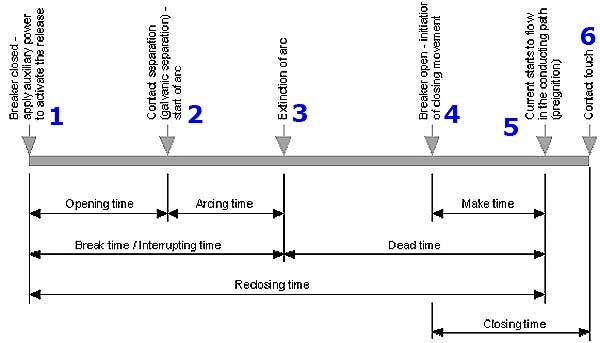
Параллельные тексты EN-RU
1
Breaker closed - apply auxillary power to activate the release.
Выключатель во включенном положении. Начинает прикладываться внешнее усилие, направленное на отключение.
2
Contact separation - start of arc.
Наличие зазора между разомкнутыми контактами. Возникновение дуги.
3
Extinction of arc.
Погасание дуги.
4
Breacer open - initiation of closing movement.
Выключатель в отключенном положении. Инициирование включения.
5
Current starts to flow in the conducting path (preignition)
Начало протекания тока (начало горения дуги в изоляционном промежутке между разомкнутыми контактами).
6
Contact touch.
Соприкосновение контактов.
-
Opening time.
Собственное время отключения.
-
Arcing time
Время дуги.
-
Make time.
Время включения.
-
Break time/Interrupting time
-
Dead time.
Бестоковая пауза.
-
Closing time.
Собственное время включения.
-
Reclosing time.
Цикл автоматического повторного включения.
[Siemens]
[Перевод Интент]
Тематики
- выключатель, переключатель
EN
Русско-английский словарь нормативно-технической терминологии > коммутационный цикл
-
10 caída
f.1 fall, collapse, downfall, downturn.2 wipe-out.3 prolapse, ptosis, drooping, lapsus.past part.past participle of spanish verb: caer.* * *1 (acción de caer) fall, falling2 (pérdida) loss3 (de precios, temperatura) fall, drop4 (de un terreno) slope5 (del sol) setting6 (de tejidos) body, hang8 figurado downfall, fall\a la caída del sol at sunsetcaída de ojos demure lookcaída libre free fall* * *noun f.1) fall2) drop3) collapse4) loss* * *SF1) (=accidente) fall; [de caballo] fall, tumble•
sufrir una caída — to have a fall, take a tumbledurante un campeonato regional, sufrió una grave caída del caballo — during a regional championship, he had a bad fall o tumble off his horse
caída de cabeza, sufrir una caída de cabeza — to fall headfirst, take a header *
2) [de gobierno, imperio] fall, collapse; [de un gobernante] downfallla caída del Muro de Berlín — the collapse o fall of the Berlin Wall
3) (=pérdida) [de cabello, dientes] loss4) (Dep)caída al vacío, caída libre — free fall
5) (=descenso) [de precios, ventas] fall, drop; [de divisa] fallla espectacular caída de precios afectó con gran dureza a numerosas economías — many economies were hard hit by the dramatic fall o drop in prices
el gobierno está decidido a frenar la caída de la libra — the government is determined to curb the fall of the pound
caída de tensión — (Med) drop in blood pressure; (Elec) drop in voltage
el banco intervino para evitar la caída en picado del dólar — the bank intervened to stop the dollar taking a nose-dive o plummeting
6)7) (=desprendimiento) fallhabía una continua caída de piedras desde la cima de la montaña — rocks fell continuously from the top of the mountain
8) (=inclinación) [de terreno] slope; [brusco] drop9) [de tela, ropa] hangcaída de ojos, tenía una caída de ojos entre coqueta y malvada — the way she lowered her eyes was somewhere between coquettish and wicked
10) (Rel)11)12) pl caídasa) * (=golpes) witty remarks¡qué caídas tiene! — isn't he witty?
b) (=lana) low-grade wool sing* * *1) ( accidente) fallsufrir una caída — persona to have a fall
2) ( del cabello)3) (de tela, falda)4) (de gobierno, de ciudad) fallla caída del Imperio Romano — the fall o collapse of the Roman Empire
5) ( descenso) fall, drop6)a la caída del sol or de la tarde — at sunset, at dusk
7) (de terreno, de superficie) slope; ( más pronunciada) drop* * *= drop, spiral, downfall, slippage, downturn, droop, trough, downward spiral, fall, slump, downswing, descent, labefaction.Ex. Perfect recall can only be achieved by a drop in the proportion of relevant documents considered.Ex. The spiral begins its downward swirl very early in life when a child has difficulty learning to read.Ex. What this time will be the cause of his slapstick downfall?.Ex. The Food and Agricultural Organization (FAO) also publishes FAO Books in Print on an intended annual cycle but the programme has been subject to slippage in recent years.Ex. Part of the trend towards declining conference attendance results from the downturn in the economy = Parte de la tendencia hacia el descenso de la asistencia a los congresos es consecuencia de la caída de la economía.Ex. This article describes a study undertaken in Brazil to investigate the phenomenon of the droop at the end of the graph demonstrating Bradford's law which corresponds to the journals of low productivity.Ex. Public libraries have continued to expand since the trough of the 1950s.Ex. The downward spiral of increasing serial prices and decreasing subscriptions is well documented.Ex. There has been a rapid increase in the number and costs of science, technology and medicine scholarly titles in recent years, and a fall in subscriptions.Ex. The author discusses the current upswing in paperback sales of children's books in the USA and the slump in hardback sales.Ex. A new solution to the problem of predicting cyclical highs and lows in the economy enables one to gauge whether an incipient economic downswing will turn out to be a slowdown in economic growth or a real recession.Ex. The street-smart kid's descent into crime and heroin addiction is now too familiar a story.Ex. The natural result of this labefaction is the Delaware neonate killing by a freshman couple.----* a la caída de la noche = at nightfall, at twilight.* a la caída de la tarde = at twilight.* amortiguar la caída = break + Posesivo + fall.* caída al vacío = fall into + (empty) space.* caída de la bolsa = market crash, stock market crash.* caída de la tarde = sundown.* caída del imperio romano, la = Fall of the Roman Empire, the.* caída de los precios = falling prices.* caída del sistema = system crash.* caída de pelo = hair loss.* caída en picado = plunge, nosedive, swoop.* caída libre = free fall.* en caída = flowing.* * *1) ( accidente) fallsufrir una caída — persona to have a fall
2) ( del cabello)3) (de tela, falda)4) (de gobierno, de ciudad) fallla caída del Imperio Romano — the fall o collapse of the Roman Empire
5) ( descenso) fall, drop6)a la caída del sol or de la tarde — at sunset, at dusk
7) (de terreno, de superficie) slope; ( más pronunciada) drop* * *= drop, spiral, downfall, slippage, downturn, droop, trough, downward spiral, fall, slump, downswing, descent, labefaction.Ex: Perfect recall can only be achieved by a drop in the proportion of relevant documents considered.
Ex: The spiral begins its downward swirl very early in life when a child has difficulty learning to read.Ex: What this time will be the cause of his slapstick downfall?.Ex: The Food and Agricultural Organization (FAO) also publishes FAO Books in Print on an intended annual cycle but the programme has been subject to slippage in recent years.Ex: Part of the trend towards declining conference attendance results from the downturn in the economy = Parte de la tendencia hacia el descenso de la asistencia a los congresos es consecuencia de la caída de la economía.Ex: This article describes a study undertaken in Brazil to investigate the phenomenon of the droop at the end of the graph demonstrating Bradford's law which corresponds to the journals of low productivity.Ex: Public libraries have continued to expand since the trough of the 1950s.Ex: The downward spiral of increasing serial prices and decreasing subscriptions is well documented.Ex: There has been a rapid increase in the number and costs of science, technology and medicine scholarly titles in recent years, and a fall in subscriptions.Ex: The author discusses the current upswing in paperback sales of children's books in the USA and the slump in hardback sales.Ex: A new solution to the problem of predicting cyclical highs and lows in the economy enables one to gauge whether an incipient economic downswing will turn out to be a slowdown in economic growth or a real recession.Ex: The street-smart kid's descent into crime and heroin addiction is now too familiar a story.Ex: The natural result of this labefaction is the Delaware neonate killing by a freshman couple.* a la caída de la noche = at nightfall, at twilight.* a la caída de la tarde = at twilight.* amortiguar la caída = break + Posesivo + fall.* caída al vacío = fall into + (empty) space.* caída de la bolsa = market crash, stock market crash.* caída de la tarde = sundown.* caída del imperio romano, la = Fall of the Roman Empire, the.* caída de los precios = falling prices.* caída del sistema = system crash.* caída de pelo = hair loss.* caída en picado = plunge, nosedive, swoop.* caída libre = free fall.* en caída = flowing.* * *A (accidente) fallsufrir una caída «persona» to have a fallha sufrido varias caídas y no se ha roto it's fallen on the floor/it's been dropped several times without breakingfue una mala caída it was a nasty fall, he took a nasty tumble ( colloq)Compuestos:hacerle una caída de ojos a algn to flutter one's eyelids at sbfree fallB(del cabello): un tratamiento contra la caída del cabello a treatment to prevent hair lossC(de una tela, falda): para esta falda se necesita una tela con más caída you need a heavier material for this skirttiene muy buena caída it hangs very wellD1 (de un gobierno) fall; (de una ciudad) fallla caída del Imperio Romano the fall o collapse of the Roman Empire2E (descenso) fall, dropla caída del dólar/del precio del petróleo the fall in the dollar/in the price of oilse ha producido una caída de las exportaciones/la demanda there has been a fall o drop in exports/demandla caída de la temperatura the drop in temperatureuna caída de voltaje or tensión a drop in voltageCompuesto:waterfallFa la caída del sol or de la tarde at sunset, at duskG1 (del terreno) slope; (más pronunciada) drop2 (de un techo) slope, pitch; (de una superficie) slope, dropH ( Náut) (de un palo, mástil) rake* * *
caída sustantivo femenino
1 ( en general) fall;
caída libre free fall;
la caída del gobierno the fall of the government;
la caída del cabello hair loss
2 (de tela, falda):
tiene buena caída it hangs well
3 ( descenso) caída de algo ‹del dólar/de los precios/de la demanda› fall in sth;
‹de temperatura/voltaje› drop in sth;
caído,-a
I adjetivo
1 fallen: había varios troncos caídos en la carretera, there were tree trunks on the road
2 (en defensa de una causa) los soldados caídos en el desembarco de Normandía, the soldiers who fell in during the Normandy landings
3 (parte del cuerpo) Pedro es caído de hombros, Pedro has drooping shoulders
II mpl Mil los caídos, the fallen
caída sustantivo femenino
1 fall
la caída del muro de Berlín, the fall of the Berlin wall
2 (del pelo, los dientes) loss
3 (de los precios) drop
4 (de un tejido) es una tela con poca caída, it's a fabric that hangs badly
5 Pol downfall, collapse
6 (salto de agua) waterfall, cascade
' caída' also found in these entries:
Spanish:
capa
- convalecer
- escalabrarse
- patinazo
- precipitarse
- aparatoso
- malo
- pique
- revolcón
English:
break
- collapse
- cushion
- downfall
- drape
- fall
- free fall
- inflamed
- rise
- sheer
- sky-dive
- sky-diver
- tumble
- descent
- dip
- doldrums
- down
- drop
- sky
- slump
- sun
- wind
* * *caída nf1. [de persona] fall;sufrir una caída to have a fall;se rompió la cadera por una mala caída he fell badly and broke his hip2. [de hojas, lluvia, nieve] fall;[de diente, pelo] loss;en la época de la caída de la hoja when the leaves fall off the trees;RP Famser la caída de la estantería to be out of this worldcaída de agua waterfall;caída libre free fall;caída de ojos: [m5] tiene una atractiva caída de ojos she has an attractive way of lowering her eyelashes;caída en picado [de avión] crash dive3. [de imperio, ciudad, dictador] fall;la caída del Imperio Romano the fall of the Roman Empire;la caída del muro (de Berlín) the fall of the Berlin Wall4. [de paro, precios] drop (de in);se espera una caída de las temperaturas temperatures are expected to drop;se ha registrado una caída del desempleo there has been a fall in unemployment, unemployment has gone downcaída en picado [de la economía] free fall; [de precios] nose-dive;caída de tensión voltage dropa la caída de la tarde at nightfall7. [de tela, vestido] drape10. [en golf] break* * *f fall;a la caída del sol at sunset;a la caída de la tarde at sunset;caída del gobierno fall of the government;caída del pelo hair loss* * *caída nf1) baja, descenso: fall, drop2) : collapse, downfall* * *caída n fall -
11 Warren, Henry Ellis
SUBJECT AREA: Horology[br]b. 21 May 1872 Boston, Massachusetts, USAd. 21 September 1957 Ashland, Massachusetts, USA[br]American electrical engineer who invented the mains electric synchronous clock.[br]Warren studied electrical engineering at the Boston Institute of Technology (later to become the Massachusetts Institute of Technology) and graduated in 1894. In 1912 he formed the Warren Electric Clock Company to make a battery-powered clock that he had patented a few years earlier. The name was changed to the Warren Telechron (time at a distance) Company after he had started to produce synchronous clocks.In 1840 Charles Wheatstone had produced an electric master clock that produced an alternating current with a frequency of one cycle per second and which was used to drive slave dials. This system was not successful, but when Ferranti introduced the first alternating current power generator at Deptford in 1895 Hope-Jones saw in it a means of distributing time. This did not materialize immediately because the power generators did not control the frequency of the current with sufficient accuracy, and a reliable motor whose speed was related to this frequency was not available. In 1916 Warren solved both problems: he produced a reliable self-starting synchronous electric motor and he also made a master clock which could be used at the power station to control accurately the frequency of the supply. Initially the power-generating companies were reluctant to support the synchronous clock because it imposed a liability to control the frequency of the supply and the gain was likely to be small because it was very frugal in its use of power. However, with the advent of the grid system, when several generators were connected together, it became imperative to control the frequency; it was realized that although the power consumption of individual clocks was small, collectively it could be significant as they ran continuously. By the end of the 1930s more than half the clocks sold in the USA were of the synchronous type. The Warren synchronous clock was introduced into Great Britain in 1927, following the setting up of a grid system by the Electricity Commission.[br]Principal Honours and DistinctionsFranklin Institute John Price Wetherill Medal. American Institute of Electrical Engineers Lamme Medal.BibliographyThe patents for the synchronous motor are US patent nos. 1,283,432, 1,283,433 and 1,283,435, and those for the master clock are 1,283,431, 1,409,502 and 1,502,493 of 29 October 1918 onwards.1919, "Utilising the time characteristics of alternating current", Transactions of the American Institute of Electrical Engineers 38:767–81 (Warren's first description of his system).Further ReadingJ.M.Anderson, 1991, "Henry Ellis Warren and his master clocks", National Association of Watch and Clock Collectors Bulletin 33:375–95 (provides biographical and technical details).DV -
12 генератор
generator
– аварийный генератор
– асинхронный генератор
– аэрозольный генератор
– бесколлекторный генератор
– брызгозащищенный генератор
– вертикальный генератор
– возбуждать генератор
– вольтодобавочный генератор
– высокочастотный генератор
– генератор Аркадьева-Маркса
– генератор Баркхузена
– генератор биений
– генератор видеочастоты
– генератор возбуждается
– генератор воющий
– генератор времязадающий
– генератор вызывной
– генератор гармоник
– генератор дифференциальный
– генератор задающий
– генератор задержки
– генератор запирающий
– генератор зарядный
– генератор импульсов
– генератор индуктивно-емкостный
– генератор индукторный
– генератор интерполяционный
– генератор квантовый
– генератор колебаний
– генератор Мейснеровский
– генератор накачки
– генератор нейтронов
– генератор пара
– генератор пены
– генератор помех
– генератор развертки
– генератор раскачивается
– генератор реактивный
– генератор с самовозбуждением
– генератор СВЧ
– генератор СВЧ-диапазона
– генератор синхроимпульсов
– генератор строб-импульсов
– генератор тональный
– генератор ультразвука
– генератор униполярный
– генератор Хартли
– генератор частоты
– генератор ЧМ
– генератор шума
– гетерополярный генератор
– главный генератор
– гомополярный генератор
– горизонтальный генератор
– двухполярный генератор
– двухтактный генератор
– джозефсоновский генератор
– диапазонный генератор
– динатронный генератор
– дуговой генератор
– емкостно-резистивный генератор
– задающий генератор
– закрытый генератор
– запирающий генератор
– запускать генератор
– зарядный генератор
– звуковой генератор
– зуммерный генератор
– измерительный генератор
– импульсный генератор
– индукторный генератор
– интерполяционный генератор
– искровой генератор
– калибровочный генератор
– камертонный генератор
– квадратурный генератор
– кванторный генератор
– кварцевый генератор
– клистронный генератор
– когерентный генератор
– кольцевой генератор
– ламповый генератор
– магнетронный генератор
– магнитострикционный генератор
– магнитоэлектрический генератор
– мазерный генератор
– многоканальный генератор
– многотоковый генератор
– молекулярный генератор
– неявнополюсный генератор
– отключать генератор
– параметрический генератор
– педальный генератор
– плазменный генератор
– реактивный генератор
– резервный генератор
– релаксационный генератор
– релейный генератор
– самовозбуждающийся генератор
– самохронирующийся генератор
– сельсинный генератор
– синхронный генератор
– стояночный генератор
– струйный генератор
– тахометрический генератор
– твердотельный генератор
– тепловой генератор
– термозэрозольный генератор
– термоэлектрический генератор
– термоэлектронный генератор
– тиратронный генератор
– транзитронный генератор
– трехфазный генератор
– уксусный генератор
– ультразвуковой генератор
– униполярный генератор
– фотоэлектрический генератор
– хронирующий генератор
– широкополосный генератор
– электрофорный генератор
– эталонный генератор
– явнополюсный генератор
ацетиленовый генератор сухого типа — dry-residue acetylene generator
вызывной генератор звуковой частот — voice-frequency ringing generato
генератор бегущей волны — traveling-wave-tube oscillator
генератор белого шума — white noise generator
генератор биений в гетеродинном приеме — beat oscillator
генератор вихревой джозефсоновский — Josephson flux-flow oscillator
генератор возбуждающих импульсов — driver
генератор временной развертки — time-base generator
генератор вызывного тока — ringing generator
генератор высокой частоты — < radio> oscillator, RF oscillator
генератор газа свободнопоршневой — <chem.> free-piston gas generator
генератор задержанных импульсов — delayed pulse oscillator
генератор заднего полустроба — late-gate generator
генератор зарядный ветровой — wind charger
генератор заряженного торуса адиабатический — electron ring compressor
генератор затухающих колебаний — self-quenching oscillator, squegger
генератор звуковой частоты — audio oscillator, voice-frequency generator
генератор импульсного напряжения — high-voltage generator
генератор импульсного тока — surge current generator
генератор импульсных напряжений — <electr.> pulse voltage generator
генератор импульсов заданной формы — pulse waveform generator
генератор импульсов малого цикла — minor-cycle pulse generator
генератор импульсов отметки — <tech.> mark pulse generator, notch generator
генератор индукторного вызова — subharmonic generator
генератор испытательного сигнала — pattern generator
генератор испытательных импульсов — test signal generator
генератор кадровой развертки — field deflection oscillator, vertical-scanning generator
генератор качающейся частоты — < radio> sweep generator, sweep-frequency generator, wobbulator
генератор квантовый молекулярный — <phys.> maser
генератор комбинационных частот — comb generator
генератор компенсации темного пятн — shading-correcting generator
генератор коротких импульсов — narrow-pulse generator
генератор линейного напряжения развертки — <phot.> linear sweep generator
генератор масштабных импульсов — <tech.> range-marker oscillator
генератор меток времени — time-mark generator
генератор меток дальности — range-marker generator
генератор механических колебаний — generator of mechanical oscillations
генератор на топливных элементах — fuel-cell generator
генератор начинает возбуждаться — generator picks up
генератор несущей частоты — carrier oscillator
генератор низкой частоты — audio-oscillator
генератор одиночных импульсов — single-pulse generator
генератор опорного сигнала — reference generator
генератор пачек импульсов — pulse-burst generator
генератор переднего полустроба — early-gate generator
генератор переменного тока — alternating current generator, <engin.> alternator
генератор переменной частоты — <tech.> sweep generator
генератор пилообразного напряжения — saw-tooth voltage generator
генератор пилообразных импульсов — sawtooth generator
генератор плавного диапазона — variable frequency oscillator
генератор по схеме моста Вина — Wien-bridge oscillator
генератор повышенной частоты — rotary frequency changer
генератор погружного исполнения — submerged generator
генератор полного синхросигнала — composite sync generator
генератор постоянного напряжения — constant-potential generator
генератор постоянного тока — DC generator, direct-current generator
генератор постоянной силы тока — constant-current generator
генератор построен на лампе — oscillator uses valve
генератор построен по схеме — oscillator is set up as
генератор прерывистого действия — chopping oscillator
генератор прямоугольных импульсов — <tech.> square pulse generator, square wave-form oscillator, square-wave generator
генератор прямоугольных сигналов — <tech.> square wave generator
генератор пусковых импульсов — trigger-pulse generator
генератор равновероятных цифр — equiprobable number generator
генератор развертки дальности — <tech.> range sweep generator, range-sweep generator
генератор разрывных колебаний — <tech.> relaxation oscillator
генератор с внешним возбуждением — radio-frequency power amplifier
генератор с водородным охлаждением — hydrogen-cooled generator
генератор с индуктивной обратной связью — <tech.> Meissner oscillator, tickler-coil oscillator
генератор с искровым возбуждением — spark-excited oscillator
генератор с кварцевой стабилизацией — <tech.> crystal-controlled oscillator
генератор с ленточным лучом — <electr.> strip-beam oscillator
генератор с настроенными анодом и сеткой — < radio> Armstrong oscillator
генератор с независимым охлаждением — separate fan-cooled generator
генератор с постоянными магнитами — permanent magnet generator
генератор с тормозящим полем — retarding-field oscillator
генератор с фазовым сдвигом — phase-shift oscillator
генератор с частотной модуляцией — frequency-modulated oscillator
генератор сантиметрового диапазона — SHF oscillator
генератор сверхвысокой частоты — < radio> microwave oscillator
генератор света параметрический — <phys.> parametric light generator
генератор сетки частот — spectrum generator
генератор синусоидальных колебаний — harmonic oscillator
генератор синхронизирующих импульсов — clock pulse generator
генератор случайных сигналов — random-signal generator
генератор случайных событий — random event generator
генератор смешанного возбуждения — compound-wound generator
генератор со скоростной модуляцией — velocity-modulated generator
генератор со смешанным возбуждением — compound-wound generator
генератор собственных нужд — house generator
генератор срывающей частоты — quenching oscillator
генератор стабилизированный кварцем — <tech.> crystal-controlled oscillator
генератор стабилизированный линией — line-controlled oscillator
генератор стандартных импульсов — standard pulse generator
генератор стандартных сигналов — standard signal generator
генератор строчной развертки — horizontal deflection oscillator, horizontal-scanning generator
генератор ступенчатой функции — step-function generator
генератор тактовых импульсов — clock pulse generator, clock pulse source
генератор тонального вызова — ringer oscillator, voice-frequency ringer
генератор трехточечный с индуктивной связью — < radio> Bartley oscillator, tapped-coil oscillator
генератор трехточный с емкостной связью — < radio> Colpitts oscillator, tapped-capacitor oscillator
генератор ударного возбуждения — shock-excited oscillator
генератор ударных волн — shock-wave generator
генератор узких строб-импульсов — narrow gate generator
генератор управляемый напряжением — voltage-controlled oscillator
генератор хронирующих импульсов — <tech.> base-pulse generator
генератор цветных изображений — <phot.> color pattern generator
дуговой генератор плазмы — arc plasma generator
заторможенный блокинг - генератор — biassed blocking oscillator
квантовый генератор ИК-диапазона — infrared laser
квантовый генератор СВЧ — maser
квантовый генератор СВЧ на аммиаке — ammonia gas maser
квантовый генератор СВЧ на порошке — powder maser
квантовый генератор СВЧ на рубине — ruby maser
маломощный генератор импульсов — low-level pulser
матричный генератор импульсов — matrix-type pulse generator
мощный генератор импульсов — power pulser
оптический инжекционный квантовый генератор — injection laser
оптический квантовый генератор — laser
ставить генератор под нагрузку — throw generator on the load
хронированный импульсный генератор — timed pulse oscillator
эквивалентный генератор напряжения — constant-voltage generator
-
13 токоограничивающий автоматический выключатель
- limiting circuit-breaker
- limiting circuit breaker
- current-limiting circuit-breaker
- current-limiting circuit breaker
- current limiting circuitbreaker
токоограничивающий автоматический выключатель
Выключатель с чрезвычайно малым временем отключения, в течение которого ток короткого замыкания не успевает достичь своего максимального значения.
[МЭК 60947-1]En
current-limiting circuit breaker
Circuit-breaker with a break-time short enough to prevent the short-circuit current reaching its otherwise attainable peak value.
[< size="2">IEC 60077-3, ed. 1.0 (2001-12)]
Circuit-breaker that, within a specified range of current, prevents the let-through current reaching the prospective peak value and which limits the let-through energy (I2t) to a value less than the let-through energy of a half-cycle wave of the symmetrical prospective current
NOTE 1 - Reference may be made to either the symmetrical or asymmetrical prospective peak value of let-through current.
NOTE 2 - The let-through current is also referred to as the cut-off current (see IEV 441-17-12).
NOTE 3 - Templates for the graphical representation of the cut-off current characteristic and the let-through energy characteristic are given in Figures K.2 to K.5 and examples of the use of the templates in Figures K.6 and K.7.
[IEC 60947-2, ed. 4.0, amd. 1 (2009-01)]Fr
disjoncteur limiteur de courant
Disjoncteur dont la durée de coupure est particulièrement brève en vue d’obtenir que le courant de court-circuit ne puisse atteindre son amplitude maximale
[< size="2">IEC 60077-3, ed. 1.0 (2001-12)]
Disjoncteur qui, à l'intérieur d'un domaine de courant spécifié, empêche le courant coupé limité d'atteindre la valeur crête présumée et qui limite l'énergie limitée (I2t) à une valeur inférieure à l'énergie limitée d'une demi-période du courant présumé symétrique
NOTE 1 Il peut être fait référence à la valeur crête présumée symétrique ou assymétrique du courant coupé limité.
NOTE 2 Le courant coupé limité (let-through current) est aussi nommé "cut-off current" (voir VEI 441-17-12).
NOTE 3 Les modèles de représentation graphique des caractéristiques de courant coupé limité et d'énergie limitée sont illustrés dans les Figures K.2 à K.5 et les exemples d'utilisation des modèles dans les Figures K.6 et K.7.
[IEC 60947-2, ed. 4.0, amd. 1 (2009-01)]Токоограничивающий автоматический выключатель имеет чрезвычайно малое время отключения, в течение которого ток КЗ не успевает достичь максимального значения.
Токоограничивающие автоматические выключатели ограничивают ток КЗ с помощью быстрого введения в цепь дополнительного сопротивления электрической дуги (в первый же полупериод, до того, как ток КЗ значительно возрастет) и последующего быстрого отключения КЗ, при этом ток КЗ не достигает ожидаемого расчетного максимального значения. Токоограничение начинается с некоторого значения тока, определяемого характеристикой токоогранияения.
В токоограничивающих автоматических выключателях при больших ожидаемых токах КЗ контакты, сразу же отбрасываются электродинамическими силами, вводя в цепь сопротивление дуги, и затем уже не соприкасаются, так как своевременно срабатывает электромагнитный расцепитель.
При малых токах КЗ контакты не отбрасываются, а отключение производится электромагнитным расцепителем.
[А.В.Беляев. Выбор аппаратуры, защит и кабелей в сетях 0,4 кВ. - Л.: Энергоатомиздат. 1988.]Тематики
Классификация
>>>Обобщающие термины
EN
- current limiting circuitbreaker
- current-limiting circuit breaker
- current-limiting circuit-breaker
- limiting circuit breaker
- limiting circuit-breaker
DE
FR
Русско-английский словарь нормативно-технической терминологии > токоограничивающий автоматический выключатель
-
14 final
adj.final, end.punto final end pointf.final.m.1 end.a finales de at the end ofya verás como al final acepta she'll agree in the end, you'll seeal final de at the end ofal final del pasillo at the end of the corridorfinal feliz happy ending2 ending, bottom, end, finale.* * *► adjetivo1 (último) final, last1 end2 MÚSICA finale1 DEPORTE final\al final in the endal final del día at the end of the dayhasta el final until the endfinal de línea terminusfinal feliz happy ending* * *1. adj. 2. noun m.end, final* * *1.ADJ (=último) [momento, capítulo, resultado, decisión] final; [objetivo] ultimatejuicio 4), recta, punto 2)2. SM1) (=fin) [de ceremonia, vida, aventura, guerra] end; [de obra musical] finale•
al final — in the end•
al final de algo — at the end of sthel anuncio se realizó ayer al final de la reunión — the announcement was made yesterday at the end of the meeting
2) (=desenlace) [de película, libro] ending3)• a finales de — at the end of
3.SF (Dep) final•
cuartos de final — quarter-finals* * *I IImasculino endIIIestábamos al final de la cola — we were last in line (AmE) o (BrE) at the back of the queue
femenino (Dep)a) (en fútbol, tenis etc) finalpasar a la final — to go through to o make it to the final
b) finales femenino plural (en béisbol, baloncesto, fútbol americano) playoffs (pl)* * *I IImasculino endIIIestábamos al final de la cola — we were last in line (AmE) o (BrE) at the back of the queue
femenino (Dep)a) (en fútbol, tenis etc) finalpasar a la final — to go through to o make it to the final
b) finales femenino plural (en béisbol, baloncesto, fútbol americano) playoffs (pl)* * *final11 = completion, end, ending, finale, goodbye [good-bye], output stage, final.Ex: The time period between the completion of a cycle (e.g. at the end of a volume or a year) and the publication of the associated cumulative indexes should be as short as possible.
Ex: Scanning must start to the left of the bar codes and must continue past the right end.Ex: The teacher should not give away any details which would be best enjoyed when met for the first time in a full reading, such as twist in the plot, unexpected endings, and the like.Ex: The article 'Encore! Integrating children's literature as a prelude or finale to music experiences with young children' shows how teachers and library specialists can integrate children's literature about song, dance, or musical instruments in music classes.Ex: The article 'Books -- is it goodbye?' shows that while there was a sharp increase in fiction in Finland after the 2nd World War, the amount of fiction is now beginning to decline.Ex: To rephrase this in terms already used, they involve effort at the input stage in order to reduce effort at the output stage = Expresando esto con términos ya usados, suponen un esfuerzo en la etapa inicial con objeto de reducir el esfuerzo en la etapa final.Ex: A heavy reliance on midterms and finals were associated with lower teacher ratings across disciplines.* acercarse al final = draw to + an end, draw to + a close, come to + an end.* a final de cuentas = after all is said and done.* a finales de = by the end of, in the late + Fecha.* a finales de + Expresión Temporal = as of late + Expresión Temporal, at the end of + Expresión Temporal, at the close of + Expresión Temporal, by the close of + Expresión Temporal.* a finales de + Fecha = in late + Fecha.* a finales de los + Década = late + Década, the.* a finales del + Siglo = late + Siglo, late period of + Siglo.* aguantar hasta el final = stick it out.* al final = in the end, eventually, in the final count, terminally, ultimately, at the end of the day.* al final (de) = at the end (of).* al final de cuentas = when all is said and done.* al final del día = at the close of the day.* al final de su mandato = lame duck.* al final resultó que = in the event.* al principio y al final = both ends.* al principio y al final de = at each end of.* balance final, el = bottom line, the.* cuartos de final = quarter-finals.* de final de año = end-year.* de finales del siglo XIX y principios del XX = turn-of-the-century.* el final de = the close of.* el final de los problemas = the light at the end of the tunnel.* empezar por el final = work back from.* estrategia final = endgame.* fase final = endgame.* final apoteósico = grandstand finish.* final de la jornada laboral = close of business.* final del plazo = closing date, deadline, dateline.* final feliz = happy ending, happy end.* final, la = final, the.* hacia finales del + Siglo = later + Siglo, the.* hasta el final = until the end, until the bitter end.* hasta el final de los tiempos = till the end of time.* incluir al final = append.* llegar a final de mes = make + ends meet.* llegar al final de = come to + the end of, get through.* llegar al final de su vida útil = come to + the end of + Posesivo + useful life, reach + the end of + Posesivo + useful life.* llevar Algo hasta el final = carry + Nombre + to the end.* luchar hasta el final = battle + it out, fight until + the end.* marca de final de campo = delimiter.* marcar el final = mark + the end.* marcar + Posesivo + final = mark + Posesivo + end.* nota al final = endnote.* nota al final del texto = endnote.* para finales de = by the end of.* para finales de + Expresión Temporal = by the close of + Expresión Temporal.* poner punto y final a = sound + the death knell for.* puede que al final sea para bien = be a blessing in disguise.* salir bien al final = turn out + right in the end.* significar el final de = mean + the end of.* toque final, el = finishing touch, the.final22 = concluding, eventual, final, terminal, ultimate, finished, wrap-up.Ex: Therefore, during the concluding phase of the revision project, the representatives of ALA units and other organizations will function as a single group.
Ex: If a concept is recognized in the subject analysis of a document, it will form part of the eventual index description of that document.Ex: The final index will mirror current terminology.Ex: Numbers may be grouped in columns according to their terminal digit.Ex: Abstracting and indexing data are a vital component in the communication link between the originator of information and its ultimate consumer.Ex: For storytelling and reading aloud are performance arts: They involve a script (even when the words are improvised on the spot), an interpreter (the teller or reader), and an audience, and as in all performances, the audience plays a part in molding the finished work.Ex: The workshop itself will serve as the wrap-up event for a project that has spent the last two years seeking to improve access to environmental information in the Balkan region.* como fecha final = at the very latest.* cuestionario final = exit survey.* día del Juicio Final = Judgement Day.* el día del Juicio Final = the Day of Judgement.* El Juicio Final = The Last Judgement.* escena final = closing scene.* espacio en blanco final = trailing blank.* examen final = final, final exam.* frase graciosa final = punchline [punch line].* índice final = back-of-the-book index, back-of-book index.* informe final = final report.* juicio final = doom.* poner el colofón final = bookend.* poner punto final a = bring + an end to, bring to + an end, close + the book on.* poner punto y final a = put + a stop to.* producto final = end product, finished product, final product.* producto final, el = finished work, the.* prueba final = final.* resultado final = end result.* sondeo final = exit survey.* sprint final = last-minute rush.* usuario final = end user [end-user/enduser], ultimate consumer, ultimate reader.* ver la luz al final del túnel = see + the light at the end of the tunnel.la final= final, theEx: Tony was disappointed the last time he was in the finals, and he's determined to leave everything on the dance floor this time.
* * *‹decisión› final; ‹objetivo› ultimateendme quedé hasta el final I stayed to the enda finales de junio at the end of Juneal final de la película ella muere she dies at the end of the movieno me gustó nada el final I didn't like the ending at alltiene un final feliz it has a happy endingestán al final de la lista they're at the bottom of the listvivo al final de la calle I live at the end of the streetal final del partido at the end of the gameal final tendrá que decidirse he'll have to make his mind up in the endsiempre protestando pero al final nunca hace nada he spends his whole time complaining but he never actually does anything( Dep)1 (en fútbol, tenis etc) finalla final de copa the cup finalpasar a la final to go through to o make it to the final* * *
final adjetivo ‹ decisión› final;
‹ objetivo› ultimate
■ sustantivo masculino
end;
un final feliz a happy ending;
al final de la lista at the bottom of the list;
al final tendrá que decidirse he'll have to make his mind up in the end o eventually
■ sustantivo femenino (Dep)
pasar a la final to go through to o make it to the finalb)
final
I adjetivo final
la decisión final, the final decision
II sustantivo masculino end
a finales de, at the end of
al final, in the end: nos apetecía mucho, pero al final no fuimos, we really felt like doing it, but in the end we didn't go
final de trayecto, terminus
final feliz, happy ending
III f Dep final
' final' also found in these entries:
Spanish:
A
- actual
- avenirse
- cepillarse
- cierre
- cola
- coletilla
- cuarta
- cuarto
- decorado
- disolución
- disputarse
- echarse
- emitir
- fin
- gato
- guinda
- hasta
- hermosa
- hermoso
- incidir
- infarto
- inicial
- judicatura
- juicio
- machacar
- octava
- octavo
- paciencia
- política
- recta
- remate
- retocar
- retoque
- sacacorchos
- servidor
- servidora
- sprint
- total
- traca
- última
- último
- animar
- clasificación
- clasificar
- concho
- conseguir
- contar
- decir
- ensayo
English:
actual
- aggregate
- also
- Armageddon
- back
- best
- bitter
- bottom
- bottom line
- bring round
- close
- doomsday
- end
- ending
- evade
- eventual
- fast forward
- final
- finale
- follow through
- from
- grand finale
- hear of
- in
- last
- late
- light
- listen
- out of
- outsmart
- outtake
- quarter-final
- reckoning
- right
- see
- sit through
- soon
- stage
- still
- straight
- tack on
- tag on
- tail end
- to
- track down
- truth
- turn
- ultimate
- ultimately
- way
* * *♦ adj1. [último] final, end;sus palabras finales fueron muy aplaudidas her closing words were loudly applauded;punto final end point2. Gram final♦ nm1. [terminación] end;el final del libro es sorprendente the book has a surprise ending;a finales de at the end of;al final [en conclusión] in the end;la cocina está al final del pasillo the kitchen is at the end of the corridor;responderé preguntas al final de la charla I will answer questions at the end of the talk;al final siempre tengo que ayudarles I always have to help them in the end;ya verás como al final acepta she'll agree in the end, you'll seefinal feliz happy ending2. [examen] final (exam)♦ nffinal;cuartos de final quarter finalsfinal de consolación 3rd/4th place play-off;final de la copa cup final;final a cuatro [en baloncesto] final four* * *1 f & adj final2 m end;al final in the end;a finales de mayo at the end of May* * *final adj: final, ultimate♦ finalmente advfinal nm1) : end, conclusion, finale2) finales nmpl: play-offs* * *final1 adj final / lastfinal2 n1. (fin) end2. (de competición) final3. (de historia) ending -
15 Joubert, Jules François
SUBJECT AREA: Electricity[br]b. 1834 Tours, Franced. 1910 Paris, France[br]French physicist, investigator of alternating-current wave-forms.[br]Joubert became Professor of Physics in the Collège Rollin, Paris, in 1874, a position he held until 1888. He was at one time General Secretary of the Société Française de Physique. In collaboration with Pasteur he began studies into the theories of germs and bacteria. In 1880 Joubert carried out research on wave-forms in alternating-current arc-lighting circuits. Reinventing a method previously used by earlier experimenters, including Wheatstone, he was, by a mechanical sampling technique, able to determine the voltage at different points in the cycle. By using a rotating contact on the alternator shaft, the angular position of which could be varied, the whole of the wave-form could be delineated. This successful technique was widely used for some thirty years.[br]Bibliography1880, "Sur les courants alternatifs et la force électromotive de l'arc électrique", Journal of Physics 9:297–303 (describes his experiments).Further Reading"Investigation of alternating current arcs", Electrician (1880) 5:151–2 (a report on Joubert's method).V.J.Phillips, 1987, Waveforms, Bristol (an extensive account of early methods of wave-form observation).W.Bulloch, 1938, The History of Bacteriology, Oxford; 1979, repub. New York.See also: Duddell, William du BoisGWBiographical history of technology > Joubert, Jules François
-
16 महा _mahā
1महा A cow.2महा The substitute of महत् at the beginning of Karmadhāraya and Bahuvrīhi compounds, and also at the beginning of some other irregular words. (Note: The number of compounds of which महा is the first mem- ber is very large, and may be multiplied ad infinitum. The more important of them, or such as have peculiar significations, are given below.)-Comp. -अक्षः an epithet of Śiva. ˚पटलिक a chief keeper of archives.-अङ्ग a. huge, bulky.-(ङ्गः) 1 a camel.-2 a kind of rat.-3 N. of Śiva.-अञ्जनः N. of a mountain.-अत्ययः a great danger or calamity.-अध्वनिक a. 'having gone a long way', dead.-अध्वरः a great sacrifice.-अनसम् 1 a heavy carriage.-2 cooking utensils. (-सी) a kitchen-maid. (-सः, -सम्) a kitchen; सूपानस्य करिष्यामि कुशलो$स्मि महानसे Mb.4.2.2.-अनिलः a whirl- wind; महानिलेनेव निदाघजं रजः Ki.14.59.-अनुभाव a.1 of great prowess, dignified, noble, glorious, magnanimous, exalted, illustrious; ग्रहीतुमार्यान् परिचर्यया मुहुर्महानु- भावा हि नितान्तमर्थिनः Śi.1.17; Ś.3.-2 virtuous, righteous, just.(-वः) 1 a worthy or respectable person.-2 (pl.) people of a religious sect in Mahārāṣtra founded by Chakradhara in the 13th century.-अन्तकः 1 death.-2 an epithet of Śiva.-अन्धकारः 1 thick darkness.-2 gross (spiritual) ignorance.-अन्ध्राः (pl.) N. of a people and their country.-अन्वय, -अभिजन a. nobly-born, of noble birth. (-यः, -नः) noble birth, high descent.-अभिषवः the great extraction of Soma.-अमात्यः the chief or prime minister (of a king).-अम्बुकः an epithet of Śiva.-अम्बुजम् a billion.-अम्ल a. very sour. (-म्लम्) the fruit of the tamarind tree. अरण्यम् a great (dreary) forest, large forest.-अर्घ a. very costly, costing a high price; महार्घस्तीर्थानामिव हि महतां को$प्यतिशयः U.6.11. (-र्घः) a kind of quail.-अर्घ्य a.1 valuable, precious.-2 invaluable; ines- timable; see महार्ह below.-अर्चिस् a. flaming high.-अर्णवः 1 the great ocean.-2 N. of Śiva.-अर्थ a.1 rich.-2 great, noble, dignified.-3 important, weighty.-4 significant.-अर्बुदम् one thousand millions.-अर्ह a.1 very valuable, very costly; महार्हशय्यापरिवर्तनच्युतैः स्वकेशपुष्पैरपि या स्म दूयते Ku.5.12.-2 invaluable, inestimable; महार्हशयनोपेत किं शेषे निहतो भुवि Rām.6.19. 2. (-र्हम्) white sandal-wood.-अवरोहः the fig-tree.-अशनिध्वजः a great banner in the form of the thunderbolt; जहार चान्येन मयूरपत्रिणा शरेण शक्रस्य महाशनि- ध्वजम् R.3.56.- अशन a. voracious, gluttonous; Mb. 4.-अश्मन् m. a precious stone, ruby.-अष्टमी the eighth day in the bright half of Āśvina sacred to Durgā; आश्विने शुक्लपक्षस्य भवेद् या तिथिरष्टमी । महाष्टमीति सा प्रोक्ता......-असिः a large sword.-असुरी N. of Durgā.-अह्नः the afternoon.-आकार a. extensive, large, great.-आचार्यः 1 a great teacher.-2 an epithet of Śiva.-आढ्य a. wealthy, very rich. (-ढ्यः) the Kadamba tree.-आत्मन् a.1 high-souled, high-minded, magnanimous, noble; अयं दुरात्मा अथवा महात्मा कौटिल्यः Mu.7; द्विषन्ति मन्दाश्चरितं महात्मनाम् Ku.5.75; U.1.49; प्रकृतिसिद्धमिदं हि महात्मनाम् Bh.1.63.-2 illustrious, distinguished, exalted, eminent; किमाचाराः किमाहाराः क्व च वासो महात्मनाम् Mb.3. 1.4.-3 mighty (महाबल); अथायमस्यां कृतवान् महात्मा लङ्केश्वरः कष्टमनार्यकर्म Rām.5.9.74. (-m.)1 the Supreme Spirit; युगपत्तु प्रलीयन्ते यदा तस्मिन् महात्मनि Ms.1.54.-2 the great principle, i. e. intellect of the Sāṅkhyas. (महात्मवत् means the same as महात्मन्).-आनकः a kind of large drum.-आनन्दः, -नन्दः 1 great joy or bliss.-2 espe- cially, the great bliss of final beatitude.(-न्दा) 1 spirituous liquor.-2 a festival on the ninth day in the bright half of Māgha.-आपगा a great river.-आयुधः an epithet of Śiva.-आरम्भ a. undertaking great works, enterprizing. (-म्भः) any great enterprize.-आलयः 1 a temple in general.-2 a sanctuary, an asylum.-3 a great dwelling.-4 a place of pilgrimage.-5 the world of Brahman.-6 the Supreme Spirit.-7 a tree &c. sacred to a deity.-8 N. of a particular dark fortnight.-9 पितृश्राद्ध in the month of Bhādra- pada. (-या) N. of a particular deity.- आशय a. high- souled, nobleminded, magnanimous, noble; दैवात् प्रबुद्धः शुश्राव वराहो हि महाशयः Ks; राजा हिरण्यगर्भो महाशयः H.4; see महात्मन्.(-यः) 1 a noble-minded or magnanimous person; महाशयचक्रवर्ती Bv.1.7.-2 the ocean.-आस्पद a.1 occupying a great position.-2 mighty, powerful.-आहवः a great or tumultuous fight.-इच्छ a.1 magnanimous, noble-minded, high-souled, noble; मही महेच्छः परिकीर्य सूनौ R.18.33.-2 having lofty aims or aspirations, ambitious; विद्यावतां महेच्छानां...... नाश्रयः पार्थिवं विना Pt.1.37.-इन्द्रः 1 'the great Indra', N. of Indra; इयं महेन्द्रप्रभृतीनधिश्रियः Ku.5.53; R.13.2; Ms.7.7.-2 a chief or leader in general.-3 N. of a mountain range; पतिर्महेन्द्रस्य महोदधेश्च R.6.54;4.39,43. ˚चापः rain-bow. ˚नगरी N. of Amarāvatī, the capital of Indra. ˚मन्त्रिन् m. an epithet of Bṛihaspati. ˚वाहः the elephant Airāvata; महेन्द्रवाहप्रतिमो महात्मा Mb.9.17.52.-इभ्य a. very rich.-इषुः a great archer; अधिरोहति गाण्डीवं महेषौ Ki.13.16.-इष्वासः a great archer, a great warrior; अत्र शूरा महेष्वासा भामार्जुनसमा युधि Bg.1.4.-ईशः, -ईशानः N. of Śiva; महेशस्त्वां धत्ते शिरसि रसराजस्य जयिनीम् Udb. ˚बन्धुः the Bilva tree.-ईशानी N. of Pārvatī.-ईश्वरः 1 a great lord, sovereign; महेश्वरस्त्र्यम्बक एव नापरः R.; गोप्तारं न निधीनां कथयन्ति महेश्वरं विबुधाः Pt.2.74.-2 N. of Śiva.-3 of Viṣṇu.-4 a god (opp. प्रकृति).-5 the Supreme Being (परमात्मा); मायां तु प्रकृतिं विद्यान्मायिनं तु महेश्वरम् Śvet. Up.4.1. ˚सखः N. of Kubera; यया कैलासभवने महेश्वरसखं बली Mb.9.11.55.(-री) 1 N. of Durgā.-2 a kind of bell-metal.-उक्षः (for उक्षन्) a large bull; a full grown or strong bull; महोक्षतां वत्सतरः स्पृशन्निव R.3.32;4.22;6.72; Śi.5.63.-उत्पलम् a large blue lotus. (-लः) the Sārasa bird.-उत्सवः 1 a great festival or occasion of joy; नयनविषयं जन्मन्येकः स एव महोत्सवः Māl.1.36.-2 the god of love.-उत्साह a. possessed of great energy, energetic, persevering; अहं च कर्णं जानामि...... सत्यसंधं महोत्साहं...... Mb.3.91.2.(-हः) 1 perseverance.-2 great pride; ये जात्यादिमहो- त्साहान्नरेन्द्रान्नोपयान्ति च । तेषामामरणं भिक्षा प्रायश्चितं विनिर्मितम् ॥ Pt.1.38.-उदधिः 1 the great ocean; महोदधेः पूर इवेन्दु- दर्शनात् R.3.17.-2 an epithet of Indra. ˚जः a conch- shell, shell.- उदय a. very prosperous or lucky, very glorious or splendid, of great prosperity.(-यः) 1 (a) great elevation or rise, greatness, prosperity; नन्दस्त्वतीन्द्रियं दृष्ट्वा लोकपालमहोदयम् Bhāg.1.28.1; अपवर्ग- महोदयार्थयोर्भुवमंशाविव धर्मयोर्गतौ R.8.16. (b) great fortune or good luck. (c) greatness, pre-eminence.-2 final beatitude.-3 a lord, master.-4 N. of the district called Kānyakubja or Kanouja; see App.-5 N. of the capital of Kanouja.-6 sour milk mixed with honey.-7 = महात्मन् q. v.; संसक्तौ किमसुलभं महोदयानाम Ki.7.27. ˚पर्वन् a time of union of the middle of श्रवण नक्षत्र and the end of व्यतिपात (generally in the month of माघ or पौष at the beginning of अमावास्या).- उदर a. big-bellied, corpulent.-(रम्) 1 a big belly.-2 dropsy.-उदार a.1 very generous or magnanimous.-2 mighty, powerful.-उद्यम a. = महोत्साह q. v; महोद्यमाः कर्म समा- रभन्ते.-उद्योग a. very industrious or diligent, hard- working.-उद्रेकः a particular measure (= 4 प्रस्थs).-उन्नत a. exceedingly lofty. (-तः) the palmyra tree.-उन्नतिः f. great rise or elevation (fig. also), high rank.-उपकारः a great obligation.-उपाध्यायः a great preceptor, a learned teacher.-उरगः a great serpent; वपुर्महोरगस्येव करालफणमण्डलम् R.12.98.-उरस्क a. broad-chested. (-स्कः) an epithet of Śiva.-उर्मिन् m. the ocean; ततः सागरमासाद्य कुक्षौ तस्य महोर्मिणः Mb.3.2.17.-उल्का 1 a great meteor.-2 a great fire-brand.-ऋत्विज् m. 'great priest', N. of the four chief sacri- ficial priests.-ऋद्धि a. very prosperous, opulent. (-f.) great prosperity or affluence.-ऋषभः a great bull.-ऋषिः 1 a great sage or saint; यस्मादृषिः परत्वेन महांस्त- स्मान्महर्षयः; (the term is applied in Ms.1.34 to the ten Prajāpatis or patriarchs of mankind, but it is also used in the general sense of 'a great sage').-2 N. of Sacute;iva.-3 of Buddha.-ओघ a. having a strong current.-घः a very large number; शतं खर्व- सहस्राणां समुद्रमभिधीयते । शतं समुद्रसाहस्रं महौघमिति विश्रुतम् ॥ Rām.6.28.37.-ओष्ठ (महोष्ठ) a. having large lips. (-ष्ठः) an epithet of Śiva.-ओजस् a. very mighty or powerful, possessed of great splendour or glory; महौजसा मानधना धनार्चिताः Ki.1.19. (-m.) a great hero or warrior, a champion. (-n.) great vigour.-ओजसम् the discus of Viṣṇu (सुदर्शन). (-सी) N. of plant (Mar. कांगणी).-ओदनी Asparagus Racemosus (Mar. शतावरी).-ओषधिः f.1 a very efficacious medicinal plant, a sovereign drug.-2 the Dūrvā grass.-3 N. of various plants ब्राह्मी, श्वेतकण्टकारी, कटुका, अतिविष &c. ˚गणः a collection of great or medicinal herbs:-- पृश्निपर्णी श्यामलता भृङ्गराजः शतावरी । गुड्चा सहदेवी च महौषधिगणः स्मृतः ॥ cf. also सहदेवी तथा व्याघ्री बला चातिबला त्वचा । शङ्खपुष्पी तथा सिंही अष्टमी च सुवर्चला ॥ महौषध्यष्टकं प्रोक्तं....-औषधम् 1 a sovereign remedy, panacea.-2 ginger.-3 garlic.-4 a kind of poison (वत्सनाभ).-कच्छः 1 the sea.-2 N. of Varuṇa.-3 a mountain.-कन्दः garlic.-कपर्दः a kind of shell.-कपित्थः 1 the Bilva tree.-2 red garlic.-कम्बु a. stark naked. (-म्बुः) an epithet of Śiva.-कर a.1 large-handed.-2 having a large revenue.-कर्णः an epithet of Śiva.-कर्मन् a. doing great works. (-m.) an epithet of Śiva.-कला the night of the new moon.-कल्पः a great cycle of time (1 years of Brahman); Bhāg.7.15.69.-कविः 1 a great poet, a classical poet, such as कालिदास, भवभूति, बाण, भारवि &c.-2 an epithet of Śukra.-कषायः N. of a plant (Mar. कायफळ).-कान्तः an epithet of Śiva. (-ता) the earth.-काय a. big-bodied, big, gigantic, bulky.(-यः) 1 an elephant.-2 an epithet of Śiva.-3 of Viṣṇu.-4 of a being attending on Śiva (= नन्दि).-कारुणिक a. exceedingly compassionate.-कार्तिकी the night of full-moon in the month of Kārtika.-कालः 1 a form of Śiva in his character as the destroyer of the world; महाकालं यजेद्देव्या दक्षिणे धूम्रवर्णकम् Kālītantram.-2 N. of a cele- brated shrine or temple of Śiva (Mahākāla) (one of the 12 celebrated Jyotirliṅgas) established at Ujjayinī (immortalized by Kālidāsa in his Meghadūta, which gives a very beautiful description of the god, his temple, worship &c., together with a graphic picture of the city; cf. Me.3-38; also R.6.34); महाकालनिवासिनं कालीविलासिनमनश्वरं महेश्वरं समाराध्य Dk.1.1.-3 an epithet of Viṣṇu.-4 N. of a kind of gourd.-5 N. of Śiva's servant (नन्दि). ˚पुरम् the city of Ujjayinī. ˚फलम् a red fruit with black seeds; पक्वं महाकालफलं किलासीत् N.22.29.-काली an epithet of Durgā in her terrific form.-काव्यम् a great or classical poem; (for a full description of its nature, contents &c., according to Rhetoricians see S. D.559). (The number of Mahākāvyas is usually said to be five:-- रघुवंश, कुमारसंभव, किरातार्जुनीय, शिशुपालवध and नैषधचरित or six, if मेघदूत-- a very small poem or खण़्डकाव्य-- be added to the list. But this enumeration is apparently only traditional, as there are several other poems, such as the भट्टिकाव्य, विक्रमाङ्कदेवचरित, हरविजय &c. which have an equal claim to be considered as Mahākāvyas).-कीर्तनम् a house.-कुमारः the eldest son of a reigning prince, heir-apparent.-कुल, -कुलीन a. of noble birth or descent, sprung from a noble family, nobly born. (-लम्) a noble birth or family, high descent.-कुहः a species of parasitical worm.-कृच्छ्रम् a great penance.-केतुः N. of Śiva.-केशः, -कोशः 1 an epithet of Śiva.-2 a large sheath.-क्रतुः a great sacrifice; e. g. a horse-sacrifice; तदङ्गमग्ऱ्यं मघवन् महाक्रतोरमुं तुरङ्गं प्रतिमोक्तुमर्हसि R.3.46.-क्रमः an epithet of Viṣṇu.-क्रोधः an epithet of Śiva.-क्षत्रपः a great satrap.-क्षीरः sugar-cane.-क्षीरा f. a She-buffalo; Nighaṇṭaratnākara.-खर्वः, -र्वम् a high number (ten billions ?).-गजः a great elephant; see दिक्करिन्.-गणपतिः a form of the god Gaṇeśa.-गदः fever.-गन्ध a. exceedingly fragrant. (-न्धः) a kind of cane. (-न्धम्) a kind of sandal- wood. (-न्धा) N. of Chāmuṇḍā.-गर्तः, -गर्भः -गीतः N. of Śiva.-गर्दभगन्धिका N. of a plant, भारङ्गी.-गल a. longnecked.-गवः Bos gavaeus.-गुण a. very efficacious, sovereign (as a medicine); त्वया ममैष संबन्धः कपिमुख्य महागुणः Rām.5.1.12. (-णः) a chief quality, cardinal virtue.-गुरुः a highly respectable or venerable person; (these are three, the father, mother and preceptor; पिता माता तथाचार्यो महागुरुरिति स्मृतः).-गुल्मा the Soma plant.-गृष्टिः f. a cow with a large hump.-ग्रहः 1 an epithet of Rāhu.-2 the sun; महाग्रहग्राहविनष्टपङ्कः Rām.5.5.6.-ग्रामः N. of the ancient capital of Ceylon, the modern Māgama.-ग्रीवः 1 a camel.-2 an epithet of Śiva.-ग्रीविन् m. a camel.-घूर्णा spirituous liquor.-घृतम् ghee kept for a long time (for medicinal purposes).-घोष a. noisy, loud-sounding. (-षम्) a market, fair. (-षः) a loud noise, clamour.-चक्रम् the mystic circle in the शाक्त ceremonial.-चक्रवर्तिन् m. a universal monarch.-चण्डा N. of Chāmuṇḍā.-चपला a kind of metre.-चमूः f. a large army.-छायः the fig-tree.-जङ्घः a camel.-जटः an epithet of Śiva.-जटा 1 a great braid of hair.-2 the matted hair of Śiva.-जत्रु a. having a great collar-bone. (-त्रुः) an epithet of Śiva.-जनः 1 a multitude of men, a great many beings, the general populace or public; महाजनो येन गतः स पन्थाः Mb.3.313. 117; आगम्य तु ततो राजा विसृज्य च महाजनम् 6.98.25.-2 the populace, mob; विलोक्य वृद्धोक्षमधिष्ठितं त्वया महाजनः स्मेरमुखो भविष्यति Ku.5.7.-3 a great man, a distinguished or eminent man; महाजनस्य संसर्गः कस्य नोन्नतिकारकः । पद्मपत्रस्थितं तोयं धत्ते मुक्ताफलश्रियम् Pt.3.6.-4 the chief of a caste or trade.-5 a merchant, tradesman.-जवः an antelope.-जातीय a.1 rather large.-2 of an excellent kind.-जालिः, -ली N. of a plant (Mar. सोनामुखी)-जिह्वः an epithet of Śiva.-ज्ञानिन् m.1 a very learned man.-2 a great sage.-3 N. of Śiva.-ज्यैष्ठी the day of fullmoon in the month of Jyeṣṭha; ताभिर्दृश्यत एष यान् पथि महाज्यैष्ठीमहे मन्महे N.15.89; पूर्णिमा रविवारेण महाज्यैष्ठी प्रकीर्तिता Agni P.121.63.-ज्योतिस् m. an epithet of Śiva.-ज्वरः great affliction.-ज्वाल a. very brilliant or shining.(-लः) 1 N. of Śiva.-2 a sacrificial fire.-डीनम् a kind of flight; 'यानं महाडीनमाहुः पवित्रामूर्जितां गतिम्' Mb.8.41.27 (com.).-तपस् m.1 a great ascetic.-2 an epithet of Viṣṇu.-तलम् N. of one of the seven lower regions; see पाताल.-तारा N. of a Buddhist goddess.-तिक्तः the Nimba tree.-तिथिः the 6th day of a lunation.-तीक्ष्ण a. exceedingly sharp or pungent. (-क्ष्णा) the marking- nut plant.-तेजस् a.1 possessed of great lustre or splendour.-2 very vigorous or powerful, heroic. (-m.)1 a hero, warrior.-2 fire.-3 an epithet of Kārtikeya. (-n.) quick-silver.-त्याग, -त्यागिन् a. very generous. (-m.) N. of Śiva.-दंष्ट्रः a species of big tiger.-दन्तः 1 an elephant with large tusks.-2 an epithet of Śiva.-दण्डः 1 a long arm.-2 a severe punishment.-दम्भः an epithet of Śiva.-दशा the influence exercised (over a man's destiny) by a predominant planet.-दानम् the gift of gold equal to one's own weight; अथातः संप्रवक्ष्यामि महादानस्य लक्षणम्.-दारु n. the devadāru tree.-दुर्गम् a great calamity; Pt.-दूषकः a kind of grain.-देवः N. of Śiva.(-वी) 1 N. of Pārvatī.-2 the chief queen.-द्रुमः the sacred fig-tree.-द्वारम् a large gate, the chief or outer gate of a temple.-धन a.1 rich.-2 expensive, costly; हेमदण्डैर्महाधनैः Rām.7. 77.13.(-नम्) 1 gold.-2 incense.-3 a costly or rich dress.-4 agriculture, husbandry.-5 anything costly or precious.-6 great booty.-7 a great battle (Ved.).-धनुस् m. an epithet of Śiva.-धातुः 1 gold.-2 an epithet of Śiva.-3 lymph.-4 N. of Meru.-धी a. having a great understanding.-धुर्यः a full-grown draught ox.-ध्वजः a camel.-ध्वनिक a. dead.-नग्नः an athlete; Buddh.-नटः an epithet of Śiva; महानटः किं नु...... तनोति...... साम्प्रतमङ्गहारम् N.22.7; महानटबाहुनेव बद्धभुजाङ्केन Vās.-नदः a great river.-नदी 1 a great river, such as Gaṅgā, Kṛiṣṇā; मन्दरः पर्वतश्चाक्षो जङ्घा तस्य महानदी Mb.8.34.2; संभूयाम्भोधिमभ्येति महानद्या नगापगा Śi.2.1.-2 N. of a river falling into the bay of Bengal.-नन्दा 1 spirituous liquor.-2 N. of a river.-3 ninth day of the bright half of the month of Māgha; माघमासस्य या शुक्ला नवमी लोकपूजिचा । महानन्देति सा प्रोक्ता....-नरकः N. of one of the 21 hells.-नलः a kind of reed.-नवमी the ninth day in the bright half of Āśvina, sacred to the worship of Durgā ततो$नु नवमी यस्मात् सा महानवमी स्मृता.-नाटकम् 'the great drama', N. of a drama, also called Hanumannāṭaka, (being popularly ascribed to Hanumat); thus defined by S. D.:-- एतदेव यदा सर्वैः पताकास्थानकैर्युतम् । अङ्कैश्च दशभिर्धीरा महानाटकमूचिरे ॥-नाडी sinew, tendon.-नादः 1 a loud sound, uproar.-2 a great drum.-3 a thunder-cloud.-4 a shell.-5 an elephant.-6 a lion.-7 the ear.-8 a camel.-9 an epithet of Śiva. (-दम्) a musical instrument.-नाम्नी 1 N. of a परिशिष्ट of Sāmaveda.-2 (pl.) N. of 9 verses of Sāmaveda beginning with विदा मघवन् विदा.-नायकः 1 a great gem in the centre of a string of pearls.-2 a great head or chief.-नासः an epithet of Śiva.-निद्र a. fast asleep. (-द्रा) 'the great sleep', death.-निम्नम् intestines, abdomen.-नियमः an epithet of Viṣṇu.-निर्वाणम् total extinction of individuality (according to the Buddhists).-निशा 1 the dead of night, the second and third watches of the night; महानिशा तु विज्ञेया मध्यमं प्रहरद्वयम्-2 an epithet of Durgā.-नीचः a washerman.-नील a. dark-blue. (-लः) a kind of sapphire or emerald; इन्द्रनीलमहानीलमणिप्रवरवेदिकम् Rām.5.9.16; महा- महानीलशिलारुचः Śi.1.16;4.44; R.18.42; Kau. A.2.11. 29. ˚उपलः a sapphire.-नृत्यः, -नेत्रः an epithet of Śiva.-नेमिः a crow.-न्यायः the chief rule.-पक्ष a.1 having many adherents.-2 having a large family or retinue; महापक्षे धनिन्यार्थे निक्षेपं निक्षिपेद् बुधः Ms.8.179.(-क्षः) 1 an epithet of Garuḍa.-2 a kind of duck. (-क्षी) an owl.-पङ्क्तिः, -पदपङ्क्तिः a kind of metre.-पञ्चमूलम् the five great roots:-- बिल्वो$ग्निमन्थः श्योनाकः काश्मरी पाटला तथा । सर्वैस्तु मिलितैरेतैः स्यान्महापञ्चमूलकम् ॥-पञ्चविषम् the five great or deadly poisons:-- शृङ्गी च कालकूटश्च मुस्तको वत्सनाभकः । शङ्खकर्णीति योगो$यं महापञ्चविषाभिधः ॥-पटः the skin.-पथः 1 chief road, principal street, high or main road; संतानकाकीर्णमहापथं तत् Ku.7.3.-2 the passage into the next world, i. e. death.-3 N. of certain mountain-tops from which devout persons used to throw themselves down to secure entrance into heaven.-4 an epithet of Śiva.-5 the long pilgrimage to mount Ke- dāra.-6 the way to heaven.-7 the knowledge of the essence of Śiva acquired in the pilgrimage to Kedāra.-पथिक a.1 undertaking great journeys.-2 one receiving Śulka (toll) on the high way; cf. Mb.12.76.6 (com. महापथिकः समुद्रे नौयानेन गच्छन् यद्वा महापथि शुल्कग्राहकः)-पद्मः 1 a particular high number.-2 N. of Nārada.-3 N. of one of the nine treasures of Kubera.-4 N. of the southernmost elephant supporting the world.-5 an epithet of Nanda.-6 a Kinnara attendant on Kubera.(-द्मम्) 1 a white lotus.-2 N. of a city. ˚पतिः N. of Nanda.-पराकः a. a particular penance; Hch.-पराङ्णः a late hour in the afternoon.-पवित्रः an epithet of Viṣṇu.-पशुः large cattle; महापशूनां हरणे... दण्डं प्रकल्पयेत् Ms.8.324.-पातः a long flight; Pt.2.58.-पातकम् 1 a great sin, a heinous crime; ब्रह्महत्या सुरापानं स्तेयं गुर्वङ्गनागमः । महान्ति पातकान्याहुस्तत्संसर्गश्च पञ्चमम् ॥ Ms.1154.-2 any great sin or transgression.-पात्रः a prime minister.-पादः an epithet of Śiva.-पाप्मन् a. very sinful or wicked.-पुराणम् N. of a Purāṇa; महापुराणं विज्ञेयमेकादशकलक्षणम् Brav. P.-पुंसः a great man.-पुरुषः 1 a great man, an eminent or distinguished personage; शब्दं महापुरुषसंविहितं निशम्य U. 6.7.-2 the Supreme Spirit.-3 an epithet of Viṣṇu.-पौरुषिकः a worshipper of Viṣṇu; तदहं ते$भिधास्यामि महापौरुषिको भवान् Bhāg.2.1.1.-पुष्पः a kind of worm.-पूजा great worship; any solemn worship performed on extraordinary occasions.-पृष्ठः a camel.-पोटगलः a kind of large reed.-प्रजापतिः N. of Viṣṇu.-प्रतीहारः a chief door-keeper.-प्रपञ्चः the great universe.-प्रभ a. of great lustre. (-भः) the light of a lamp.-प्रभुः 1 a great lord.-2 a king, sovereign.-3 a chief.-4 an epithet of Indra.-5 of Śiva-6 of Viṣṇu.-7 a great saint or holy man.-प्रलयः 'the great dissolution', the total annihilation of the universe at the end of the life of Brahman, when all the lokas with their inha- bitants, the gods, saints &c. including Brahman himself are annihilated; महाप्रलयमारुत...... Ve.3.4.-प्रश्नः a knotty question.-प्रसादः 1 a great favour.-2 a great present (of food offered to an idol); पादोदकं च निर्माल्यं नैवेद्यं च विशेषतः । महाप्रसाद इत्युक्त्वा ग्राह्यं विष्णोः प्रयत्नतः-प्रस्थानम् 1 departing this life, death.-2 setting out on a great journey for ending life; इहैव निधनं याम महाप्रस्थानमेव वा Rām.2.47.7 (com. महाप्रस्थानं मरणदीक्षा- पूर्वकमुत्तराभिमुखगमनम्); Mb.1.2.365.-प्राणः 1 the hard breathing or aspirate sound made in the pronunciation of the aspirates.-2 the aspirated letters themselves (pl.); they are:-- ख्, घ्, छ्, झ्, ठ्, ढ्, थ्, ध्, फ्, भ्, श्, ष्, स्, ह्.-3 a raven.-प्राणता possession of great strength or essence; अन्यांश्च जीवत एव महाप्राणतया स्फुरतो जग्राह K.-प्रेतः a noble departed spirit.-प्लवः a great flood, deluge;... क्षिप्तसागरमहाप्लवामयम् Śi.14.71.-फल a.1 bearing much fruit.-2 bringing much reward.(-ला) 1 a bitter gourd.-2 a kind of spear.(-लम्) 1 a great fruit or reward.-2 a testicle.-फेना the cuttle-fish bone.-बन्धः a peculiar position of hands or feet.-बभ्रुः a kind of animal living in holes.-बल a. very strong; नियुज्यमानो राज्याय नैच्छद्राज्यं महाबलः Rām(-लः) 1 wind, storm.-2 a Buddha.-3 a solid bamboo.-4 a palm.-5 a crocodile.-बला N. of a plant; महाबला च पीतपुष्पा सहदेवी च सा स्मृता Bhāva. P. (-लम्) lead. ˚ईश्वरः N. of a Liṅga of Śiva near the modern Mahābaleśwara.-बाध a. causing great pain or damage.-बाहु a. long-armed, powerful. (-हुः) an epithet of Viṣṇu.-बि(वि)लम् 1 the atmosphere.-2 the heart.-3 a water-jar, pitcher.-4 a hole, cave.-बिसी a variety of skin (चर्म), a product of द्वादशग्राम in the Himālayas.-बी(वी)जः an epithet of Śiva.-बी (वी)ज्यम् the perinæum.-बुध्न a. having a great bottom or base (as a mountain).-बुशः barley.-बृहती a kind of metre.-बोधिः 1 the great intelligence of a Buddha.-2 a Buddha.-ब्रह्मम्, -ब्रह्मन् n. the Supreme Spirit.-ब्राह्मणः 1 a great or learned Brāhmaṇa.-2 a low or contemptible Brāhmaṇa.-भटः a great warrior; तदोजसा दैत्यमहाभटार्पितम् Bhāg.-भद्रा N. of the river Gaṅgā.-भाग a.1 very fortunate or blessed, very lucky or prosperous.-2 illustrious, distinguished, glo- rious; उभौ धर्मौ महाभागौ Mb.12.268.3; महाभागः कामं नरपतिरभिन्नस्थितिरसौ Ś.5.1; Ms.3.192.-3 very pure or holy, highly virtuous; पतिव्रता महाभागा कथं नु विचरिष्यति Mb.4.3.16.-भागता, -त्वम्, -भाग्यम् 1 extreme good fortune, great good luck, prosperity.-2 great excel- lence or merit.-भागवतम् the great Bhāgavata, one of the 18 Purāṇas. (-तः) a great worshipper of Viṣṇu.-भागिन् a. very fortunate or prosperous.-भाण्डम् a chief treasury.-भारतम् N. of the celebrated epic which describes the rivalries and contests of the sons of Dhṛitarāṣṭra and Pāṇḍu. (It consists of 18 Parvans or books, and is said to be the composition of Vyāsa; cf. the word भारत also); महत्त्वाद्भारतत्वाच्च महाभारतमुच्यते-भाष्यम् 1 a great commentary.-2 particularly, the great commentary of Patañjali on the Sūtras of Pāṇini.-भासुरः an epithet of Viṣṇu.-भिक्षुः N. of Śākyamuni.-भीता a kind of sensitive plant (लाजाळू).-भीमः an epithet of king Śantanu.-भीरुः a sort of beetle or fly.-भुज a. long-armed, powerful.-भूतम् a great or primary element; see भूत; तस्यैतस्य महाभूतस्य निःश्वसितमेतद्यदृग्वेदः Up.; तं वेधा विदधे नूनं महाभूतसमाधिना R.1. 29; Ms.1.6.(-तः) 1 the Supreme Being.-2 a great creature.-भोगः 1 a great enjoyment.-2 a great coil or hood; great winding.-3 a serpent. (-गा) an epi- thet of Durgā.-मणिः 1 a costly or precious jewel; संस्कारोल्लिखितो महामणिरिव क्षीणो$पि नालक्ष्यते Ś.6.5.-2 N. of Śiva.-मति a.1 high-minded.-2 clever. (-तिः) N. of Bṛihaspati or Jupiter.-मत्स्यः a large fish, sea-monster.-मद a. greatly intoxicated. (-दः) an elephant in rut.-मनस्, -मनस्क a.1 high-minded, noble- minded, magnanimous; ततो युधिष्ठिरो राजा धर्मपुत्रो महामनाः Mb.4.1.7.-2 liberal.-3 proud, haughty. (-m) a fabulous animal called शरभ q. v.-मन्त्रः 1 any sacred text of the Vedas.-2 a great or efficacious charm, a powerful spell.-मन्त्रिन् m. the prime-minister, premier.-मयूरी N. of Buddhist goddess.-मलहारी a kind of Rāgiṇi.-महः a great festive procession; Sinhās.-महस् n. a great light (seen in the sky).-महोपाध्यायः 1 a very great preceptor.-2 a title given to learned men and reputed scholars; e. g. महामहो- पाध्यायमल्लिनाथसूरि &c.-मांसम् 'costly flesh', especially human flesh; न खलु महामांसविक्रयादन्यमुपायं पश्यामि Māl.4; अशस्त्रपूतं निर्व्याजं पुरुषाङ्गोपकल्पितम् । विक्रीयते महामांसं गृह्यतां गृह्यतामिदम् 5.12 (see Jagaddhara ad loc.).-माघी the full-moon day in the month of Māgha.-मात्र a.1 great in measure, very great or large.-2 most excellent, best; वृष्ण्यन्धकमहामात्रैः सह Mb.1.221.27; 5.22.37.(-त्रः) 1 a great officer of state, high state- official, a chief minister; (मन्त्रे कर्मणि भूषायां वित्ते माने परिच्छदे । मात्रा च महती येषां महामात्रास्तु ते स्मृताः); Ms. 9.259; गूढपुरुषप्रणिधिः कृतमहामात्रापसर्पः (v. l. महामात्यापसर्पः) पौरजानपदानपसर्पयेत् Kau. A.1.13.9; Rām.2.37.1.-2 an elephant-driver or keeper; मदोन्मत्तस्य भूपस्य कुञ्जरस्य च गच्छतः । उन्मार्गं वाच्यतां यान्ति महामात्राः समीपगाः ॥ Pt.1.161.-3 a superintendent of elephants.(-त्री) 1 the wife of a chief minister.-2 the wife of a spiritual teacher.-मानसी N. of a Jain goddess.-मान्य a. being in great honour with; मकरन्दतुन्दिलानामरविन्दानामयं महामान्यः Bv.1.6.-मायः 1 an epithet of Śiva.-2 of Viṣṇu.-माया 1 worldly illusion, which makes the material world appear really existent.-2 N. of Durgā; महामाया हरेश्चैषा यया संमोह्यते जगत् Devīmāhātmya.-मायूरम् a particular drug. (-री) N. of an amulet and a goddess; Buddh.-मारी 1 cholera, an epidemic.-2 an epithet of Durgā.-मार्गः high road, main street. ˚पतिः a superintendent of roads.-मालः N. of Śiva.-माहेश्वरः a great worshipper of Maheśvara or Śiva.-मुखः a crocodile.-मुद्रा a parti- cular position of hands or feet (in practice of yoga).-मुनिः 1 a great sage.-2 N. of Vyāsa.-3 an epithet of Buddha.-4 of Agastya.-5 the coriander plant. (-नि n.)1 coriander seed.-2 any medicinal herb or drug.-मूर्तिः N. of Viṣṇu.-मूर्धन् m. an epithet of Śiva.-मूलम् a large radish. (-लः) a kind of onion.-मूल्य a. very costly. (-ल्यः) a ruby.-मृगः 1 any large animal.-2 an elephant,-3 the fabulous animal called शरभ.-मृत्युः, -मेधः N. of Śiva.-मृत्युंजयः a kind of drug.-मृधम् a great battle.-मेदः the coral tree; महामेदाभिधो ज्ञेयः Bhāva. P.-मेधा an epithet of Durgā.-मोहः great infatuation or confusion of mind. (ससर्ज) महामोहं च मोहं च तमश्चाज्ञानवृत्तयः Bhāg.3.12.2. (-हा) an epithet of Durgā.-यज्ञः 'a great sacrifice', a term applied to the five daily sacrifices or acts of piety to be performed by a house-holder; अध्यापनं ब्रह्मयज्ञः पितृयज्ञस्तु तर्पणम् । होमो दैवो (or देवयज्ञः) बलिर्भौतो (or भूतयज्ञः) नृयज्ञो$तिथिपूजनम् ॥ Ms.3.7,71, (for explanation, see the words s. v.).-2 N. of Viṣṇu.-यमकम् 'a great Yamaka', i. e. a stanza all the four lines of which have exactly the same words, though different in sense; e. g. see Ki.15.52, where विकाशमीयुर्जगतीशमार्गणाः has four different senses; cf. also बभौ मरुत्वान् विकृतः समुद्रः Bk.1.19.-यशस् a. very famous, renowned, celebrated.-यात्रा 'the great pilgrimage', the pilgrimage to Benares.-यानम् N. of the later system of Buddhist teaching, firstly promul- gated by Nāgārjuna (opp. हीनयान).-याम्यः an epi- thet of Viṣṇu.-युगम् 'a great Yuga', consisting of the four Yugas of mortals, or comprising 4,32, years of men.-योगिन् m.1 an epithet of Śiva.-2 of Viṣṇu.-3 a cock.-योनिः f. excessive dilation of the female organ.-रक्तम् coral.-रङ्गः a large stage.-रजतम् 1 gold; उच्चैर्महारजतराजिविराजितासौ Śi.4.28.-2 the thorn-apple.-रजनम् 1 safflower.-2 gold.-3 turmeric; तस्य हैतस्य पुरुषस्य रूपं यथा महारजनं वासः Bṛi. Up.2.3.6.-रत्नम् 1 a precious jewel; वज्रं मुक्ता प्रवालं च गोमेदश्चेन्द्रनीलकः ॥ वैडूर्यः पुष्करागश्च पाचिर्माणिक्यमेव च । महारत्नानि चैतानि नव प्रोक्तानि सूरिभिः ॥ Śukra.4.155-56.-रथः 1 a great chariot.-2 a great warrior or hero; द्रुपदश्च महारथः Bg.1.4; कुतः प्रभावो धनंजयस्य महारथजयद्रथस्य विपत्तिमुत्पादयितुम् Ve.2; दशरथः प्रशशास महारथः R.9.1; Śi.3.22; (a महारथ is thus defined:-- एको दशसहस्राणि योधयेद्यस्तु धन्विनाम् ॥ शस्त्रशास्त्र- प्रवीणश्च विज्ञेयः स महारथः ॥).-3 desire, longing; cf. मनोरथ.-रवः a frog.-रस a. very savoury.(-सः) 1 a sugar- cane.-2 quicksilver.-3 a precious mineral.-4 the fruit of the date tree.-5 any one of the eight substan- ces given below:-- दरदः पारदं शस्ये वैक्रान्तं कान्तमभ्रकम् । माक्षिकं विमलश्चेति स्युरेते$ष्टौ महारसाः ॥ (-सम्) sour ricewater.-राजः 1 a great king, sovereign or supreme ruler; पञ्चाशल्लक्षपर्यन्तो महाराजः प्रकीर्तितः Śukra.1.184.-2 a respect- ful mode of addressing kings or other great personages (my lord, your majesty, your highness); इति सत्यं महाराज बद्धो$स्म्यर्थेन कौरवैः Mb.-3 a deified Jaina teacher.-4 a fingernail. ˚अधिराजः a universal emperor, para- mount sovereign. ˚चूतः a kind of mango tree.-राजिकः N. of Viṣṇu.-राजिकाः (m. pl.) an epithet of a class of gods (said to be 22 or 236 in number.).-राज्यम् the rank or title of a reigning sovereign.-राज्ञी 1 the reigning or chief queen, principal wife of a king.-2 N. of Durgā.-रात्रम् midnight, dead of night.-रात्रिः, -त्री f.1 see महाप्रलय; ब्रह्मणश्च निपाते च महाकल्पो भवेन्नृप । प्रकीर्तिता महारात्रिः.-2 midnight.-3 the eighth night in the bright half of Āśvina.-राष्ट्रः 'the great kingdom', N. of a country in the west of India, the country of the Marāṭhās.-2 the people of Mahārāṣṭra; the Marāṭhās (pl.). (-ष्ट्री) N. of the principal Prākṛita; dialect, the language of the people of the Mahārāṣṭra; cf. Daṇḍin:-- महाराष्ट्राश्रयां भाषां प्रकृष्टं प्राकृतं विदुः Kāv.1.34.-रिष्टः a kind of Nimba tree growing on mountains.-रुज्, -ज a. very painful.-रुद्रः a form of Śiva.-रुरुः a species of antelope.-रूप a. mighty in form.(-पः) 1 an epithet of Śiva.-2 resin.-रूपकम् a kind of drama.-रेतस् m. an epithet of Śiva.-रोगः a dangerous illness, grievous malady; (these are eight:-- उन्मादो राजयक्ष्मा च श्वासस्त्वग्दोष एव च । मधुमेहश्चाश्मरी च तथो- दरभगन्दरौ ॥).-रौद्र a. very dreadful. (-द्री) an epithet of Durgā.-रौरवः N. of one of the 21 hells; Ms.4.88-9.-लक्ष्मी 1 the great Lakṣmī, or Śakti of Nārāyaṇa; सेवे सैरिभमर्दिनीमिह महालक्ष्मीं सरोजस्थिताम्.-2 a young girl who represents the goddess Durgā at the Durgā festival.-लयः 1 a great world destruction.-2 the Supreme Being (महदादीनां लयो यस्मिन्).-लिङ्गम् the great Liṅga or Phallus. (-ङ्गः) an epithet of Śiva.-लोलः a crow.-लोहम् a magnet.-वंशः N. of a wellknown work in Pali (of the 5th century).-वक्षस् m. epithet of Śiva.-वनम् a large forest in Vṛindāvana.-वरा Dūrvā grass.-वराहः 'the great boar', an epithet of Viṣṇu in his third or boar incarnation.-वर्तनम् high wages;-वल्ली 1 the Mādhavī creeper.-2 a large creeping plant.-वसः the porpoise.-वसुः silver; Gīrvāṇa.-वाक्यम् 1 a long sentence.-2 any continuous composition or literary work.-3 a great proposition, principal sentence; such as तत्त्वमसि, ब्रह्मैवेदं सर्वम् &c.-4 a complete sentence (opp. अवान्तरवाक्य q. v.); न च महावाक्ये सति अवान्तरवाक्यं प्रमाणं भवति ŚB. on MS.6.4.25.-वातः a stormy wind, violent wind; महावाता<?>तैर्महिषकुलनीलैर्जलधरैः Mk.5.22.-वादिन् m. a great or powerful disputant.-वायुः 1 air (as an element).-2 stormy wind, hur- ricane, tempest.-वार्तिकम् N. of the Vārtikas of Kātyāyana on Pāṇini's Sūtras.-विडम् a kind of factitious salt.-विदेहा N. of a certain वृत्ति or condition of the mind in the Yoga system of philosophy.-विद्या the great lores; काली तारा महाविद्या षोडशी भुवनेश्वरी । भैरवी छिन्नमस्ता च विद्या धूमवती तथा । बगला सिद्धविद्या च मातङ्गी कमला- त्मिका । एता दश महाविद्याः... ॥-विपुला a kind of metre.-विभाषा a rule giving a general option or alternative; इति महाविभाषया साधुः.-विभूतिः an epithet of Śiva.-विषः a serpent having two mouths.-विषुवम् the vernal equinox. ˚संक्रान्तिः f. the vernal equinox (the sun's entering the sign Aries).-विस्तर a. very extensive or copious.-वीचिः N. of a hell.-वीरः 1 a great hero or warrior.-2 a lion.-3 the thunderbolt of Indra.-4 an epithet of Viṣṇu.-5 of Garuḍa.-6 of Hanumat.-7 a cuckoo.-8 a white horse.-9 a sacrificial fire.-1 a sacrificial vessel.-11 a kind of hawk. ˚चरितम् N. of a celebrated drama by Bhavabhūti.-वीर्य a. of great valour, very powerful.(-र्यः) 1 N. of Brah- man.-2 the Supreme Being. (-र्या) the wild cotton shrub.-2 an epithet of संज्ञा, the wife of the sun.-वृषः a great bull.-वेग a.1 very swift or fleet.(-गः) 1 great speed, excessive velocity.-2 an ape.-3 the bird Garuḍa.-वेघः a particular position of hands or feet (in the practice of Yoga).-वेल a. billowy.-व्याधिः f.1 a great disease.-2 a very bad kind of leprosy (black leprosy).-व्याहृतिः f. a great mystical word, i. e. भूर्, भुवस् and स्वर्.-व्रत a. very devotional, rigidly observing vows.(-तम्) 1 a great vow, a great reli- gious observance; a vow for not taking even water for a month; महाव्रतं चरेद्यस्तु Mb.12.35.22 (com. महाव्रतं मासमात्रं जलस्यापि त्यागः).-2 any great or funda- mental duty; प्राणैरपि हिता वृत्तिरद्रोहो व्याजवर्जनम् । आत्मनीव प्रियाधानमेतन्मैत्रीमहाव्रतम् Mv.5.59; क्रतौ महाव्रते पश्यन् ब्रह्मचारी- त्वरीरतम् N.17.23.-व्रतिन् m.1 a devotee, an ascetic.-2 an epithet of Śiva.-शक्तिः 1 an epithet of Śiva.-2 of Kārtikeya.-शङ्कुः the sine of the sun's eleva- tion.-शङ्खः 1 a great conch-shell; पौण्ड्रं दध्मौ महाशङ्खं Bg.1.15; महाशङ्खमयी माला ताराविद्याजपे प्रिया Tantra.-2 the temporal bone, forehead.-3 a human bone.-4 a particular high number.-5 one of Kubera's treasures.-शठः a kind of thorn-apple.-शब्द a. making a loud sound, very noisy, boisterous.-शल्कः a kind of sea- crab or prawn; Ms.3.272.-शालः a great householder.-शालिः a kind of large and sweetsmelling rice.-शाल्वणम् ('great fomentation') N. of a remedy; Suśr.-शासन a.1 exercising great power.-2 whose commands are great; त्रैलोक्यघिपतित्वमेव विरसं यस्मिन् महा- शासने Bh.3.8.(-नम्) 1 the knowledge of Brahma as expounded in the Upaniṣadas.-2 great order of government.-शिरस् m. a kind of serpent.-शिवरात्रिः N. of a festival on the 14th day of the dark half of Māgha,-शुक्तिः f. a pearl-shell.-शुक्ला an epithet of Sarasvatī.-शुभ्रम् silver.-शूद्रः (-द्री f.)1 a Sūdra in a high position.-2 a cowherd.-3 an upper servant. (-द्री) a female cow-keeper. (-द्रा) a Śudra woman in a high position.-शून्यम् a particular mental condi- tion of a Yogin.-शृङ्गः 1 a species of stag.-2 the शरभ animal.-श्मशानम् an epithet of Benares.-श्यामा the Sissoo tree. (Mar. शिसवी).-श्रमणः 1 an epithet of Buddha.-2 a Jain monk.-श्लक्ष्णा sand.-श्वासः a kind of asthma.-श्वेता 1 an epithet of Sarasvatī.-2 of Durgā.-3 white sugar.-संहिता great combi- nation.-संक्रान्तिः f. the winter solstice.-सती a very chaste woman.-सत्ता absolute existence.-सत्यः an epithet of Yama.-सत्त्व a.1 noble.-2 very strong or powerful.-3 just, righteous.(-त्त्वः) 1 a large animal.-2 N. of Sākyamuni.-3 an epithet of Kubera.-संधिविग्रहः the office of the minister of peace and war.-सन्नः an epithet of Kubera.-सन्निः m. (in music) a kind of measure.-समुद्रः the great ocean.-सर्गः a great or completely new creation (after a complete destruction of the world).-सर्जः the bread- fruit or jack-tree.-साधनभागः a great executive officer.-सांतपनः a kind of very rigid penance; see Ms.11. 218.-सांधिविग्रहिकः a minister of peace and war.-सामन्तः a great vassal.-सामान्यम् the widest genera- lity.-सारः a kind of Khadira tree.-सारथिः an epithet of Aruṇa.-साहसम् great violence or outrage, great audacity.-साहसिकः a dacoit, highwayman, a daring robber.-सिंहः the fabulous animal called Śarabha.-सिद्धिः f. a kind of magical power.-सुखम् 1 great pleasure.-2 copulation. (-खः) a Buddha.-सुगन्धम् a fragrant unguent.-सुगन्धिः a kind of antidote.-सुधा silver; Gīrvāṇa.-सुभिक्षम् good times.-सूक्तः the composer of the great Sūktas or hymns of the 1th Maṇḍala of the Ṛigveda.-सूक्ष्मा sand.-सूतः a mili- tary drum.-सेनः 1 an epithet of Kārtikeya; महासेन- प्रसूतिं तद्ययौ शरवणं महत् Rām.7.16.1.-2 the commander of a large army. (-ना) a great army.-स्कन्धः a camel.-स्थली the earth.-स्थानम् a great position.-स्नेहः a combination of the 4 kinds of fat.-स्मृतिः the Ṣaḍaṅgas and Smṛitis; महास्मृतिं पठेद्यस्तु तथैवानुस्मृतिं शुभाम् Mb.12.2.3.-स्रोतस् n. the bowels.-स्रग्विन् m. an epithet of Śiva.-स्वनः a kind of drum.-हंसः an epithet of Viṣṇu.-हविस् n. clarified butter.-हस्तः an epithet of Śiva.-हासः a loud or boisterous laughter, cachinnation.-हिमवत् m. N. of a mountain.-ह्रस्वा N. of a plant (Mar. कुहिली). -
17 лампа
lamp, light* * *ла́мпа ж.1. ( электрическая) lampвключа́ть ла́мпу в цепь [в схе́му] — bring a lamp into circuitла́мпа га́снет — a lamp goes outла́мпа гори́т вполнака́ла — a lamp is at half-glowла́мпа загора́ется — a lamp illuminates [lights (up), comes on]ла́мпа загора́ется при напряже́нии (напр. 220 V [m2]) — a lamp starts on [from] (e. g., 220 V)ла́мпа не све́тится — the (signal) lamp is darkла́мпа перегора́ет — a lamp blowsла́мпа рабо́тает от исто́чника то́ка напряже́нием (напр. 220 V) — a lamp runs on [from] (e. g., 220 V)ла́мпа све́тится — the (signal) lamp is lighted [illuminated, ON]уме́ньшить нака́л ла́мпы — dim a lamp [a light]2. радио брит. valve; амер. tube (Примечание. В современной английской литературе наблюдается тенденция пользоваться термином tube)включа́ть ла́мпу в цепь [в схе́му] — bring a valve [a tube] into circuitвключа́ть ла́мпу по схе́ме с о́бщим като́дом — connect a valve [a tube] in a common-cathode circuitзапира́ть ла́мпу по (напр. аноду, сетке и т. п.) — cut off a valve [a tube] on (e. g., the anode, grid, etc.)пока́чивать ла́мпу — rock [jiggle] a valve [a tube]ла́мпа с «га́зом» жарг. — the valve [the tube] is “gassy”ла́мпа авари́йной сигнализа́ции — alarm lamp, alarm lightбактерици́дная ла́мпа — germicidal lampла́мпа бегу́щей волны́ [ЛБВ] — travelling wave valve, travelling wave tube, TWTбиспира́льная ла́мпа — coiled-coil lampве́нтильная ла́мпа — rectifier valve, rectifier tube, valve tubeвибросто́йкая ла́мпа — vibration-service lampвихрева́я ла́мпа — vortex valve, vortex tubeвольфра́мовая ла́мпа — tungsten lampвольфра́мово-гало́идная ла́мпа — tungsten-halogen lampвызывна́я ла́мпа тлф. — calling lamp; ( коммутатора системы ЦБ) line lampвыпрями́тельная ла́мпа — rectifier valve, rectifier tubeвыпрями́тельная, одноано́дная ла́мпа — single-anode rectifier valve, single-anode rectifier tubeвысокова́куумная ла́мпа — high-vacuum [hard] valve, high-vacuum [hard] tubeвысоково́льтная ла́мпа — high-voltage lampла́мпа высо́кого давле́ния — high-pressure lampла́мпа высо́кого давле́ния с пара́ми мета́ллов — high-pressure metal-vapour lampвысокочасто́тная ла́мпа — high-frequency [h.f.] valve, radio-frequency [r-f] tubeгазопо́лная ла́мпа — gas-filled lampгазоразря́дная ла́мпа — (gaseous-)discharge lampгазосве́тная ла́мпа — glow-discharge lampгенера́торная ла́мпа — transmitting valve, transmitting tubeголовна́я ла́мпа горн. — head [cap] lampдвухано́дная ла́мпа — double-anode valve, double-plate tubeдвухлучева́я ла́мпа — double-beam valve, double-beam tubeдвухсве́тная ла́мпа авто — double-filament [bifilar, two-filament] bulbдвухсе́точная ла́мпа ( с катодной сеткой) — space-charge tetrodeдвухцо́кольная ла́мпа — double-base [double-ended] valve, double-base [double-ended] tubeдвухэлектро́дная ла́мпа — two-electrode valve, two-electrode tubeдека́дная ла́мпа — decade counting valve, decade counting tubeде́мпферная ла́мпа — damper valve, damper tubeдете́кторная ла́мпа — detector valve, detector tubeла́мпа дневно́го све́та — daylight lampдугова́я ла́мпа — arc lampла́мпа дугово́го разря́да — arc-discharge lampла́мпа Дэ́ви горн. — Davy lampжё́сткая ла́мпа — hard [high-vacuum] valve, hard [high-vacuum] tubeзадаю́щая ла́мпа — driver valve, driver tubeла́мпа за́нятости свз. — busy [engaged] lampла́мпа за́нятости всех реги́стров свз. — all-senders-busy lampзапи́сывающая ла́мпа — recording lampзерка́льная ла́мпа — reflector lampи́мпульсная ла́мпа — flash lamp, flash tubeинве́рторная ла́мпа — inverter valve, inverter tubeиндика́торная ла́мпа — indicating [signal] lamp, indicating lightиндика́торная, цифрова́я ла́мпа — numerical read-out [digital indicator] tubeла́мпа инфракра́сного излуче́ния — infra-red lamp, IR-lampио́нная ла́мпа — gas-filled valve, gas-filled tubeква́рцевая ла́мпа — quartz lampкинопроекцио́нная ла́мпа — projection lampкомбини́рованная ла́мпа — multi-unit [multiple, multisection] valve, multiunit [multiple, multisection] tubeкоммута́торная ла́мпа — switchboard lampконтро́льная ла́мпа — pilot [supervisory, indicating] lampконтро́льная ла́мпа включе́ния да́льнего све́та фар — high-beam headlight [headlight main-beam] indicator, blue control [beam indicator] lampконтро́льная ла́мпа заря́дки — charge indicator lampконтро́льная ла́мпа сигна́ла поворо́та — turn-signal control lampла́мпа контро́ля вре́мени тлф. — time-check lampкопирова́льная ла́мпа кфт. — printer lampла́мпа ко́свенного нака́ла — indirectly-heated [heater] valve, indirectly-heated [heater] tubeкра́терная ла́мпа — crater lampлюминесце́нтная ла́мпа — luminescent lampманипуля́торная ла́мпа — keying [keyer] valve, keying [keyer] tubeмати́рованная ла́мпа — frosted lampмаячко́вая ла́мпа — lighthouse tube, disk-seal tubeмига́ющая ла́мпа указа́теля поворо́та — flasher [turn indicator] bulbмногосе́точная ла́мпа — multigrid valve, multigrid tubeмногоэлектро́дная ла́мпа — multielectrode valve, multielectrode tubeмодуля́торная ла́мпа — modulator valve, modulator tubeмя́гкая ла́мпа — soft [low-vacuum, gassy] valve, soft [low-vacuum, gassy] tubeла́мпа нака́ливания — incandescent [filament] lampла́мпа нака́ливания с йо́дным ци́клом — iodine-cycle incandescent lampла́мпа нака́чки ( лазера) — pump(ing) lamp, pump tubeла́мпа нака́чки, и́мпульсная ( лазера) — pump(ing) flashtubeла́мпа нака́чки непреры́вного излуче́ния ( лазера) — continuous pump(ing) lamp, continuous pump(ing) tubeна́триевая ла́мпа — sodium (vapour) lampнео́новая ла́мпа — neon-filled [neon-glow] lamp, neon tubeнеразбо́рная ла́мпа — permanently sealed tubeла́мпа номерно́го зна́ка — licence plate lampла́мпа обра́тной волны́ — backward-wave valve, backward-wave tube, BWTобщевызывна́я ла́мпа ( коммутатора системы ЦБ) — pilot lampоднонитева́я ла́мпа — single-filament [one-filament] bulbопа́ловая ла́мпа — opal lampла́мпа опти́ческой нака́чки ( лазера) — optical pump(ing) lamp, optical pump(ing) tubeосвети́тельная ла́мпа — illuminating [lighting] lampла́мпа освеще́ния подно́жки авто — courtesy lampотбо́йная ла́мпа тлф. — clearing lamp; ( коммутатора системы ЦБ) supervisory lampпа́льчиковая ла́мпа — small-button glass [bantam] tubeпаросве́тная ла́мпа — metal vapour lampпая́льная ла́мпа — brazing [blow, soldering] torchперека́льная ла́мпа кфт. — photofloodла́мпа переме́нной ё́мкости — variable-capacitance valve, variable-capacitance tubeла́мпа переме́нной крутизны́ — variable-mu valve, variable-mu tubeперено́сная ла́мпа — hand [inspection, portable] lampплоскоэлектро́дная ла́мпа — planar-electrode valve, planar-electrode tubeпневмоэлектри́ческая ла́мпа — compressed air electric lampла́мпа подсве́та шкалы́ — dial lampподсве́чивающая ла́мпа — bright-up [exciter] lampпопере́чно-лучева́я ла́мпа — transverse-current valve, transverse-current tubeла́мпа после́довательного включе́ния — series lampпредохрани́тельная ла́мпа эл. — safety lampпреобразова́тельная ла́мпа — converter tube, heterodyne conversion transducerла́мпа прибо́рного щитка́ — panel lamp, panel light, dash(-board) [facial] light, instrument [instrument cluster] lampприё́мно-передаю́щая широкополо́сная ла́мпа — broadband TR valve, broadband TR tubeприё́мно-усили́тельная ла́мпа — receiving valve, receiving tubeпроекцио́нная ла́мпа — projector lampпромежу́точная ла́мпа — intertubeла́мпа прямо́го нака́ла — directly heated [battery, filamentary-cathode] valve, directly heated [battery, filamentary-cathode] tubeпятиэлектро́дная ла́мпа — five-electrode tube, pentodeрадиа́льно-лучева́я ла́мпа — radial-beam valve, radial-beam tubeрадиоусили́тельная ла́мпа — amplifying valve, amplifying tubeразбо́рная ла́мпа — demountable [knock-down] valve, demountable [assembled, knock-down] tubeраздели́тельная ла́мпа — pulse separator valve, pulse separator tubeразря́дная ла́мпа — discharge lampреакти́вная ла́мпа — reactance valve, reactance tubeла́мпа регули́руемого усиле́ния — fading tube, fading hexodeрегули́рующая ла́мпа — control valve, control tubeла́мпа резнатро́нного ти́па — resnatronрезона́нсная ла́мпа — resonance (fluorescence) lampрефле́кторная ла́мпа — reflector lampрту́тная ла́мпа — mercury(-vapour) lampрту́тная, дугова́я ла́мпа — mercury-arc lampла́мпа с автоэлектро́нной эми́ссией — cold-cathode valve, cold-cathode tubeсверхминиатю́рная ла́мпа — subminiature valve, subminiature tubeла́мпа с ве́рхним вы́водом — anode-cap valve, plate-cap tubeсветодио́дная ла́мпа — light-emitting-diode [LED] lampсветомаскиро́вочная ла́мпа — black-out lampла́мпа с водяны́м охлажде́нием — water-cooled valve, water-cooled tubeла́мпа с вольфра́мовой ни́тью — tungsten lampла́мпа с втори́чной эми́ссией — secondary-emission valve, secondary-emission tubeла́мпа СВЧ ( не путать с ла́мпой сантиметро́вого диапазо́на) — microwave valve, microwave tube (not to be confused with a SHF valve or tube)ла́мпа свя́зи (в схеме, напр. приёмника) — coupling valve, coupling tubeсдво́енная ла́мпа — dual valve, dual tubeла́мпа с ди́сковыми вы́водами — disk-seal valve, disk-seal tubeсигна́льная ла́мпа — indicating [signal] lamp, indicating lightсигна́льная ла́мпа свобо́дной ли́нии — idle indicating lamp, free line signalла́мпа с като́дной се́ткой — space-charge valve, space-charge tubeсмеси́тельная ла́мпа — mixer valve, mixer tubeла́мпа с металли́ческой ни́тью — metal-filament lampла́мпа смеша́нного све́та — mixed-light lampла́мпа смеще́ния — bias valve, bias tubeла́мпа с накалё́нным като́дом — hot-cathode [thermionic] valve, hot-cathode [thermionic] tubeла́мпа со скоростно́й модуля́цией — velocity-modulation valve, velocity-modulation tubeла́мпа с отклоня́емым лучо́м — beam-deflection valve, beam-deflection tubeла́мпа с отрица́тельным сопротивле́нием — negative-resistance valve, negative-resistance tubeсофи́тная ла́мпа — double-ended lampспектра́льная ла́мпа — spectral [spectroscopic] lampспира́льно-лучева́я ла́мпа — spiral-beam valve, spiral-beam tubeла́мпа с пло́скими электро́дами — planar-electrode valve, planar-electrode tubeла́мпа с подвижны́м ано́дом — movable-anode valve, movable-plate tubeла́мпа с подогре́вным като́дом — cathode-heater valve, cathode-heater tubeла́мпа с попере́чным управле́нием — babitron valve, babitron tubeла́мпа с просто́й спира́льной ни́тью — single-coil lampла́мпа с се́точным управле́нием — grid-control valve, grid-control tubeстерилизацио́нная ла́мпа — sterilampла́мпа с тормозя́щим по́лем — retarding field valve, retarding field tubeстроби́рующая ла́мпа — gate valve, gate tubeстробоскопи́ческая ла́мпа — stroboscopic tubeла́мпа с ту́склым нака́лом — dull-emitter valve, dull-emitter tubeла́мпа с у́гольной ни́тью — carbon (filament) lampла́мпа с удлинё́нной характери́стикой — remote-cut-off valve, remote-cut-off tubeсумми́рующая ла́мпа — adder valve, adder tubeла́мпа с холо́дным като́дом — cold-cathode valve, cold-cathode tubeсчё́тная ла́мпа — counting tubeсчё́тная, десяти́чная ла́мпа — decimal counting tubeтермокато́дная ла́мпа — hot-cathode [thermionic] valve, hot-cathode [thermionic] tubeтермоэлектро́нная ла́мпа — thermionic valve, thermionic tubeла́мпа тле́ющего разря́да — glow-discharge tubeто́чечная ла́мпа — point-source lampу́гольная ла́мпа — carbon (filament) lampударопро́чная ла́мпа — rough-service lampла́мпа ультрафиоле́тового излуче́ния — ultra-violet lamp, UV-lampуправля́ющая ла́мпа — control valve, control tubeусили́тельная ла́мпа — amplifying valve, amplifying tubeфикси́рующая ла́мпа — clamping valve, clamping tubeцветна́я ла́мпа — coloured lampцельнометалли́ческая ла́мпа — all-metal tubeчетырёхэлектро́дная ла́мпа — four-electrode valve, four-electrode tube, tetrodeчита́ющая ла́мпа кфт. — exciter lampша́говая ла́мпа — step valve, step tubeшнурова́я ла́мпа тлф. — cord lampшумова́я ла́мпа тлф. — noisy valve, noisy tubeэлектри́ческая ла́мпа — electric lamp, electric bulbэлектролюминесце́нтная ла́мпа — electroluminescent lampэлектрометри́ческая ла́мпа — electrometer tube, tube electrometerэлектро́нная ла́мпа ( в отличие от ионной лампы) — vacuum valve, vacuum tube (as distinct from a gas-filled tube)электроннолучева́я ла́мпа ( не путать с электроннолучево́й тру́бкой, ЭЛТ) — electron-ray tube, “magic eye” (not to be confused with cathode-ray tube, CRT)эрите́мная ла́мпа — sunlampэтало́нная ла́мпа — comparison [standard] lamp -
18 спадать
•Then the pulse decays ( away).
•The curve slopes down from 0°C toward the eutectic point.
•The charge and the voltage decay with the same time constant.
•When the speed falls (or drops) below this level,...
•The observation curves fall off steeply.
•The current grows to two maxima in opposite directions and dies away to two minima during each cycle.
IIРусско-английский научно-технический словарь переводчика > спадать
-
19 лампа
1. ж. lamp2. ж. брит. амер. радио valve; tubeвызывная лампа — calling lamp; line lamp
отбойная лампа — clearing lamp; supervisory lamp
-
20 циклический сдвиг
1. barrel shiftиспытывать сдвиг во времени на … — be shifted in time by …
2. ring shiftсдвиговый регистр; регистр со сдвигами — shift register
3. rotate4. rotation5. circular shift6. cycle shift7. cyclic shift8. end-around carry shift9. end-around shiftсдвиг фазы; фазовый сдвиг; сдвиг по фазе — phase shift
10. nonarithmetic shiftсдвигающая обмотка; обмотка сдвига — shift winding
11. nonarithmetical shiftток сдвига; ток сдвигающей цепи — shift current
Русско-английский большой базовый словарь > циклический сдвиг
- 1
- 2
См. также в других словарях:
Current limiting — is the practice in electrical or electronic circuits of imposing an upper limit on the current that may be delivered to a load with the purpose of protecting the circuit generating or transmitting the current from harmful effects due to a short… … Wikipedia
current — Synonyms and related words: AC, Brownian movement, DC, Zeitgeist, a la mode, absorption current, accepted, accessible, accidental, accompanying, accustomed, active current, actual, ado, advance, advised, affirmed, affluence, afflux, affluxion,… … Moby Thesaurus
cycle — Synonyms and related words: AC, AF, CPS, DC, EHF, HF, Hz, Indian file, Kekule formula, MF, O, Platonic year, RF, SHF, UHF, VHF, VLF, absorption current, active current, aeon, age, alternate, alternating current, ambit, annular muscle, annulus,… … Moby Thesaurus
Cycle — Cy cle (s? k l), n. [F. ycle, LL. cyclus, fr. Gr. ky klos ring or circle, cycle; akin to Skr. cakra wheel, circle. See {Wheel}.] 1. An imaginary circle or orbit in the heavens; one of the celestial spheres. Milton. [1913 Webster] 2. An interval… … The Collaborative International Dictionary of English
Cycle of eclipses — Cycle Cy cle (s? k l), n. [F. ycle, LL. cyclus, fr. Gr. ky klos ring or circle, cycle; akin to Skr. cakra wheel, circle. See {Wheel}.] 1. An imaginary circle or orbit in the heavens; one of the celestial spheres. Milton. [1913 Webster] 2. An… … The Collaborative International Dictionary of English
Cycle of indiction — Cycle Cy cle (s? k l), n. [F. ycle, LL. cyclus, fr. Gr. ky klos ring or circle, cycle; akin to Skr. cakra wheel, circle. See {Wheel}.] 1. An imaginary circle or orbit in the heavens; one of the celestial spheres. Milton. [1913 Webster] 2. An… … The Collaborative International Dictionary of English
Cycle of the moon — Cycle Cy cle (s? k l), n. [F. ycle, LL. cyclus, fr. Gr. ky klos ring or circle, cycle; akin to Skr. cakra wheel, circle. See {Wheel}.] 1. An imaginary circle or orbit in the heavens; one of the celestial spheres. Milton. [1913 Webster] 2. An… … The Collaborative International Dictionary of English
Cycle of the sun — Cycle Cy cle (s? k l), n. [F. ycle, LL. cyclus, fr. Gr. ky klos ring or circle, cycle; akin to Skr. cakra wheel, circle. See {Wheel}.] 1. An imaginary circle or orbit in the heavens; one of the celestial spheres. Milton. [1913 Webster] 2. An… … The Collaborative International Dictionary of English
cycle of the Sunday letter — Cycle Cy cle (s? k l), n. [F. ycle, LL. cyclus, fr. Gr. ky klos ring or circle, cycle; akin to Skr. cakra wheel, circle. See {Wheel}.] 1. An imaginary circle or orbit in the heavens; one of the celestial spheres. Milton. [1913 Webster] 2. An… … The Collaborative International Dictionary of English
Current 93 — Saltar a navegación, búsqueda Current 93 Información personal Origen Londres, Reino Unido … Wikipedia Español
cycle — [sī′kəl; ] for n.7 & vi.2, also [ sik′əl] n. [ME cicle < LL cyclus < Gr kyklos, a circle, cycle: see WHEEL] 1. a recurring period of a definite number of years, used as a measure of time 2. a period of time within which a round of regularly … English World dictionary
